Beyond the Detail Aid: Empowering Sales Teams with Visual Authority

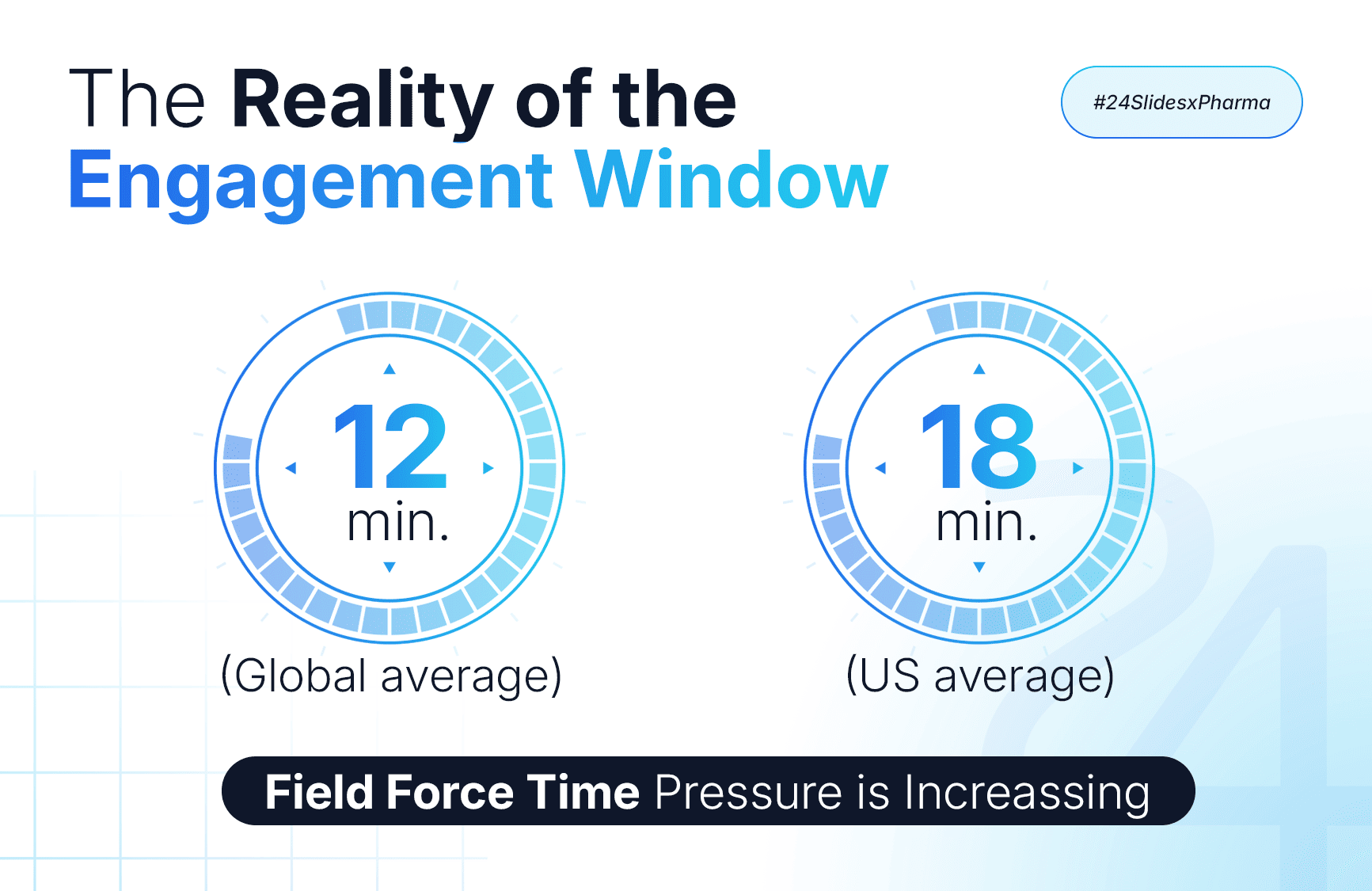
At 24Slides, we focus on what happens in the first 60 seconds of every scientific exchange. Research shows that visual structure influences credibility and comprehension immediately, which is critical when field teams have only 12 to 18 minutes of total interaction time. According to the Veeva Pulse Field Trends Report, global and US field meetings average 12 and 18 minutes, respectively.
In This Article, We Cover:
- Why Visual Hierarchy Wins the Office Visit: How shrinking HCP access and compressed engagement windows make cognitive clarity a competitive advantage.
- Turning MSLs and Reps into Strategic Communicators: Why scientific exchange requires modular, dialogue-driven presentation systems rather than rigid slide sequences.
- The Consistency Bridge: From Global Brand Leads to the Field: Solving the “Frankenstein Deck” problem by balancing global brand control with local agility through structured design systems.
- Establishing Visual Authority to Drive Prescription Intent: How premium design influences perceived data reliability, recall, and engagement quality in competitive clinical discussions.
- Future-Proofing Field Force Engagement: The Final ROI: Reframing design from expense to infrastructure by quantifying strategic time preservation and field force velocity.
Why Visual Hierarchy Wins the Office Visit
In the high-stakes "attention economy" of a physician's office, the window for meaningful interaction is shrinking. According to a 2024 study by Veeva Systems (Raconteur), HCP engagement with pharma field forces and online channels has declined to just 53%.
This drop intensifies competition during the visit, as 62% of physicians who still engage interact with only three or fewer companies. To remain among those select few, the clarity of every pharmaceutical sales presentation is critical.
The Access Crisis
Securing time in the office is becoming increasingly difficult. Data from the Veeva Pulse Field Trends Report (Veeva Systems) shows:
- HCP access in the U.S. declined from 60% in 2022 to 45% in 2024.
- This smaller window for communication demands that field force effectiveness pharma strategies increase pressure to prioritize clarity and immediate relevance.
Overcoming Cognitive Barriers
To improve productivity, materials must respect the brain's processing limits. A faculty guide on Cognitive Load Theory (Medical College of Wisconsin) explains that a working memory can typically process 5-9 pieces, or chunks, of information at any given time.
When a digital detail aid design uses dense, text-heavy slides, it fails to account for this capacity, making it ineffective during brief physician interactions. Instead, Evidence-Based Design leverages the brain's natural strengths:
- Processing Speed: The brain processes visuals 60,000 times faster than text, as noted in neuroscience-based storytelling research (Breakthrough Group).
- Memory Retention: Structuring MSL presentation tools around a narrative hierarchy can drastically improve recall. According to Scientific Storytelling research (MedComms Experts), stories are up to 22 times more memorable than facts alone.
The Operational Impact
Effective communication also addresses organizational health. Research from CUNY SPH (CUNY News) finds that employee burnout can cost employers millions each year.
Reducing cognitive strain through clearer communication may contribute to more sustainable engagement environments.

Turning MSLs and Reps into Strategic Communicators
Modern Medical Science Liaisons are not promotional presenters; they function as scientific partners. According to research published in the Journal of Medical Affairs, “Unlike sales representatives, MSLs operate in a noncommercial, scientific capacity”. The same study explains that their work includes “relationship-building, knowledge exchange, and strategic insight generation,” emphasizing that their impact is grounded in dialogue rather than scripted delivery.
Performance systems often don't align with reality. A global survey of MSL performance metrics shows that organizations focus on quantitative KPIs, such as KOL engagement numbers, while MSL professionals prefer qualitative measures, including the quality of KOL relationships and actionable insights. This contrast highlights a structural tension: meaningful scientific exchange may not be fully captured by activity-based evaluation frameworks.
Designing for Relevance, Not Routine
Communication tools must reflect how physicians actually engage.
According to the Veeva Pulse Field Trends Report, industry leaders acknowledge the limits of generic, untailored communication:
“A person’s capacity to ingest content that is not relevant, not timely, and not delivered in a way that they want to receive it is probably something like zero.” — Erica Taylor, PhD, Vice President, Chief Marketing Officer, Genentech
This insight suggests that static, one-size-fits-all presentations are unlikely to be effective in modern field engagement.
The same report cautions against rigid standardization. As one executive explains:
How do we get a better understanding of our customers and make sure that our messages and the way we approach people is relevant, meaningful… rather than just saying, ‘’I’m going to use the same five slides.” — Kieron Scrutton, SVP Medical Affairs Digital & Technology, and Tech Governance Risk and Compliance, GSK
Designing for dialogue, therefore, means moving beyond fixed slide sequences and toward adaptable content structures that support responsive conversation.
Time Compression and the Case for Modularity
Dialogue-first design is also supported by engagement duration data.
According to the Veeva Pulse Field Trends Report, global Veeva CRM Engage meetings average 12 minutes. In the United States, the average is 18 minutes
With engagement windows this brief, rigid, linear presentations leave limited space for adaptive dialogue. Modular layouts allow field teams to prioritize relevant evidence, pivot based on physician questions, and adjust depth dynamically within the available time.
When presentation tools are built for flexibility rather than dictation, they better support the scientific exchange and relationship-building described in current MSL performance research. In this way, design becomes an enabler of strategic communication rather than a constraint.
The Consistency Bridge: From Global Brand Leads to the Field
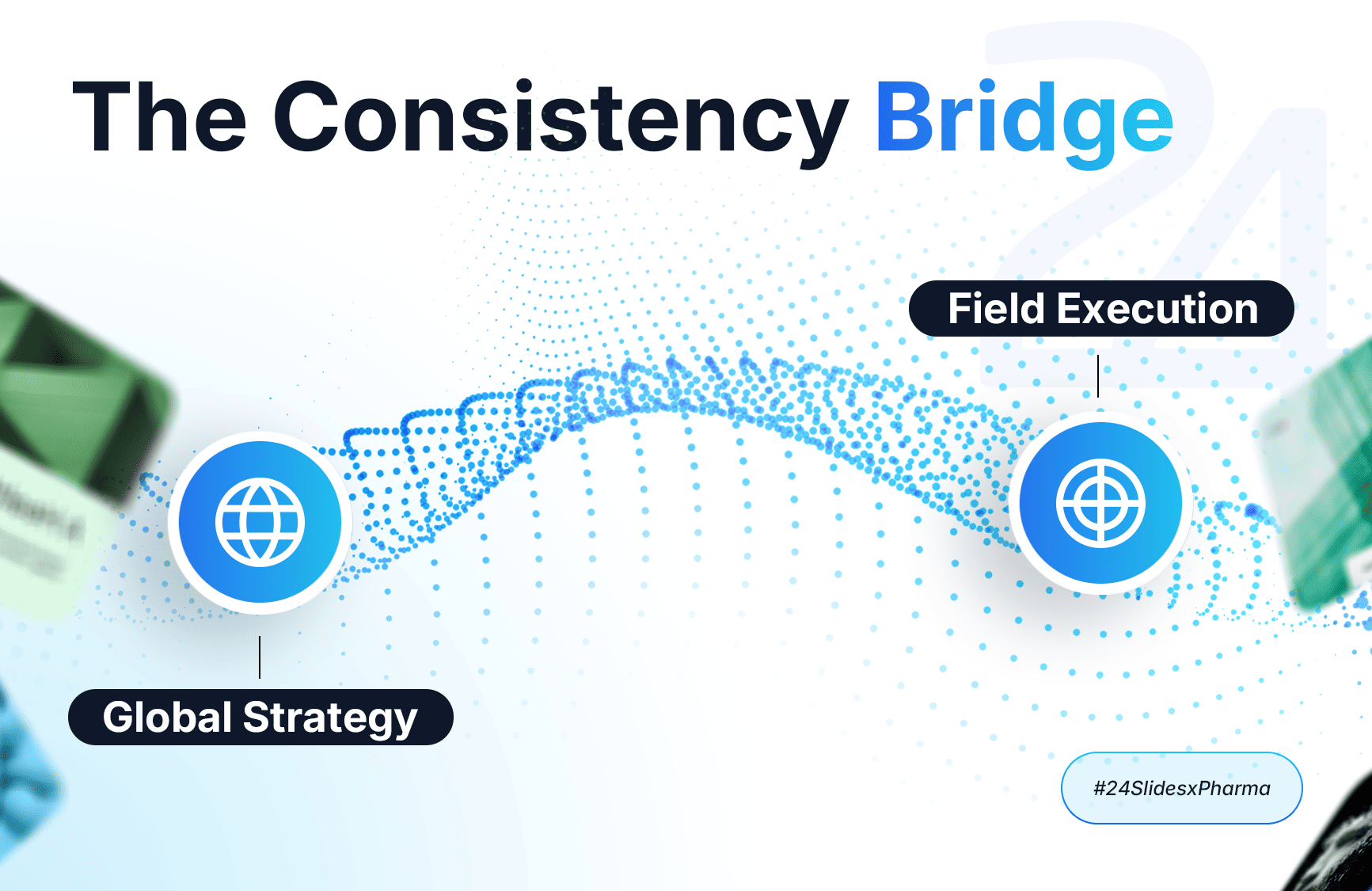
Global brand teams define strategy. Field teams execute it. The challenge is ensuring that execution does not drift into fragmentation, which may weaken overall engagement performance.
According to the Veeva Pulse Field Trends Report, 44% of key opinion leaders report a lack of coordination between clinical, medical, and sales teams. When alignment breaks down, physicians experience conflicting messages and siloed interactions, potentially weakening HCP engagement
This is the root of the “Frankenstein Deck” problem: local customization layered on top of global materials without structural guardrails.
If you want a deeper breakdown of how structural drift in global–local workflows creates compliance and brand risks, explore our guide on Maintaining CVI Compliance in Regulated Markets. It explains why consistent presentation design is essential for alignment across medical, legal, and regulatory domains.
Where Fragmentation Begins
As highlighted in the Veeva Pulse Field Trends Report, delivering a cohesive experience requires shared data, connected systems, and aligned incentives.
Without that infrastructure, local edits to a digital detail aid design can unintentionally:
- Duplicate content
- Distort narrative hierarchy
- Introduce inconsistent claims
- Dilute brand positioning
Empowerment without structure often leads to inconsistency across omnichannel engagement.
The Governance Gap
Research published in the Journal of Medical Affairs (PMC) notes that performance frameworks often rely on quantitative engagement metrics that may not fully capture interaction quality.
This signals an important distinction: Field force effectiveness is not just about activity volume; it is about strategic exchange. If global strategy measures impact differently than local teams execute it, brand coherence weakens.
The Cognitive Cost of the “Frankenstein Deck”
Design fragmentation also creates cognitive risk. According to the Medical College of Wisconsin’s Cognitive Load Theory guide (MCW), working memory can typically process 5–9 pieces of information at one time.
When decks expand through uncontrolled local edits and ignore evidence-based design principles, they can exceed that capacity. The result is not flexibility; it is overload.
Building the Consistency Bridge
A sustainable model balances control and autonomy. Global teams must provide:
- Clear narrative hierarchy
- Modular content blocks
- Defined customization boundaries
- Centralized data governance
Local teams should be empowered to tailor MSL presentation tools and sales materials within the structure, not redesign from scratch. When alignment systems support both brand consistency and adaptive delivery, field teams no longer create “Frankenstein Decks.” They are better positioned to deliver coherent, flexible, and consistent omnichannel engagement
Establishing Visual Authority to Drive Prescription Intent
Visual authority shapes how scientific data is perceived before it is fully analyzed. Research from the Stanford Web Credibility Project shows that users often judge credibility based on visual design elements such as layout and typography, particularly during initial impressions. In a pharmaceutical sales presentation, visual hierarchy contributes to perceived reliability.
Perception forms quickly under clinical time pressure. Neuroscience research notes that “The brain processes visuals 60,000 times faster than text”. This reinforces the importance of strong digital detail aid design during brief Veeva CRM Engage interactions.
Retention supports authority. Scientific storytelling research states that “Stories are up to 22 times more memorable than facts alone’’. Structuring MSL presentation tools around a clear visual narrative can improve recall during prescribing discussions.
For a deeper look at how visual evidence shapes clinical decision-making, see Visualizing Clinical Results: Data to Insights, where we break down how design quality strengthens trust in complex scientific information.
Consistency also influences credibility. According to the Veeva Pulse Field Trends Report, 44% of key opinion leaders report a lack of coordination between clinical, medical, and sales teams. Fragmented messaging can weaken perceived coherence and may affect HCP engagement.
The same report emphasizes that modern commercial models require:
- Shared data
- Connected systems
- Aligned incentives
- A unified understanding of the customer
Visual consistency across touchpoints supports this alignment within broader omnichannel engagement pharma strategies.
Cognitive clarity further reinforces perceived reliability. According to the Medical College of Wisconsin Cognitive Load Theory guide, “Working memory can typically process 5 to 9 pieces, or chunks, of information at any given time.”
When materials exceed that capacity, overload may weaken authority. Applying Evidence-Based Design principles helps structure scientific data within cognitive limits, supporting field force effectiveness in pharma initiatives.
Establishing visual authority does not guarantee prescription change. However, a structured and consistent design can strengthen perceived credibility, improve recall, and support informed decision making. In competitive environments, these factors may support sales rep productivity and increase the likelihood that clinical data is trusted and considered during prescribing conversations.
Future Proofing Field Force Engagement: The Final ROI
Future-proofing field force effectiveness pharma begins with redefining design as infrastructure, not expense. According to IntuitionLabs, “Field Force Effectiveness (FFE) in pharma refers to how well a company’s sales representatives achieve commercial goals through customer engagement and operational efficiency”.
The same source emphasizes that the field force remains the “last mile” for commercial impact. If the last mile underperforms, the strategy does not translate into revenue.
Modern benchmarks reinforce that quality now matters more than activity. Research published in the Journal of Medical Affairs notes that reliance on engagement numbers may not reflect the quality or impact of interactions. Time spent on low-value tasks reduces capacity for meaningful scientific dialogue.
Time itself is constrained. The Veeva Pulse Field Trends Report shows that global meetings average 12 minutes and US meetings average 18 minutes. In windows this short, strategic time becomes the most valuable commercial asset.
Cognitive limits add another layer. The Medical College of Wisconsin guide states, “Working memory can typically process 5 to 9 pieces, or chunks, of information at any given time”. Poorly structured materials increase friction and reduce clarity during HCP engagement.
Industry direction further confirms the shift toward scalable systems. IntuitionLabs reports that “94% of life sciences leaders expect AI agents to be critical for scaling organizational capacity”. Scalable infrastructure increases capacity. Manual deck building does not. This is where the ROI lens changes.
When highly compensated sales leaders and MSLs spend strategic hours rebuilding slides rather than engaging clinicians, those hours become a hidden cost. It does not appear in marketing budgets. It appears in payroll.
Salary leakage occurs when:
- Strategic time is diverted to manual deck building
- MSL presentation tools are rebuilt instead of optimized
- Digital detail aid design lacks a modular structure
- Administrative preparation replaces scientific exchange
Within compressed engagement windows and rising omnichannel engagement pharma expectations, preserving strategic time becomes a commercial imperative.
Professional design partnerships do not simply improve aesthetics. They standardize structure, protect cognitive clarity, and free high-value personnel to focus on revenue-driving dialogue. This directly supports sales rep productivity and strengthens the execution layer that determines commercial performance.
Future-proofing the field force means moving design from a cost center to a capability multiplier.
This is why 24Slides builds every presentation around the ‘First 60 Seconds’ principle. Research shows that users often judge credibility at the very beginning of an interaction based on visual design cues rather than content depth, which directly affects the quality of scientific exchange. The Stanford Web Credibility Project demonstrates how design shapes trust.
Ready to Audit Your Field Force Velocity?
Every hour spent rebuilding slides is an hour not spent driving meaningful HCP engagement.
Quantify how much strategic time your sales leaders and MSLs may be losing to manual deck creation and evaluate the ROI of a structured design partnership.
Audit Your Team’s Salary Leakage Now