Scaling for Launch: Design Agility in the 24-Hour Window

In this article, we’ll cover:
- Why Internal Teams Break at T-Minus 30 Days: Understanding the “Demand Spike” that overwhelms fixed capacity and triggers MLR risk.
- Maintaining Brand Integrity Across 50+ Markets: Preventing brand drift with a centralized “Master Asset” strategy.
- Design Agility for Competitive Payer Negotiations: Why speed in HEOR and Market Access presentations accelerates coverage decisions.
- Reallocating Launch Capital for Strategic Impact: Shifting from rigid agency models to scalable, cost-efficient design support.
- Future-Proofing Your Launch Velocity: Shifting from Project-Based to Infrastructure-Based Design: Moving from fragmented execution to elastic, infrastructure-driven design capacity.
- The Final Pivot: Is Your Team Suffering from "Salary Leakage"?: Quantifying hidden opportunity costs and reclaiming strategic momentum.
Why Internal Teams Break at T-Minus 30 Days
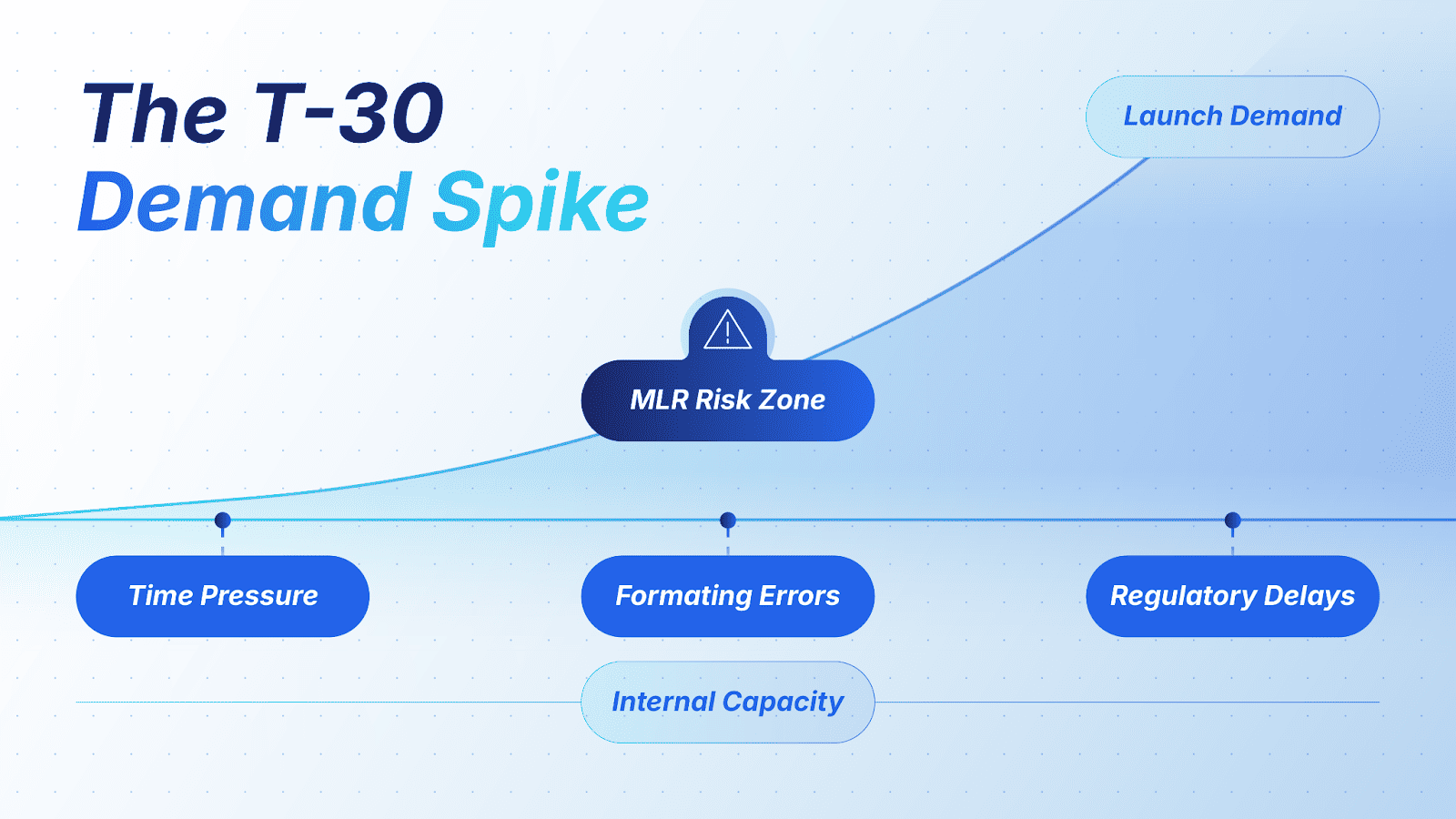
In the pharmaceutical world, the 30 days before a rollout mark a massive "Demand Spike." This is where your volume of required visual assets, from MOA animations to every presentation for product launch and complex HCP decks, far exceeds internal bandwidth.
When launch velocity meets fixed capacity, many teams turn to on-demand presentation design services to protect the visual clarity and data accuracy needed for a successful scientific presentation.
Why Formatting Errors Kill Your Launch Agility and MLR Timelines
In a pharma product launch strategy, there is no such thing as a "small" typo. A misaligned chart or inconsistent legend signals a lack of operational resilience, leading to the following:
- Throttled Brainpower: According to NCBI, time pressure is a primary stressor that reduces cognitive control. Your team is physiologically less likely to catch the minor formatting errors that trigger life sciences regulatory (MLR) rejections.
- Cognitive Interference: Managing high-stakes data alongside last-minute updates creates a "heavy load." As noted by Cognitive Load Theory, this leads to "interference," resulting in errors in simple tasks such as alignment or legend accuracy.
- Concentration Erosion: High-pressure periods create occupational stress, which MDPI confirms reduces concentration and increases error rates, precisely the pattern observed in pre-launch formatting crunches.
- The Productivity Trap: The Commonwealth Fund identifies administrative overload as the top reason for burnout, which Frontiers in Public Health highlights as a major disruptive factor in performance.
If your team is already stuck in reactive mode, you may be experiencing what we call the “Last-Minute Presentation Crisis” In a previous deep dive, we explored how subscription-based support eliminates this constant fire drill and restores launch control
Maintaining Brand Integrity Across 50+ Markets
Scaling a global-to-local rollout is one of the greatest challenges in commercial excellence. Without a centralized system, local teams often inadvertently create "brand drift", where the core message and visual clarity of your scientific presentation degrade as they are adapted for regional use.
To maintain operational resilience, top-tier pharma firms utilize a "Master Asset" strategy. This ensures that while a deck is localized, the brand's soul remains intact.
The Science of Global Brand Consistency
Maintaining a unified front across 50+ markets isn't just about aesthetics; it’s a strategic requirement for trust.
- The Balancing Act: According to research published in Arimbi, the success of global marketing strategies hinges on balancing global brand consistency with local adaptation.
- The Value System: A global brand is more than a logo. As noted by Atlantis Press, a truly global brand must reflect a consistent value system and positioning across every market it enters.
- The Trust Factor: When communication is consistent, doctors and stakeholders are more likely to stay loyal. Research from the European Management Journal shows that communication consistency has a strong direct impact on brand trust and loyalty.
If you're managing rollouts across multiple affiliates, regulatory design standards quickly become a strategic risk. We break down this challenge in detail in our guide to maintaining global brand consistency in pharma.
Design Agility for Competitive Payer Negotiations
In the high-stakes arena of payer negotiations, speed is your ultimate strategic differentiator. To achieve commercial excellence, you need more than just robust data; you need the launch velocity to present that data at the exact moment a decision-maker requires it.
Why Speed is a Strategic Asset for Market Access and HEOR
For HEOR and Market Access teams, the ability to rapidly transform complex datasets into a clear scientific presentation can be the difference between a "yes" and a "not yet."
- Accelerating Coverage Decisions: NCBI notes that HEOR evidence supports payer decision-making and access evaluations. Producing these outputs with launch agility allows you to present economic value earlier, leading to faster, more favorable reimbursement.
- Proactive Payer Integration: High-performing teams don’t wait for roadblocks. Remap Consulting notes that elite teams incorporate payer needs into their strategy during early development. This proactive approach reduces negotiation cycles and secures your new product launch strategy.
- Boosting Payer Confidence: Speed signals authority. Verana Health highlights that HEOR plays a pivotal role in shaping payer strategies and overall commercial success. Delivering high-quality insights rapidly increases payer confidence in your product's value.
When you utilize a rapid-response design partner, you gain the elastic capacity to handle the intense documentation requirements of global rollouts. This ensures your market access presentation support is defined by visual clarity and data visualization, and storytelling that resonates with payers.
By maintaining this operational resilience, your team can pivot instantly during negotiations, ensuring that no evidence gap ever stalls your path to market.
Of course, speed alone isn’t enough. The clarity of your data visualization can make or break payer confidence. We explore how medical affairs teams transform complex trial data into persuasive visual narratives in our guide to visualizing clinical trial results.
Reallocating Launch Capital for Strategic Impact
Traditional, rep-centric, and siloed commercial models are increasingly a barrier to scalable launch excellence. ZS reports that today’s model cannot support pharma’s future, calling for a bold transformation toward organization-wide customer engagement rather than isolated campaign activity.
As omnichannel capabilities evolve, many firms are rethinking how they deploy launch capital and talent. Companies are investing in digital and omnichannel capabilities to deliver improved personalization and customer impact to offset declining traditional engagement effectiveness.
The Opportunity Cost of High-Value Talent
Every hour a high-level executive spends wrestling with a text box is an hour stolen from a new product launch strategy.
- The Executive Time Sink: According to our research, executives spend an average of 4.3 hours per week on PowerPoint design, roughly 12% of their total work time.
- The Labor Burden: Research shows that professionals spend an average of 7 hours per presentation. By leveraging specialized support, firms reported an average time savings of 65 minutes per slide, resulting in significant efficiency gains across teams.
The "Hollowing-Out" of Rigid Agency Models
The traditional AOR model is often too rigid and expensive for the continuous content needs of a modern launch.
- A Structural Shift: A World Economic Forum study via Estudio-137 notes a "hollowing-out" of the corporation, where non-core activities are outsourced to specialized ventures to increase agility.
- BPO for Design: Estudio-137 notes the rise of Business Process Outsourcing (BPO) as companies increasingly outsource non-core functions, a structural pattern mirrored in how teams now outsource design to specialist partners.
Fueling Omnichannel Rollouts with Scalable Content
In an era of personalized medicine, scaling marketing capacity to handle omnichannel rollouts requires a massive volume of scientific presentations and HCP-specific assets.
- Marketing Efficiency Gains: McKinsey research suggests that commercial transformations can create a 10–20 percent increase in marketing efficiencies and cost savings.
- The Power of Personalization: These gains are driven by differentiated insights and the creation of personalized messages for individual HCPs. To achieve this at scale, you need a partner focused on launch velocity, not an AOR that treats slide production as a secondary administrative task.
Reallocating capital toward specialized partners aligns with outsourcing patterns identified in Estudio-137, enabling teams to reduce reliance on high-overhead, rigid vendor structures.
Future-Proofing Your Launch Velocity: Shifting from Project-Based to Infrastructure-Based Design
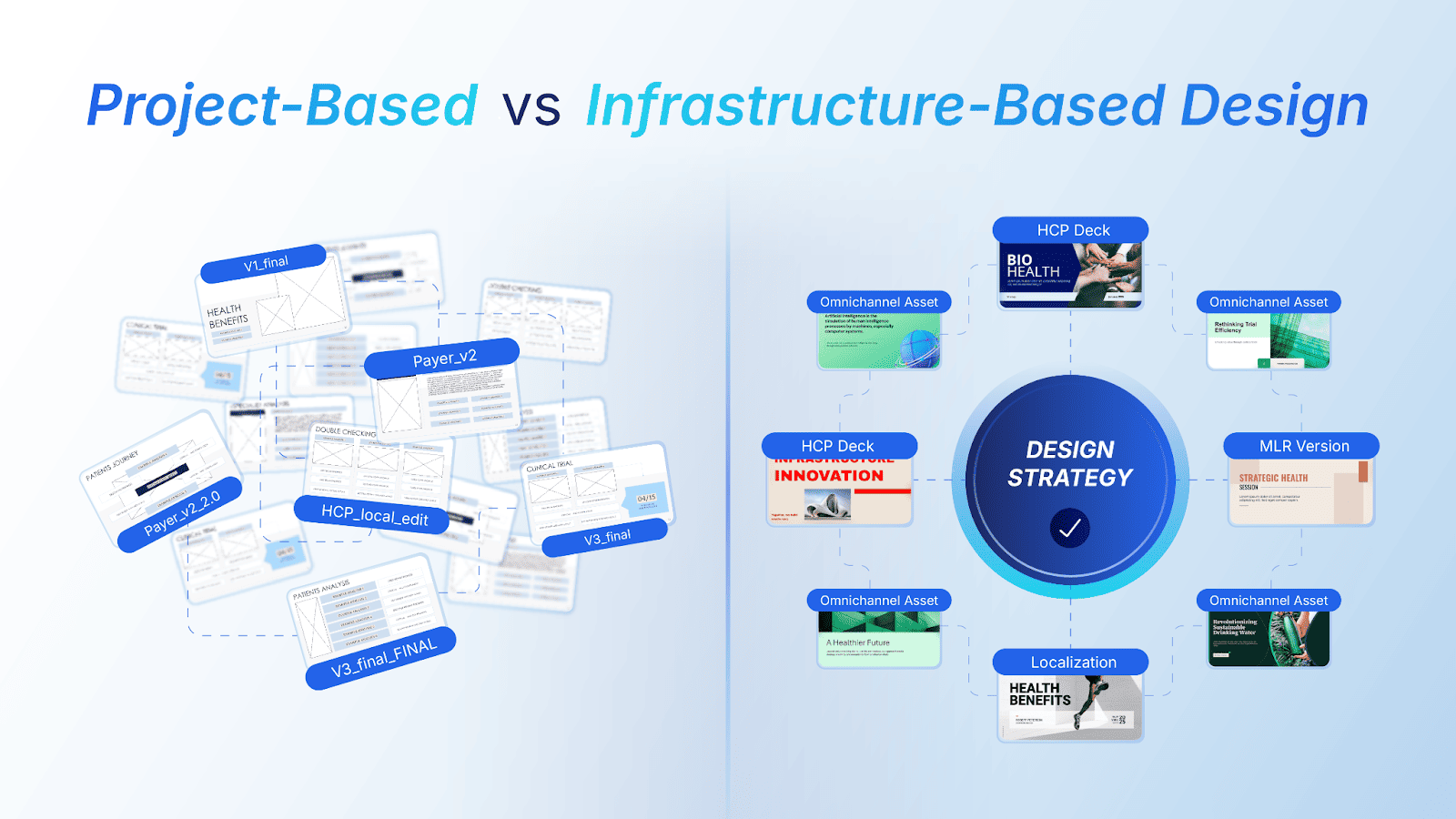
In traditional pharma models, execution often relies on fragmented, project-by-project work that limits strategic continuity. Leading organizations are shifting toward integrated, capability-based design and agile operating models, enabling repeatable processes and greater responsiveness across launch activities.
McKinsey’s findings demonstrate the industry’s need for strategic, long-term, integrated operations and agile capacity to adapt quickly.
The Efficiency Gap: Why "Project-Based" Design Fails
When every deck is treated as a new project, your team loses the cumulative benefits of speed and consistency.
- The Repetition Trap: According to McKinsey, while design processes are highly repeatable, most teams fail to use a scaled systems approach. Instead, they "start from scratch every time," sacrificing massive opportunities for time and cost efficiencies.
- Brand Integrity at Risk: In a project-based model, brand drift is more likely when teams interpret guidelines in isolation. An infrastructure model provides a centralized "design memory." As noted in our research, a dedicated team learns your brand guides so deeply they can "unfold your universe and build upon it," ensuring total visual clarity across thousands of slides.
The Infrastructure Advantage: Elastic Capacity for Global Rollouts
Shifting to a design infrastructure transforms your fixed costs into elastic capacity, allowing you to scale up or down instantly as launch demands fluctuate.
- Strategic Reallocation: RiseUpLabs highlights that by outsourcing non-core tasks, such as slide formatting, organizations can focus on their core competencies and strategic initiatives.
- Unlocking High-Value Talent: Our research confirms that professionals have deep expertise in science and medicine, not graphic design. Relieving them of "pixel-pushing" ensures they stay focused on the narrative, improving both the quality of the scientific presentation and the speed of the rollout.
The Final Pivot: Is Your Team Suffering from "Salary Leakage"?
Maintaining an outdated, project-based model isn't just inefficient; it’s a drain on your launch capital.
The data is startling: even a mid-sized leadership group can incur more than $692,000 in annual salary loss from presentation-related tasks. This "Salary Leakage" occurs when Executives, Directors, and Senior Managers, your highest-value assets, are forced to handle manual formatting rather than engage in strategic field-force engagement and new product launch strategy.
Ready to Audit Your Launch Capacity?
Stop losing strategic momentum to manual formatting. Use our ROI tool to see how much launch capital you can redirect toward commercial excellence.