Strategic Color Theory for Global Brand Presentations

In the fast-paced world of international business, your slide deck is often the first tangible representation of your brand to a new market. Applying a rigorous brand color theory is less about decoration and more about strategic communication; it ensures your visuals remain effective and on-brand regardless of the geography. By mastering color theory for branding, you can create a coherent visual language that guides your audience toward trust and action.
What we’ll cover to help your brand scale internationally:
- Why Color Meaning in Business is the First Impression of Your Deck
- The Psychology of Visual Trust: Setting the Tone for Executive Slides
- Cross-Cultural Design: How Color Meanings Shift by Region
- How Global Icons Adapt Branding for International Audiences
- Choosing the Best Color Combinations for High-Impact Slides
- Designer Advice: 24Slides Q&A on International Color Strategy
- Why You Should Outsource Graphic Design Services for Global Decks
Why Color Meaning in Business is the First Impression of Your Deck
The meaning of color in business serves as a powerful silent messenger. Research suggests that a consistent color palette can boost brand recognition by up to 80%, highlighting why your corporate colors must be identical from the first slide to the last. This immediate visual hit helps your audience encode your brand’s meaning almost instantly. Before you speak a single word, the colors and their meanings in business have already begun to tell your story.
According to a 2025 Adobe survey, 16% of consumers say color is the first thing they notice about a brand, and 50% have chosen one company over another simply because of its color scheme.

The Psychology of Visual Trust: Setting the Tone for Executive Slides
Building a corporate color palette for a global audience requires striking a balance between universal appeal and local sensitivity. For example, 54% of consumers globally name blue as the most trusted color, making it a reliable choice for professional stability. However, a truly global brand color theory must acknowledge that these psychological effects are often shaped by a person’s cultural background.
Effective cross-cultural design involves validating your palette for every major market to ensure your message isn't lost in translation. This is why many organizations rely on a professional PowerPoint presentation design service to navigate these nuances; they ensure that your color choices foster genuine emotional connections rather than accidental confusion.
Effective cross-cultural design is all about making sure your colors translate correctly in every market. To avoid mixed signals, many global companies turn to a professional PowerPoint presentation design service. These experts ensure that your color choices build a genuine emotional bond with the audience, rather than causing confusion. According to the research paper from the Newport International Journal of Research in Education, even "universal" colors like blue for trust depend heavily on a person’s cultural background and life experience to be truly effective.

Cross-Cultural Design: How Color Meanings Shift by Region
Colors carry emotional "defaults" that vary by region, and a successful cross-cultural design strategy acknowledges that the same hue can encode entirely different meanings. For instance, while white symbolizes purity in the West, it is often associated with mourning in parts of East Asia. To maintain a strong global brand identity, localization specialists recommend a "flex" approach: defining a core palette while adjusting accents for specific markets. According to branding experts at Frontmatter, global brands must design systems that adapt to regional shifts rather than assuming universal symbolism.
Western Markets: Using Blue and Gray to Engineer Corporate Trust
In Western cultures, the color meaning in business for blue is centered on reliability and rationality. It is the dominant choice for B2B corporate branding because it aligns with expectations of credible behavior.
- Blue for Authority: Navy blues are read as signals of "authority, professionalism, and expertise," while lighter blues lean toward care and calmness. According to the marketing research from Eriksen, blue is a "safe" choice in the West because it rarely carries negative connotations.
- The Role of Gray: Neutral grays support this by conveying "seriousness, balance, and modernity." This allows the primary brand blue to stand out as the emotional signal of trust.
- Engineering Trust: According to the guide by allbranded, blue earns trust by creating a sense of security that converts audiences.
Eastern Markets: Why Red and Gold Signal Prosperity and Success
For Eastern audiences, the regional context shifts toward vibrant palettes that signal growth and high status.
- Red for Fortune: In East Asian contexts, red is a powerful positive color symbolizing "happiness, luck, celebration, vitality, and success." According to the analysts at Marketing to China, red taps into long-standing associations of good fortune and protection against misfortune.
- Gold for Prestige: Yellow and gold are historically considered "imperial colors," denoting royalty and power. They are often used to elevate products into a more luxurious tier.
- The Red Bull Example: According to localization case studies from Asian Absolute, Red Bull famously switched from its silver-blue Western cans to gold cans in China to align with local expectations of wealth and premium quality.
When preparing slides for these regions, a professional PowerPoint presentation design service will often retain the core brand colors but increase the presence of red and gold accents in key moments, such as openers or financial achievements, to align with local symbolism without compromising the brand's essence.
How Global Icons Adapt Branding for International Audiences
Scaling a global brand identity requires a delicate balance between "fixed" elements, like your logo and primary font, and "flexible" elements that can change to meet local expectations. Successful companies use a "glocal" model: they keep their brand core non-negotiable but allow regional teams to adapt supporting visuals. According to marketing expert James Sackey, maintaining this consistency across diverse cultural contexts is what builds long-term global trust.
Color Adaptation Case Study: McDonald’s Sustainable Green Pivot
One of the most notable examples of regional color adaptation is McDonald’s shift to a more eco-friendly image in Europe.
- The Shift: In 2009, McDonald’s began replacing its iconic red background with a "deep hunter green" across Germany and other European nations.
- The Reason: The goal was to "clarify our responsibility for the preservation of natural resources." According to reports from NPR, the green backdrop was specifically chosen to reflect the brand's commitment to energy efficiency and recycling.
- The Result: By changing the background but keeping the "Golden Arches" intact, the brand re-framed itself as a health-conscious and sustainable choice without losing its instant recognition.

Maintaining Global Brand Identity with Culturally Relevant Accents
To maintain a strong global brand identity, you don't need to change your entire palette; you just need to adjust the accents.
- Fixed vs. Flexible: Global identity work distinguishes between fixed elements (such as logos and core colors) and flexible elements, including imagery and local taglines.
- Starbucks in Japan: While the green siren logo remains unchanged, Starbucks incorporates "pink cherry-blossom" themes into seasonal packaging in Japan to celebrate local traditions.
- Coca-Cola's Festival Palettes: Coca-Cola keeps its signature red script but often introduces festival-specific palettes for markets in India and China. According to the localization experts at Language Intelligence. Seeing these strategies in motion can spark your next big design breakthrough.
Curious how the world’s top brands translate their identity into high-stakes decks? Get inspired by the 6 best branded presentation examples we’ve seen
When preparing slides for these regions, a professional PowerPoint presentation design service will often maintain the core brand colors while incorporating localized imagery or accent colors in the borders and charts to demonstrate to your audience that you understand their specific market.
Mastering Color Harmony: Choosing the Best Color Combinations for High-Impact Slides
Selecting the right color theory for branding isn't just about aesthetics; it's about achieving color harmony to reduce "cognitive load" so your audience can process complex data faster. According to research from the Interaction Design Foundation, a well-chosen palette creates a sense of order that directs the viewer's eye to key areas without visual chaos.
Color is just one piece of the executive puzzle. To build a truly cohesive deck from the first to the final slide, you need a holistic design framework. Ready to master the full anatomy of an executive deck? Dive into our comprehensive guide on how to design corporate presentations.
Professional Monochromatic Schemes for Data-Heavy Presentations
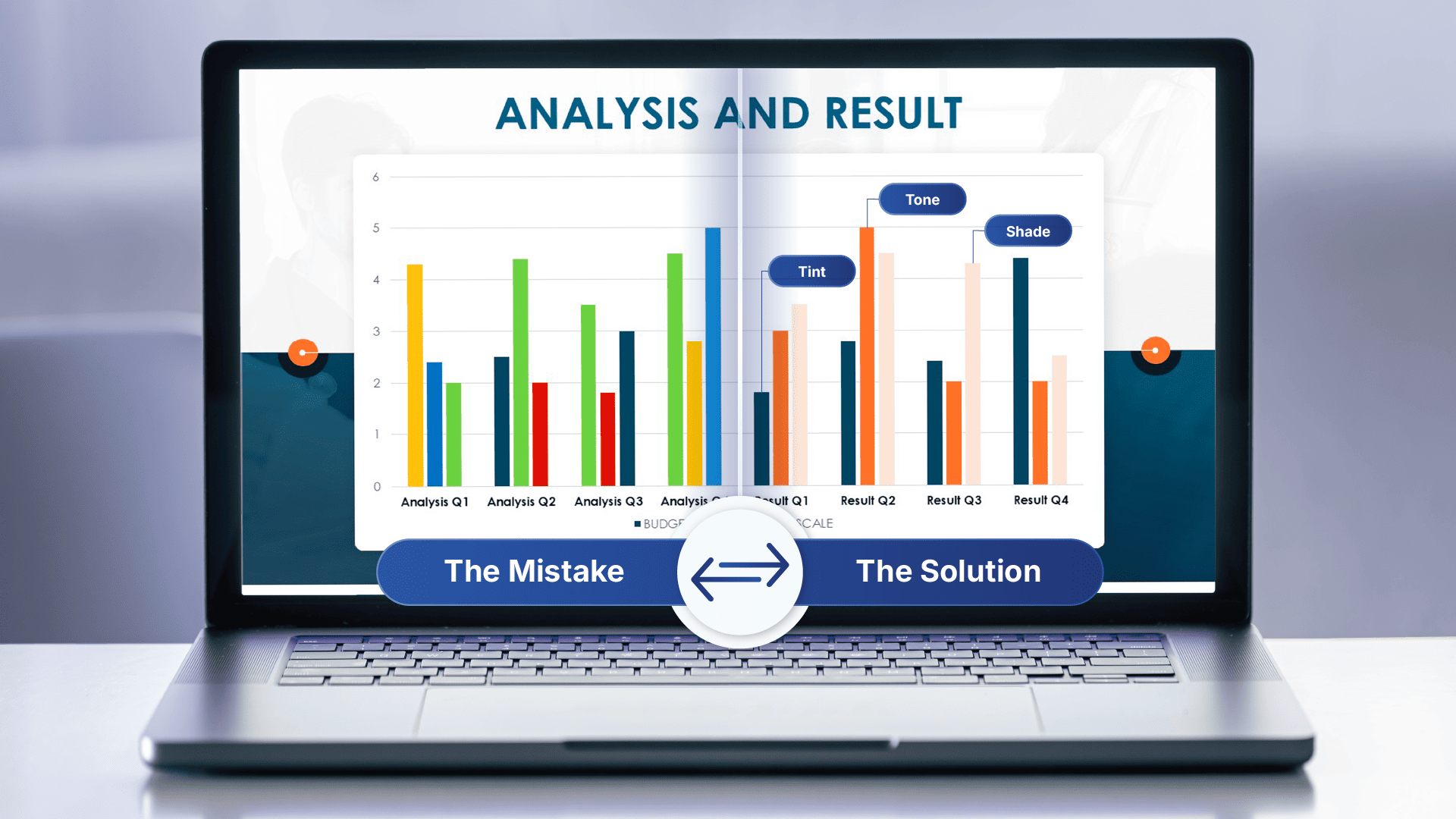
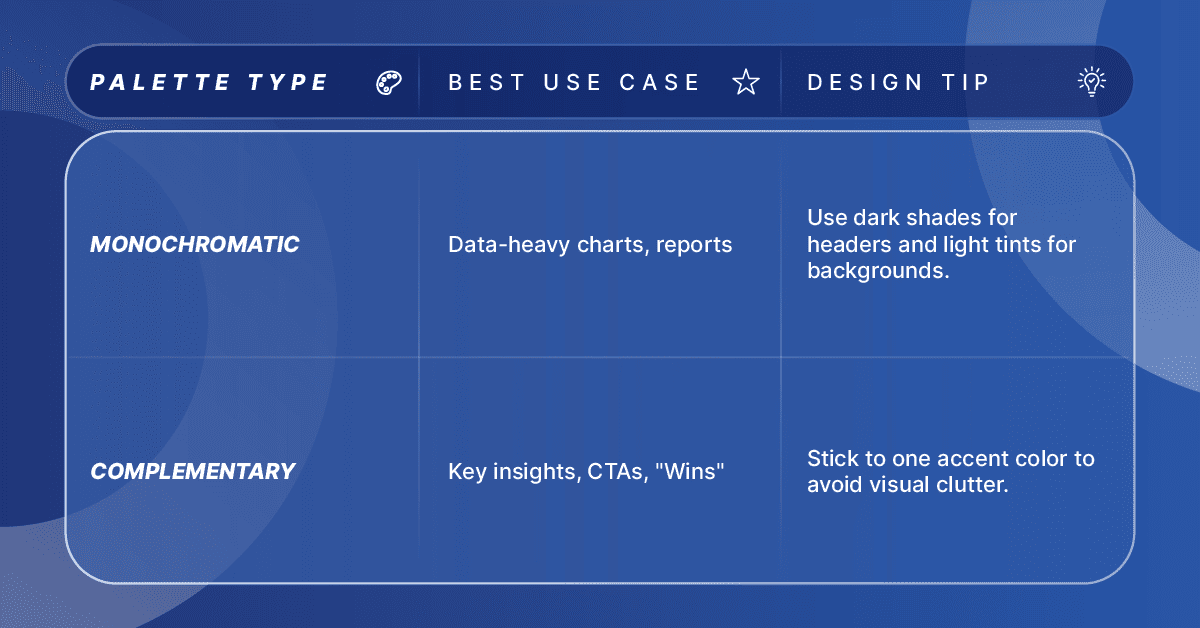
For slides packed with charts and statistics, a monochromatic palette, using variations of a single hue, is the gold standard for professional PowerPoint presentation design.
- Clean Hierarchy: Using different tints (by adding white), shades (by adding black), and tones (by adding gray) of your base color creates a unified look. According to data visualization experts, this approach is "ideal for technical or analytics decks where the data, not the color, should dominate".
- Global Safety: Monochromatic designs are inherently safer for cross-cultural design because they lean on your established brand identity rather than introducing new hues that might carry unintended cultural baggage.
- Accessibility First: A gradient from dark to light is often easier for colorblind viewers to distinguish than multiple different colors. As noted by Microsoft, this strategy conveys a high level of professionalism and ensures your trends are the main focus.
You don't have to build your global identity from scratch. We’ve pre-built the foundations for you. Launch your next international pitch with confidence using our 'Brand Identity Essentials' PPT template, designed to keep your core visuals consistent across any border.
Leveraging an Action Color with High-Contrast Complementary Schemes
While monochromatic schemes provide structure, designating a high-contrast action color through complementary schemes is one of the most effective design tactics for conveying specific insights.
- The Power of Opposites: Complementary colors sit opposite each other on the color wheel (e.g., blue and orange). This pairing creates a vibrant, eye-catching contrast that "makes highlights pop."
- Directing Attention: Use a bold accent color sparingly for callouts, revenue spikes, or your final CTA. According to the design guides at Duarte, contrast is the most effective tool for establishing visual hierarchy.
- The "Safety" Rule: To keep slides professional, pair a neutral background (such as white or charcoal) with one dominant brand color and just one complementary accent color. As recommended by Shift eLearning, this pairing can improve the clarity of your text by up to 40%.
How 24Slides Designers Master Global Color Strategy
We interviewed members of our design team to understand the "silent logic" they use when navigating the high-stakes world of international branding. What follows is a synthesized look at how professional PowerPoint presentation design bridges the gap between rigid corporate guidelines and fluid cultural expectations.
The Science of Cultural Agility
Maintaining a global brand identity doesn't mean being static; it means being adaptable. When a brand enters a new market with a rigid palette, such as a specific corporate blue, our designers apply mathematical color theory to find a "local voice" for that brand. By applying color harmony, they can introduce a culturally resonant color without disrupting the brand’s core DNA.
"What I usually do is apply color theory so complementary or analogous colors can be used. If the brand is monochrome, lighting accents can be used. This way, I can respect the client's original palette and avoid disrupting its harmony." — Rodrigo, Creative Designer
The Strategic Filter: Preventing "Visual Disasters"
A professional design service acts as a strategic filter. Often, a "disaster" isn't just a cultural faux pas; it’s a failure of hierarchy. Our designers step in when a requested palette lacks the contrast necessary to keep an audience's attention.
"I can remember one instance where the color palette was muted and didn't harmonize with the template's base color, which would have resulted in a dull presentation... The solution was to choose only one main base color and two accent colors to balance it." — Briana, Design Manager
Calibrating Visual Weight: The Research-First Approach
"Visual weight" refers to how "dense" or saturated a slide feels. While many assume this is purely geographical, our team believes that a deck's "vibe" must first be rooted in the brand’s soul.
"Before starting any design project, I invest time in deeply researching the brand... its mission, vision, and target audience. With that information, I can define not only the color usage, but also the overall level of visual complexity... Color is just one part of the system. It needs to align with the brand’s personality." — Leonardo, Creative Designer
Designer Tips: Data Storytelling Across Cultures
When visualizing complex growth, the definition of "Success" can shift visually. Our designers focus on high-contrast storytelling to ensure the most important data point is the hero of the slide.
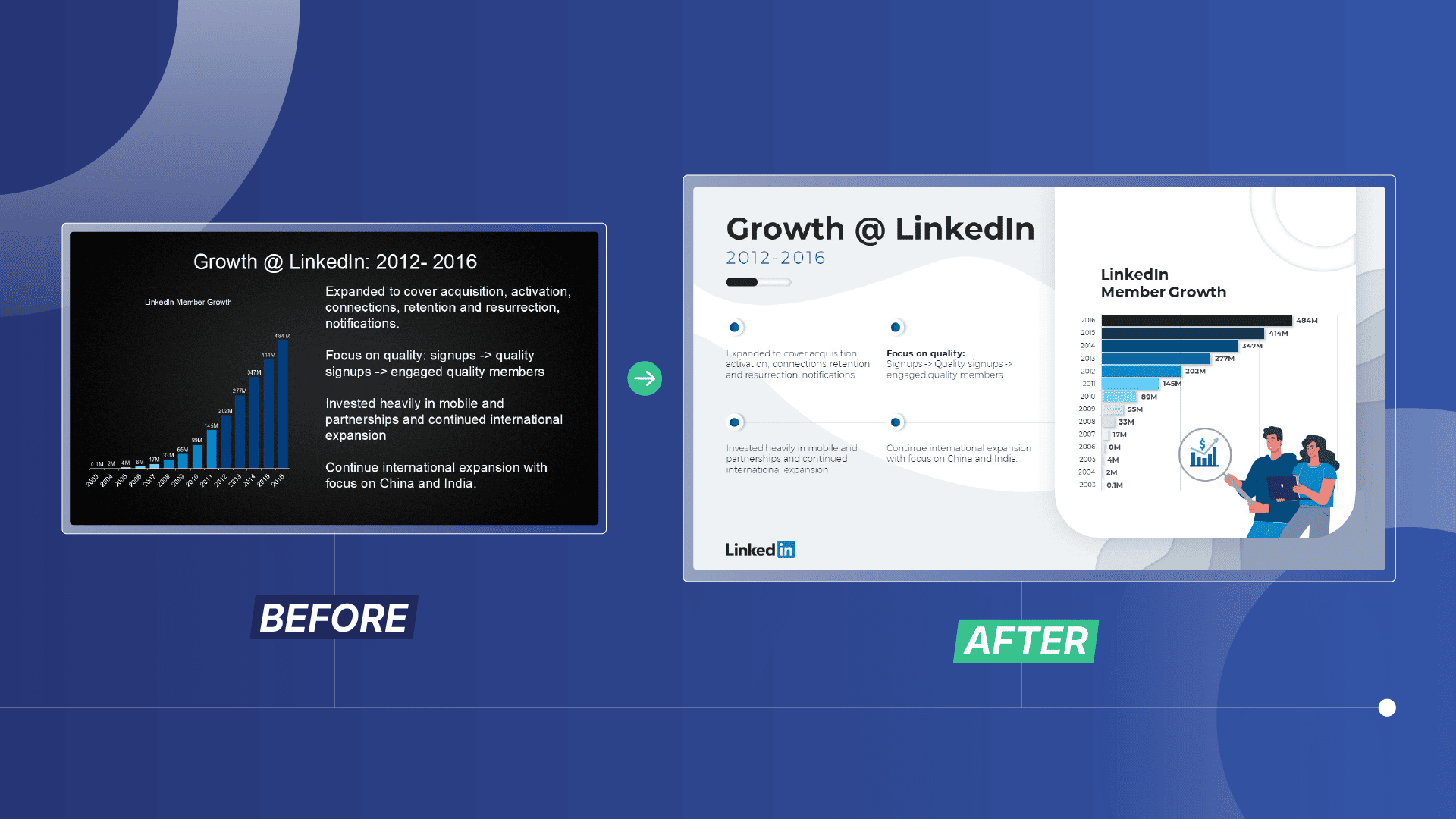
- Highlighting the Peak: To ensure growth is recognizable across all boardrooms, our team highlights the highest data point using the darkest shade in the brand palette or a sharp complementary action color.
- The "Mourning" White Paradox: In markets where white symbolizes mourning, we don't just abandon minimalism. Instead, we use off-white textures and carefully curated imagery (as suggested by our design leads) to maintain a clean look that carries no negative baggage.
- The Power of One: We avoid "rainbow syndrome." By designating a singular action color, we ensure the audience knows exactly where to look, regardless of their native language.
Why You Should Outsource Graphic Design Services for Global Decks
Managing an international brand requires a design strategy as agile as your business. While internal teams handle daily tasks well, global scaling often requires specialized regional expertise. By choosing to outsource graphic design services, you gain access to a global talent pool that masters local aesthetics, ensuring your global brand identity remains consistent, professional, and culturally resonant in every market.
While specialized human designers are essential for navigating complex cultural nuances, smart tech can help you brainstorm your initial concepts. Looking to speed up your early drafting phase? Discover our top-rated best AI presentation tools to help you get started.
Beyond the Template: Avoiding Cultural Taboos in Global Branding
Design is never "one size fits all." A visual that works in London can be a disaster in Dubai if it accidentally hits a cultural nerve. Professional design partners act as a vital filter to protect your global brand identity.
- Cultural Due Diligence: Outsourcing partners often have experience across multiple continents. They can identify "visual disasters" before they happen, such as using a stork in Japan (where storks don't deliver babies, giant peaches do) or featuring offensive animal symbols in Middle Eastern decks.
- Symbolism & Iconography: Symbols are not universal. A lotus may symbolize peace in Asia, but carries no specific weight in Europe. According to research from Sprak Design, culturally sensitive design is no longer optional; it is a requirement for building trust and avoiding public backlash.
- Typography Ethics: For regions like the Middle East or East Asia, professional designers ensure that scripts and typography aren't only translated but also stylistically appropriate (e.g., using classic Arabic calligraphy for traditional brands versus modern typefaces for tech).
Scaling Your Message with Professional PowerPoint Presentation Design Services
Speed and scale are the two biggest challenges for global marketing teams. A professional PowerPoint presentation design service provides the infrastructure to scale your message without losing quality control.
- "Follow-the-Sun" Concept: Global design agencies can operate across multiple time zones, allowing you to send a brief at 5:00 PM in New York and have a polished deck ready for you by 9:00 AM the next morning.
- Template Systems for High-Stakes Gains: Beyond individual slides, these services create robust master templates that enable seamless integration across multiple platforms. According to PitchWorx, companies using professionally designed presentations are 67% more likely to secure funding and 43% more successful in closing major deals.
- Data Visualization at Scale: Complex clinical trials or financial reports require different visualizations for a Western boardroom versus an Eastern one. Outsourced experts specialize in making "boring" statistics digestible, using charts that resonate with the specific logic and expectations of your target audience.
Mastering the Global Stage
In international presentations, color is a strategic tool, not just an aesthetic choice. The blue that builds trust in London may require a "Prosperity Red" accent to win in Shanghai. Mastering these cultural nuances ensures your deck doesn't just share information; it inspires action.
By balancing a consistent global brand identity with regional adaptations, you bridge the cultural gap. Whether you are scaling a startup or maintaining a legacy icon, the right palette ensures your brand is understood and respected worldwide.
Ready to take your global slides to the next level? Our expert team specializes in PowerPoint presentation design services that respect cultural nuances, ensuring your brand shines.
Experience world-class design with our $1 per slide promotional offer for new customers. Let us handle the complexity of global branding while you focus on the delivery.

Expand Your Presentation Strategy
Check out these relevant guides to further sharpen your design edge:
- How to Refresh Your Brand? Discover Our Strategic Approach
- Upcoming Presentation Design Trends (& How to Apply Them To Your Slides!)
- Get Inspired By The Best Branded Presentation Examples We’ve Seen
- Master the Hybrid Pitch: Essential Virtual Presentation Tips for 2026
- The Top 10 Brand Refresh Services for 2026