The 10 Best AI Presentation Makers (2026): Tested by Professional Designers With One Benchmark Prompt

24Slides tested the 10 best AI presentation makers using a single prompt to evaluate features, pricing, and PowerPoint compatibility. GenSpark led for high-impact layouts, while Canva won for free visual assets. We then redesigned the decks where AI still falls short.
Finding a reliable AI presentation tool is frustrating. Most 'Top 10' lists are written by AI software companies, conveniently ranking themselves at #1. This is not one of those reviews.
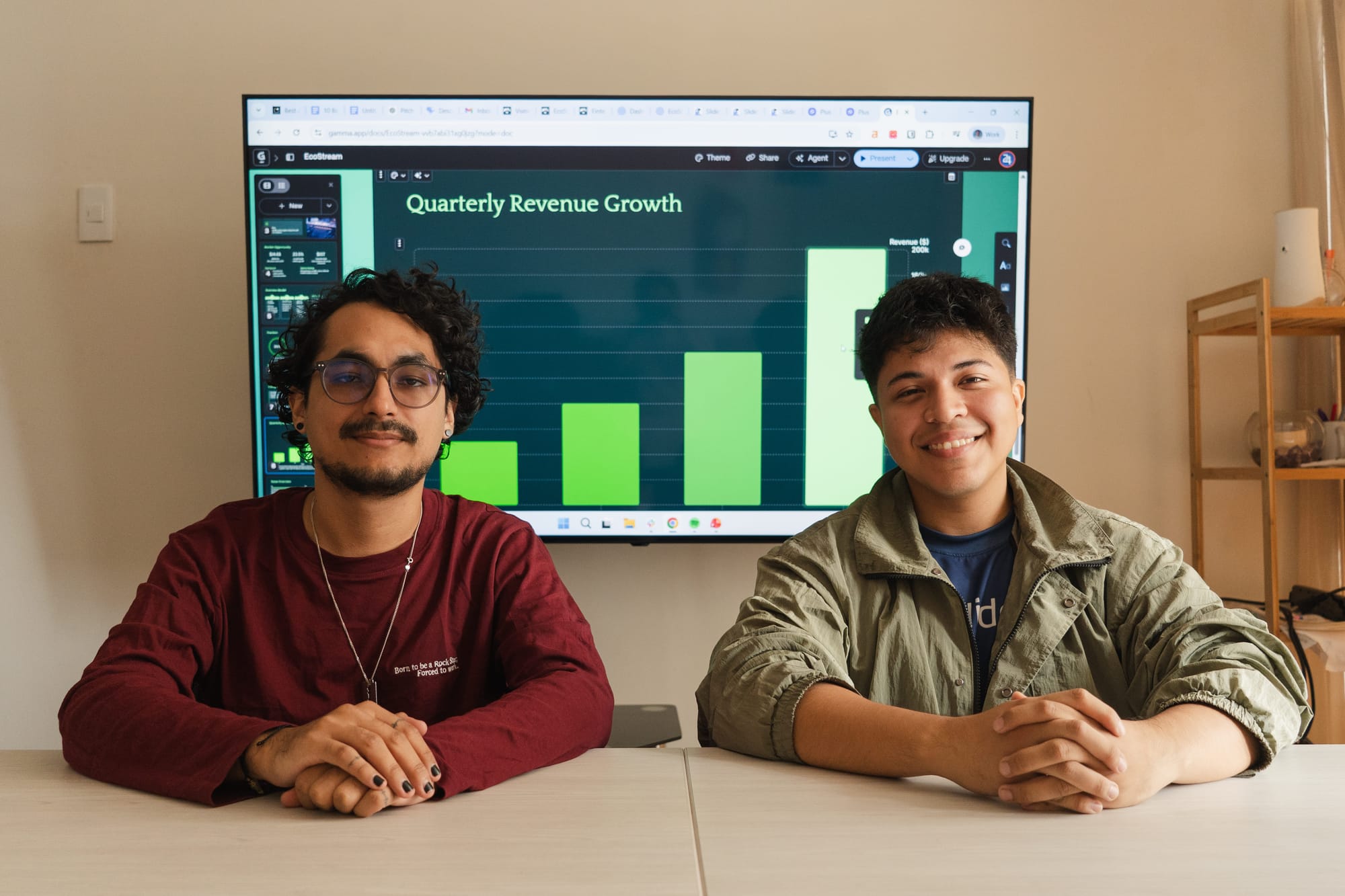
As an impartial design agency with 13+ years of experience and over 2 million slides designed, we demand proof. Our Marketing Designers, Gabriel Morales and Leonardo Acaro, benchmarked top AI platforms hands-on for layout quality, data extraction, and export fidelity.
Here are the unfiltered results of our 2026 stress tests—featuring raw example outputs, real pricing math, and our definitive "Designer's Verdict."
TL;DR: Best AI Presentation Makers at a Glance
| TOOL | BEST FOR | STARTING PRICE | PPT EXPORT | SCORE |
|---|---|---|---|---|
| Claude | Document synthesis & text-heavy outlines | $17/mo (Free text-only) | Yes (Clean formatting) | 8.7 / 10 |
| Gamma | Rapid web-based storytelling | Free (400 credits) / $9/mo | Yes (Layouts often break) | 8.2 / 10 |
| SlideSpeak | Flawless PPTX exports & vector editing | Free (3 credits) / $24.65/mo | Yes (Editable vectors) | 8.7 / 10 |
| GenSpark | Deep research & fact-checked outlines | Free (100 daily) / $19.99/mo | Paywalled (Requires Pro) | 9.2 / 10 |
| Prezi | Interactive, non-linear keynote speeches | Free (500 credits) / $4/mo | Paywalled (Requires Pro) | 8.2 / 10 |
| Alai | Brainstorming multi-layout variations | Free (300 credits) / $20/mo | Paywalled (Requires Pro) | 5.7 / 10 |
| Plus AI | Native Google Workspace & M365 add-in | Free 7-day trial / $10/mo | Yes (In-app native) | 5.2 / 10 |
| Canva | Visual, asset-heavy marketing decks | Free (Forever) / $12/mo | Yes (Flattens charts to images) | 7.5 / 10 |
| Presentations AI | Rapid internal drafting with guardrails | Free (No exports) / $20/mo | Paywalled (Requires Pro) | 6.8 / 10 |
| Pitch | Real-time multiplayer team collaboration | Free (100 credits) / $10/mo | Paywalled (Requires Pro) | 6.7 / 10 |
To find the best AI presentation maker, 24Slides stress-tested dozens of tools using a single benchmark prompt: an 8-slide VC pitch deck for a SaaS startup named EcoStream with strict brand and data constraints.
GenSpark is our top overall pick due to its highly advanced, code-based layout engine, while Gamma is the best free pick for generating stunning, ready-to-share web decks.
Tools Reviewed in this Guide (Best Use Cases)
Skip directly to the deep-dive review matching your specific workflow needs:
- 1. Claude: Best for text-heavy corporate documents
- 2. Gamma: Best for web-first visual storytelling
- 3. SlideSpeak: Best for clean PowerPoint (.pptx) exports
- 4. GenSpark: Best for unique, high-impact layouts
- 5. Prezi: Best for interactive, non-linear keynotes
- 6. Alai: Best for generating multiple layout variations
- 7. Plus AI: est for native PowerPoint and Google Slides users
- 8. Canva: Best for asset-heavy marketing decks
- 9. Presentations.ai: Best for fast drafting with locked templates
- 10. Pitch: Best for real-time team collaboration
How AI Builds Slides: The 3 Frameworks
Most blogs treat all AI presentation makers the same. They aren't.
As our 24Slides team detailed in our deep-dive report, AI vs. Professional Presentation Designer, the market is split into three distinct architectural categories. Understanding this is the secret to choosing the right tool for your workflow:
How AI Engine Architectures Compare in Practice
| Architectural Framework | Best For | The Technical Catch |
|---|---|---|
|
The Injectors (Template-Fill) |
Strict brand consistency using pre-built templates | Text overflows static boxes instead of adapting the layout |
|
The Liquid Canvas (Generative-Layout) |
Fast, web-native presentations with dynamic cards | Exporting to fixed 16:9 .pptx files breaks formatting |
|
The Conversational Coders (Agent-Orchestrated) |
Structuring complex data & text-heavy documents | Code-based layouts lack visual hierarchy and require manual cleanup |
The Technical Mechanics Behind the Frameworks
If you are evaluating these tools for enterprise deployment, you must understand how their underlying architecture dictates your final output.
- 1. The Injectors (Template-Fill): Tools like Canva and Presentations.ai "inject" AI-generated text into rigid, pre-made template boxes. The flaw: If the AI writes too much text, it overflows the container, creating overlapping, unreadable slides.
- 2. The Liquid Canvas (Generative-Layout): Platforms like Gamma and Prezi abandon traditional slides. They act as responsive website builders, dynamically expanding to fit your content perfectly on the web. The flaw: Exporting this fluid web code into a rigid 16:9 PowerPoint file frequently breaks the formatting.
- 3. The Conversational Coders (Agent-Orchestrated): Advanced AI models like Claude write raw code to generate custom layouts from scratch based on your data. The flaw: While logically and structurally sound, the resulting designs are highly mathematical and lack the persuasive visual hierarchy that a human designer provides.
How We Chose the Best AI Presentation Makers (Our Testing Methodology)
Before we dive into the data, full disclosure: We are not AI skeptics. We are AI power users.
The 24Slides team is actively using these technologies to enhance our own products and workflows. We didn't approach this review looking to prove that AI is bad. Instead, we wanted to find out exactly how much time these tools actually save in the drafting phase—and discover the exact breaking point where human expertise still needs to take over.
To find the best AI presentation makers, we didn't just read marketing brochures. We put them to the test. Can these tools actually survive a boardroom meeting?
To keep the evaluation completely fair and unbiased, the 24Slides AI Team developed a proprietary testing framework. We then handed these tools over to our Marketing Design team, the specialists who build high-stakes presentations every single day, to execute in live testing sessions.

The 24Slides 6-Point Evaluation Rubric
Every software in this guide was judged against six strict professional criteria developed by the 24Slides AI Team:
- Prompting Usability and Accuracy: Does the AI presentation generator actually understand complex corporate context, or does it just spit out generic bullet points?
- Content Generation & Editability: AI is only an assistant; it gets you 60% of the way there. We checked how easy it was for a human to edit the AI slides and fix the final 40%.
- Layout Generation (The "Designer's Eye"): We evaluated grid alignment, white space, and brand consistency using the strict professional rubric developed in our recent research: Beyond the Prompt: A 2026 Test of 5 AI PowerPoint Alternatives on Professional Standards.
- Export and Integration Features: A beautiful deck is useless if you can't present it. We tested if the software could seamlessly export to native, editable formats, finding the best AI to make PowerPoint presentation files without breaking the layout.
- The Verdict & "Who it's for": Since there is no "one-size-fits-all" tool, we identified the exact user profile for each software. (e.g., Is it best for a startup founder needing speed, or an enterprise manager needing strict brand safety?)
- Real Pricing & Value: We evaluated cost vs. output quality, highlighting the options that truly deliver the best free AI presentation makers.
The Benchmark Prompt (How We Leveled the Playing Field)
If you want to find the truly best AI presentation maker, you cannot test one tool by asking it to make a simple title slide, and test another by asking it to summarize a 50-page financial report. That isn't a fair fight.
To prevent this, our designers fed the exact same, highly-constrained prompt into every single AI slide generator on this list.
Here is the exact prompt we used:
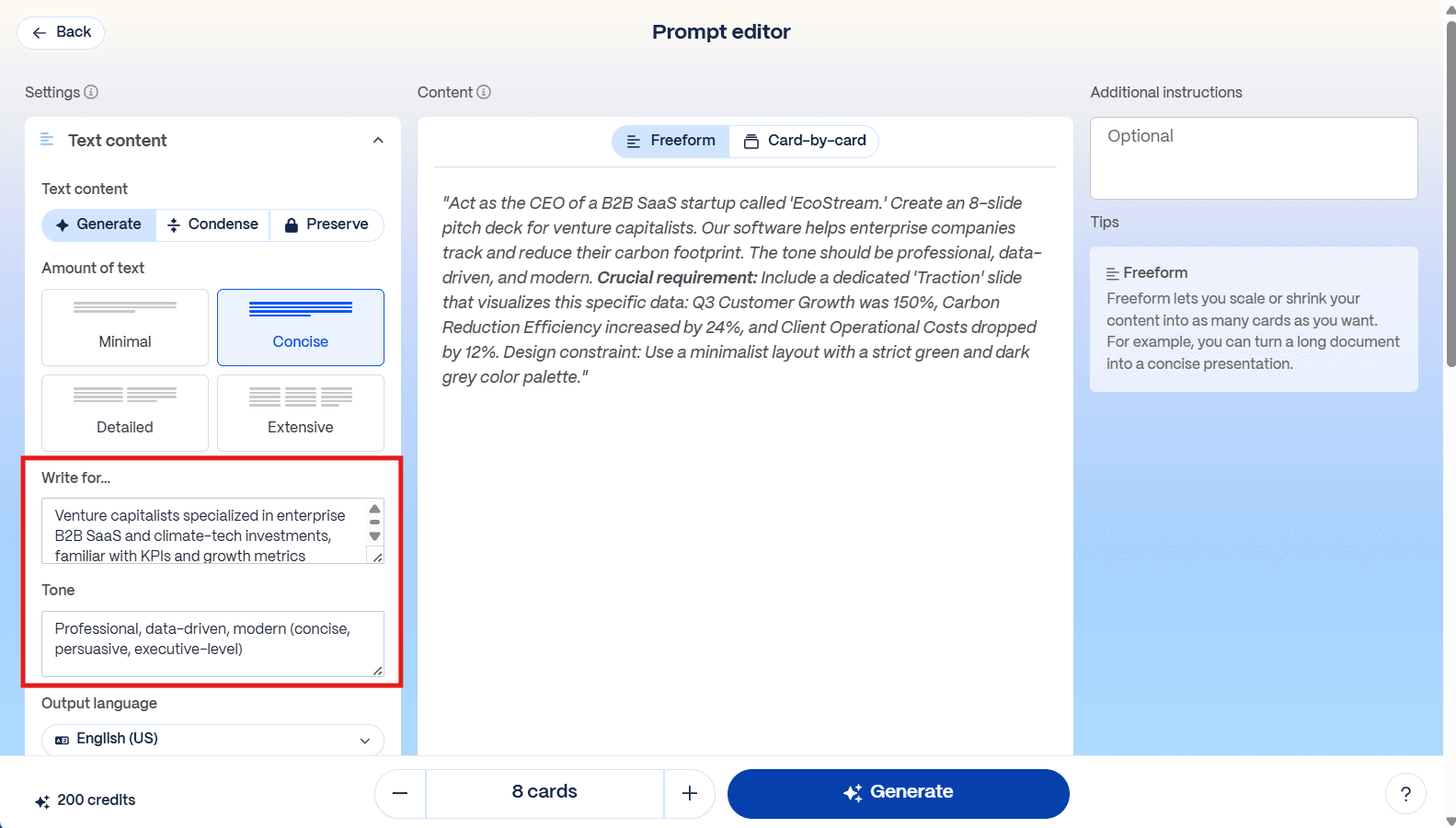
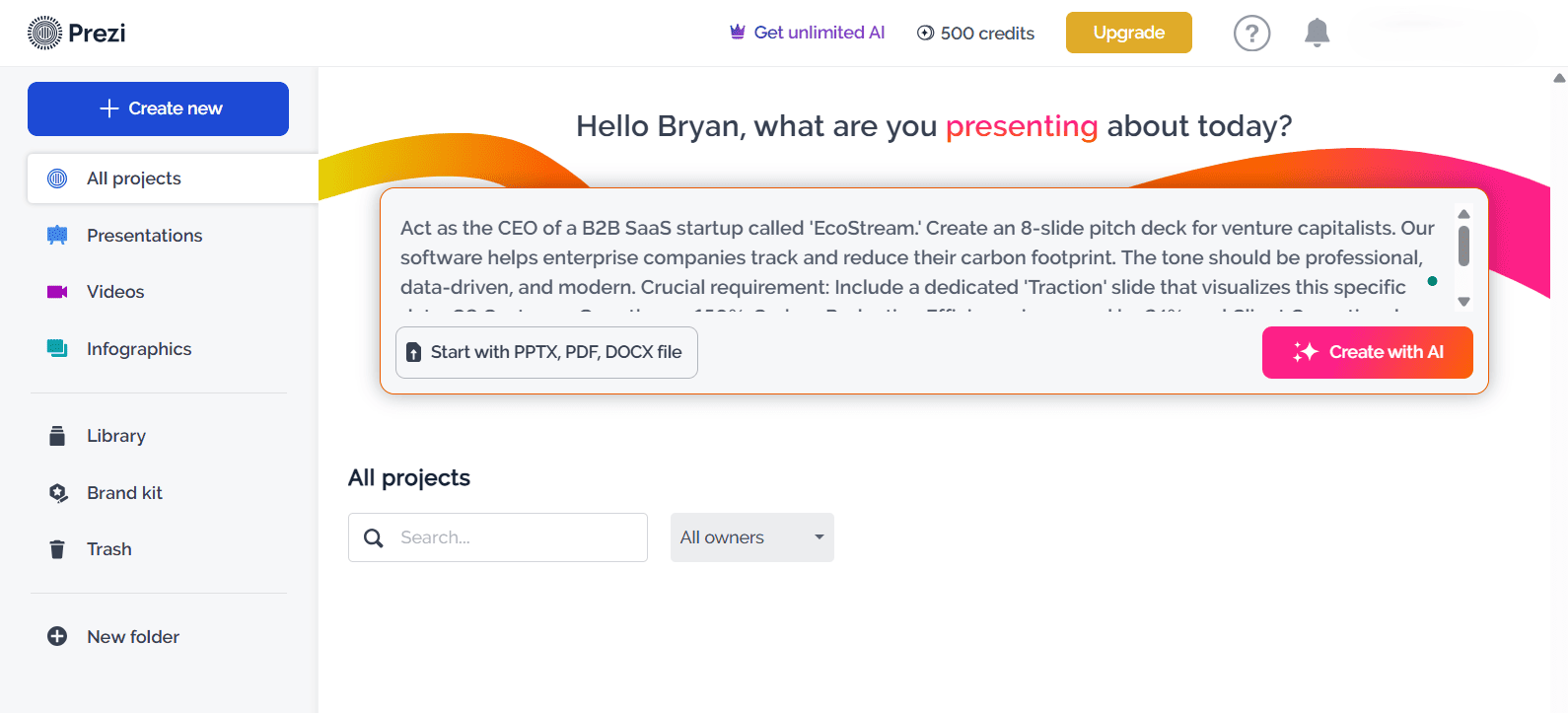
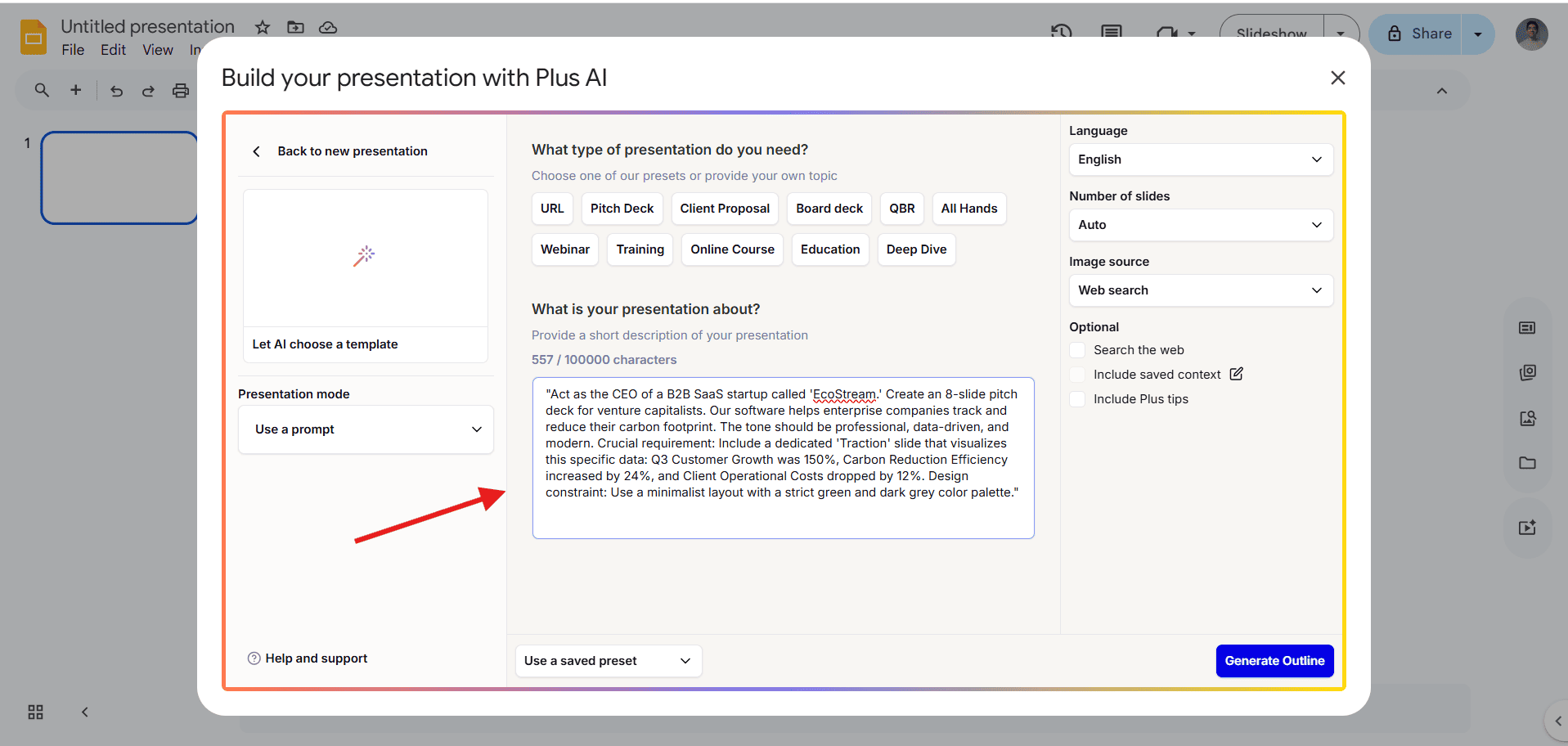
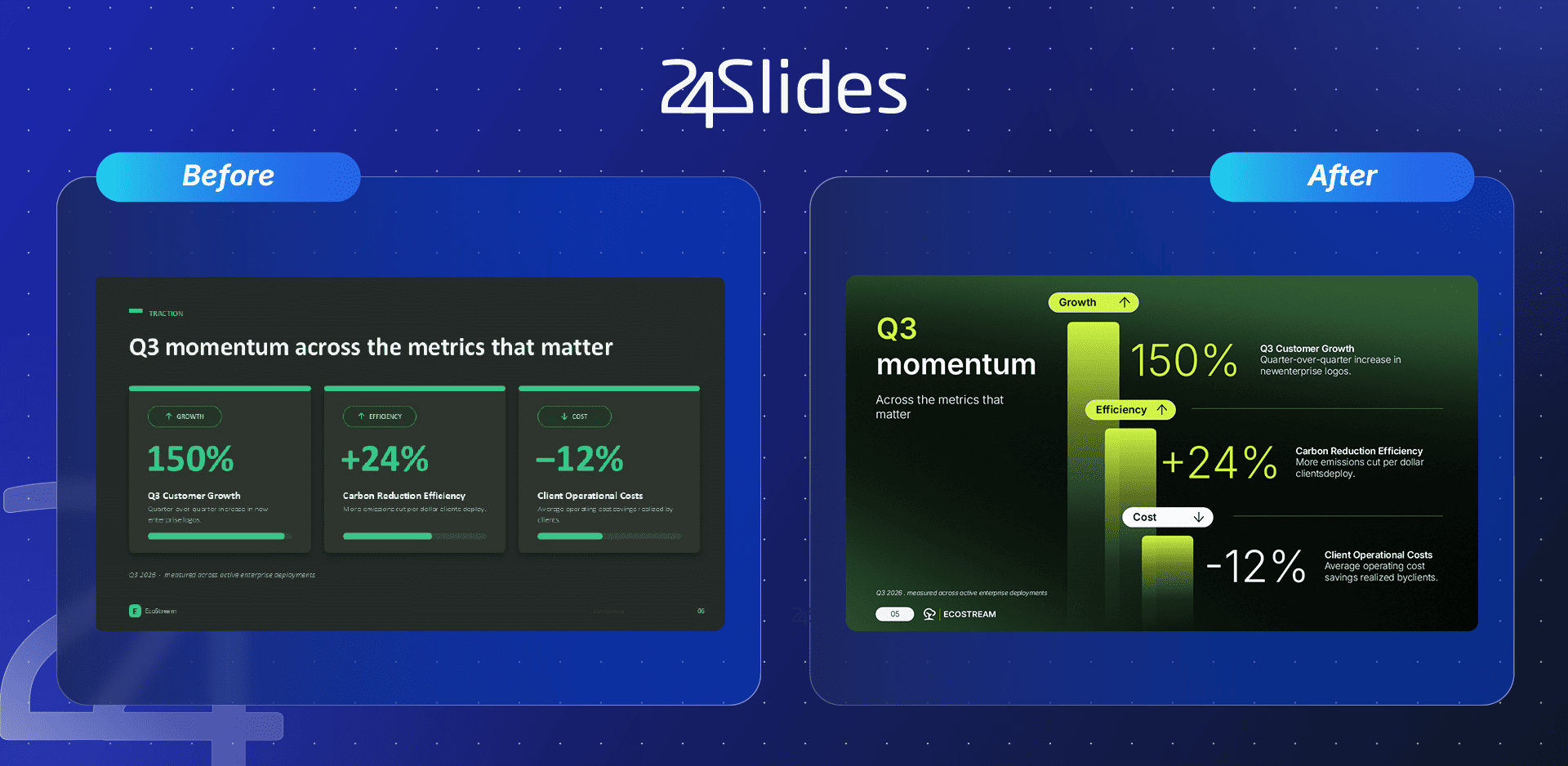
"Act as the CEO of a B2B SaaS startup called 'EcoStream.' Create an 8-slide pitch deck for venture capitalists. Our software helps enterprise companies track and reduce their carbon footprint. The tone should be professional, data-driven, and modern. Crucial requirement: Include a dedicated 'Traction' slide that visualizes this specific data: Q3 Customer Growth was 150%, Carbon Reduction Efficiency increased by 24%, and Client Operational Costs dropped by 12%. Design constraint: Use a minimalist layout with a strict green and dark grey color palette."
Why this specific prompt? It forces the AI to prove its power in three critical areas:
- The Brand Test: Will the AI actually obey the "green and dark grey" constraint, or will it force us into its default blue template?
- The Data Test: How does it handle the numbers? Does it create a beautiful, accurate chart, or does it hallucinate fake data to fill space?
- The Narrative Test: Can it write a persuasive VC pitch, or does it just generate generic corporate fluff?
You will see the raw, unedited outputs from this exact prompt in the examples below, allowing you to compare the best AI tools for presentations.
How Much Do AI Presentation Tools Actually Cost? (The Real Math)
Most AI presentation makers advertise generous "free" tiers to get you to sign up. However, the reality for B2B professionals is much stricter: almost every tool actively paywalls the ability to download your final presentation as an editable Microsoft PowerPoint (.pptx) file.
If you are evaluating these tools for your team, you need to understand the true annual cost. Assuming a moderate output of just 4 presentations per month, here is the real math on the 10 tools we tested:
2026 AI Presentation Tools: Pricing & Cost-Per-Deck Breakdown
(💡 Pricing Note: Prices reflect the discounted monthly rate when billed annually, except for tools like Alai that only offer month-to-month billing. The "Cost per Deck" estimate assumes a standard corporate output of 4 presentations per month).
Understanding the True ROI: The "Break-Even" Math
To calculate the cost per deck in the table above, we used a standard baseline of 4 presentations per month (roughly one deck per week):
- Standard Users (1–4 decks/month): Flat-rate plans like Gamma ($9/mo) or Claude Pro ($20/mo) keep software overhead at an efficient $2.25 to $5.00 per deck.
- Power Users (15+ decks/month): For high-volume teams, unit costs on flat-rate plans drop to under $1.00 per deck.
The Golden Rule: The Hidden Cost of Manual Cleanup
At under $5 a deck, AI tools look remarkably cheap. However, software subscriptions are only a fraction of the real expense: the true cost is high-salaried editing time.
As our benchmark tests proved, raw AI outputs frequently require human cleanup. If a manager spends two hours fixing overlapping text, re-creating hallucinated charts, and fixing broken PowerPoint exports, your company loses hundreds of dollars in wasted productivity on that "$1 deck."
Which AI Tools Work Natively Inside PowerPoint and Google Slides?
For corporate teams, generating a draft is only half the battle. Enterprise organizations rarely present inside browser tabs—they rely on offline compliance and master layouts natively in Microsoft PowerPoint or Google Slides.
When exporting a presentation from a standalone web app to a .pptx file, the conversion frequently breaks. Text boxes overflow, editable charts flatten into static images, and custom layouts snap out of alignment. If your team requires zero-friction compatibility, here is the workflow matrix most roundups skip:
AI Presentation Makers: Workflow & Integration Matrix
The Enterprise Trade-Off: Add-Ins vs. Web Engines
Choosing between these workflows comes down to a balance of creative freedom versus strict brand control:
- Native Add-ins (e.g., Plus AI, Claude): These operate directly inside your active PowerPoint or Google Slides window. What you see is exactly what you get, meaning zero export bugs. However, the AI's layout generation is heavily constrained by your existing software limits.
- Standalone Web Engines (e.g., Gamma, GenSpark): These offer fluid, unrestricted generative canvas design with superior visual variety. The trade-off is the post-export conversion. Exporting back into PowerPoint usually requires manual editing to fix broken line wraps, un-flatten images, and realign the master slide grids.
10 Best AI Presentation Makers, Tested and Reviewed
A quick note on our ranking: While each tool earns an overall score based on our 6-point evaluation rubric, there is no single "one-size-fits-all" winner. Below, we rank the 10 best AI presentation makers by their primary enterprise use case so you can find the exact right match for your workflow.
1. Claude: Best for text-heavy corporate documents
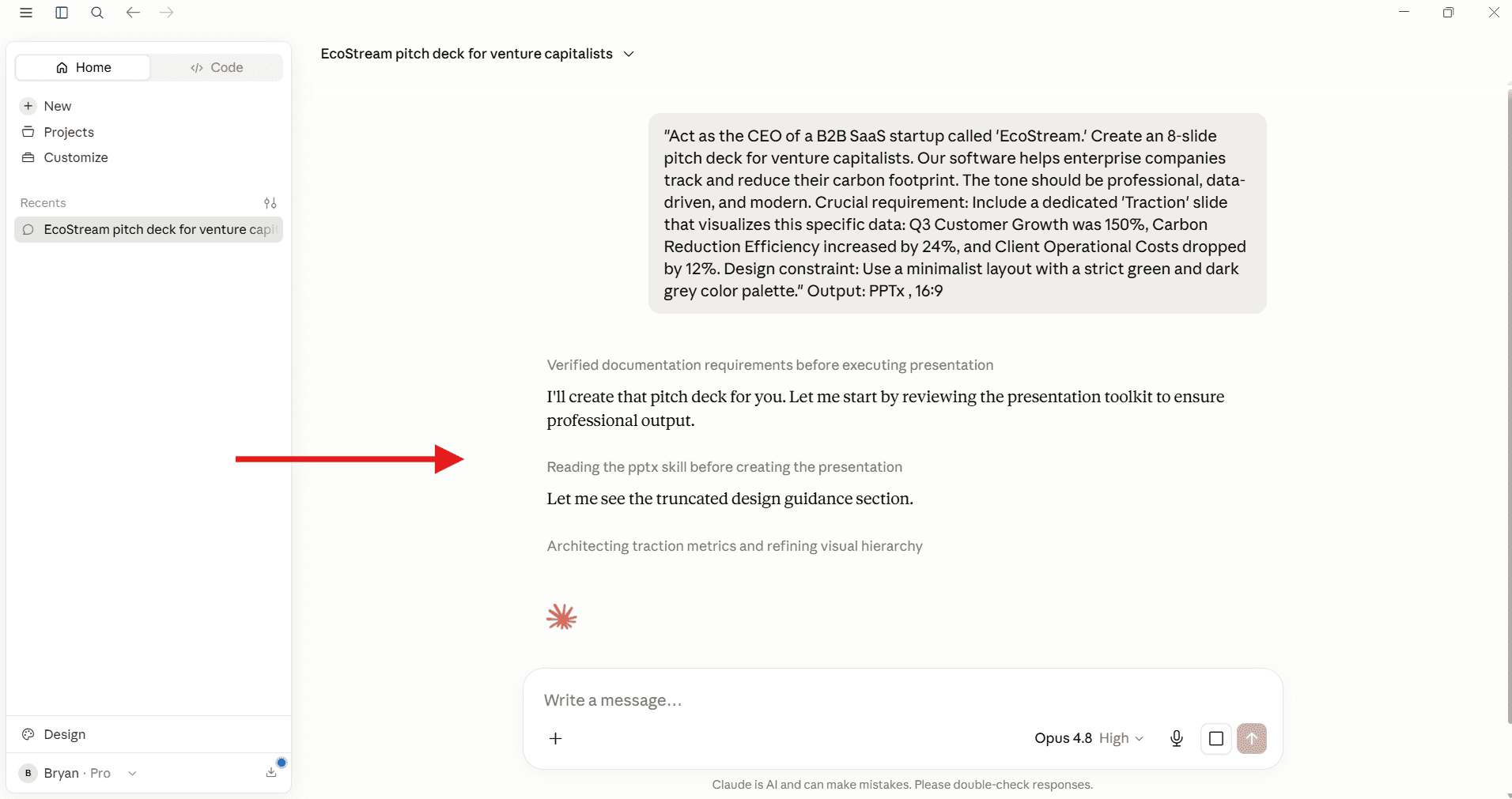
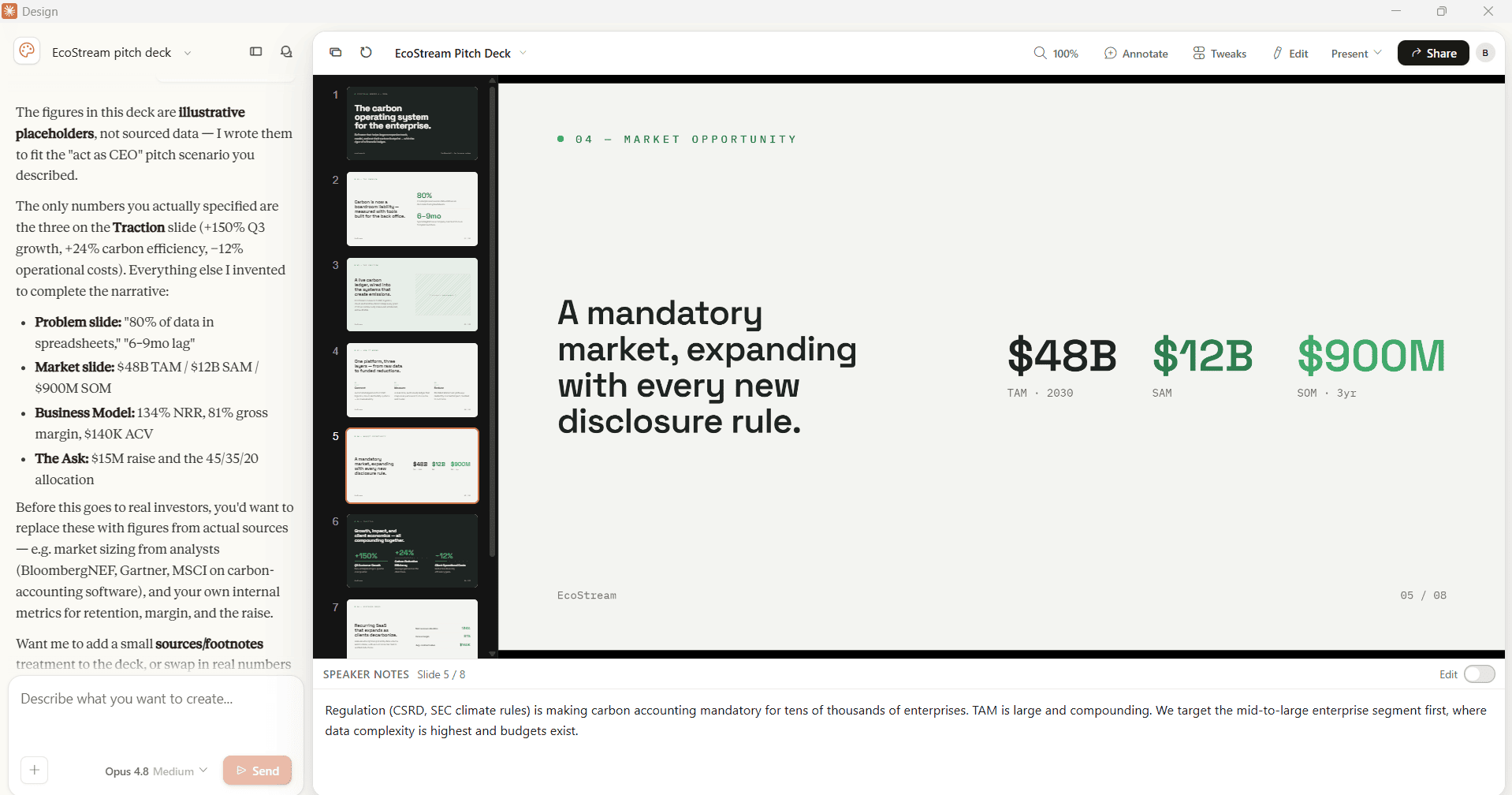
Anthropic’s Claude takes a completely different architectural approach to presentation design. To find the best workflow, we tested all three ways Claude can build slides: its General Chat, its native PowerPoint Add-in, and its dedicated web-based Design Tab.
Note: While you can generate basic presentations in the General Chat for free using older models, accessing the dedicated Design Tab, the PowerPoint Add-in, and the advanced Opus 4.8 model requires a Claude Pro subscription.
Key Features
- Unmatched Reading Comprehension: Powered by the Opus 4.8 model, Claude is arguably the smartest "brain" on this list. You can upload a dense 50-page corporate PDF, and it will flawlessly extract a logical presentation outline without hallucinating.
- The Smart PowerPoint Add-in: Claude’s native PPT integration actively asks you clarifying questions about your data before generating the layout natively in Office.
- Conversational AI Editing: Instead of using manual design menus, you refine the deck by chatting with the AI. If you ask it to "change the green color to navy blue," it executes the color swap perfectly across the code without breaking the slide.
- Model Selection: You can manually switch between Sonnet (for speed) and Opus (for deep reasoning).
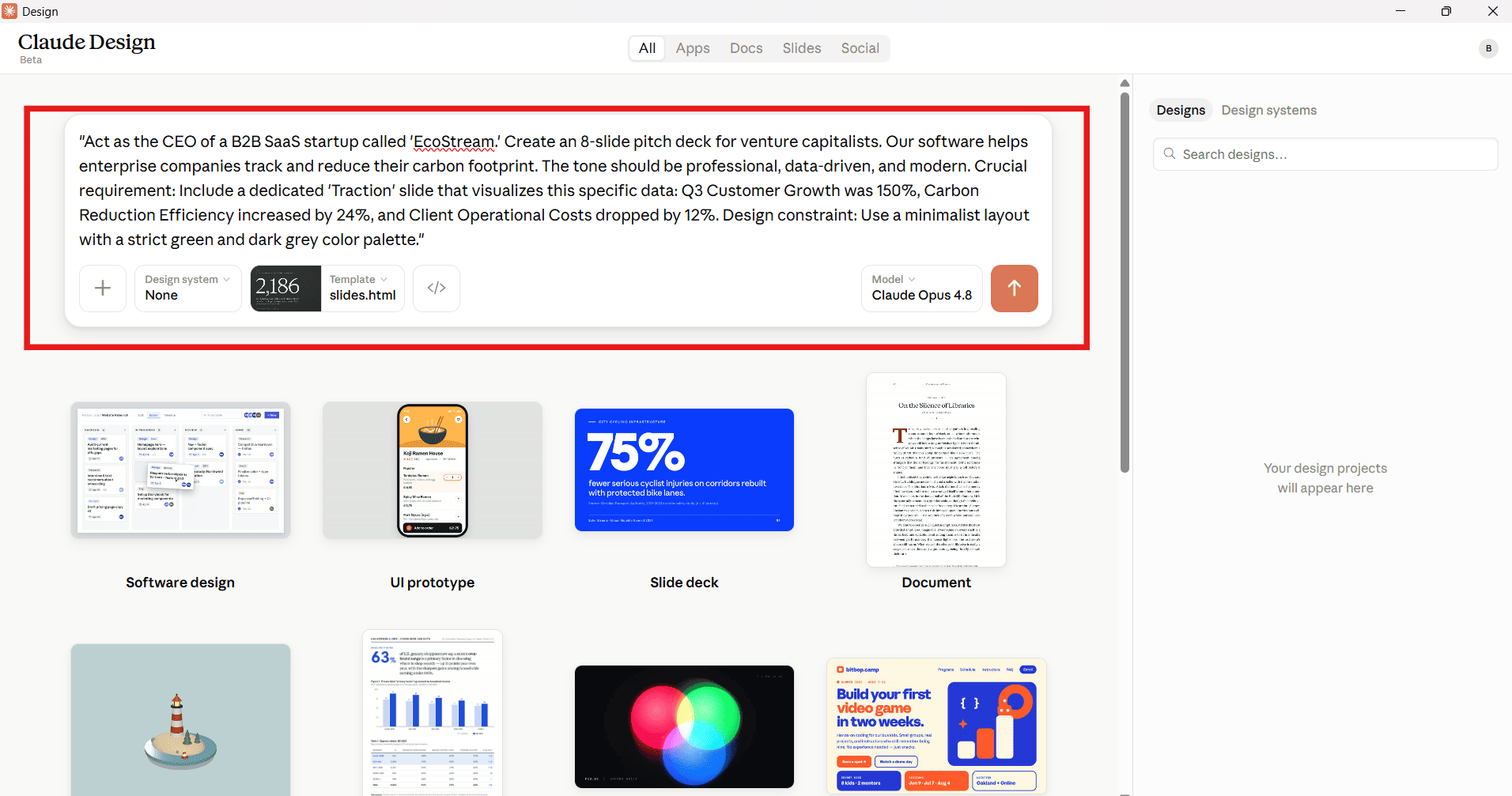
How It Handled Our Benchmark Prompt
We fed our EcoStream benchmark prompt into all three of Claude's interfaces. While the web-based Design Tab is visually impressive, we found that feeding heavy documents into the General Chat actually produced the highest quality, most editable first drafts, followed closely by the native PowerPoint Add-in.
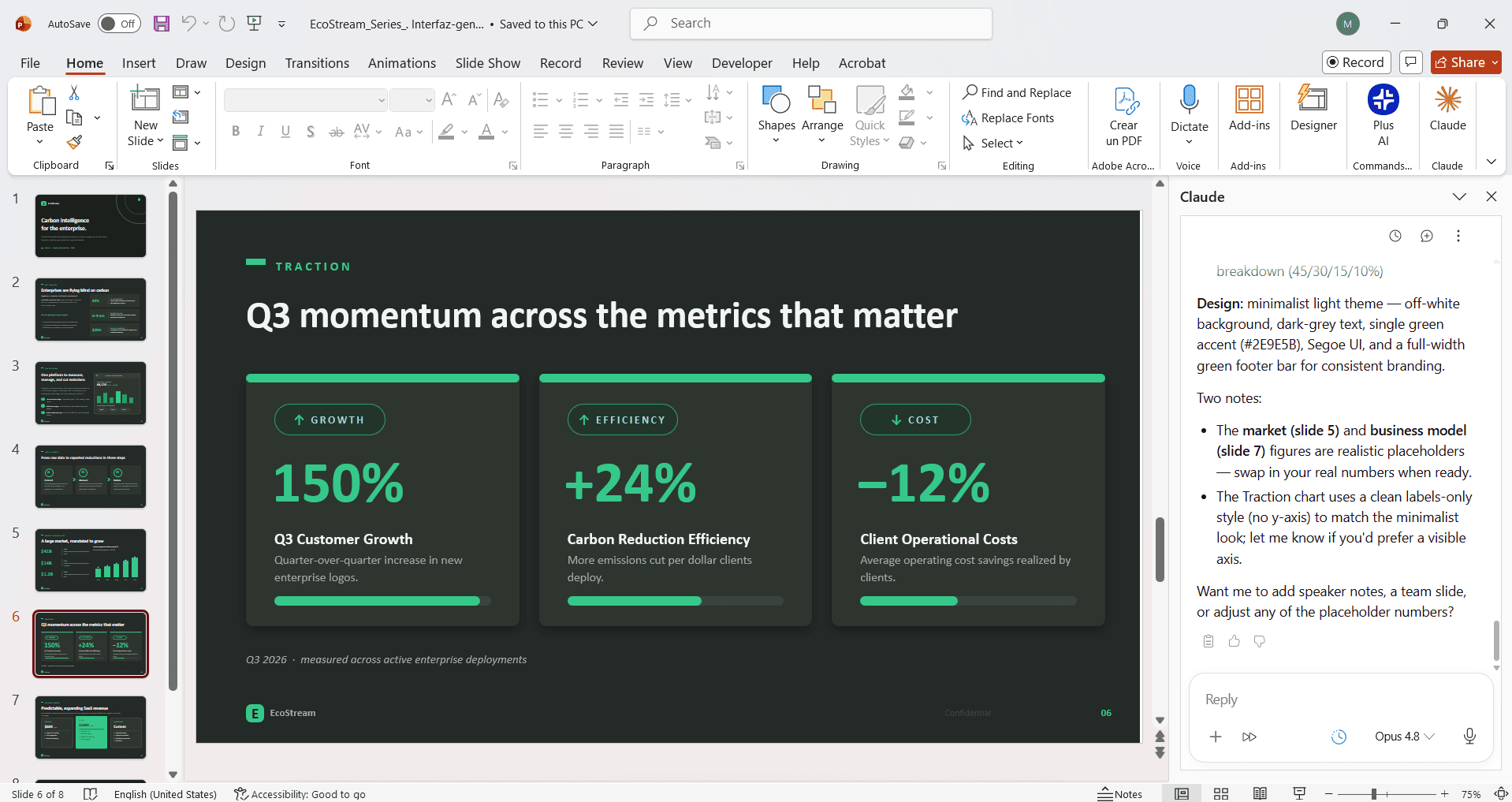
The chat interface is familiar, and its reading comprehension is phenomenal. It successfully extracted our exact data metrics and strictly obeyed our constraints.
Pros
- Flawless Native PPTX Formatting: Because the Add-in generates slides directly inside Microsoft Office rather than on a web canvas, it completely bypasses translation bugs. The resulting layouts are perfectly aligned.
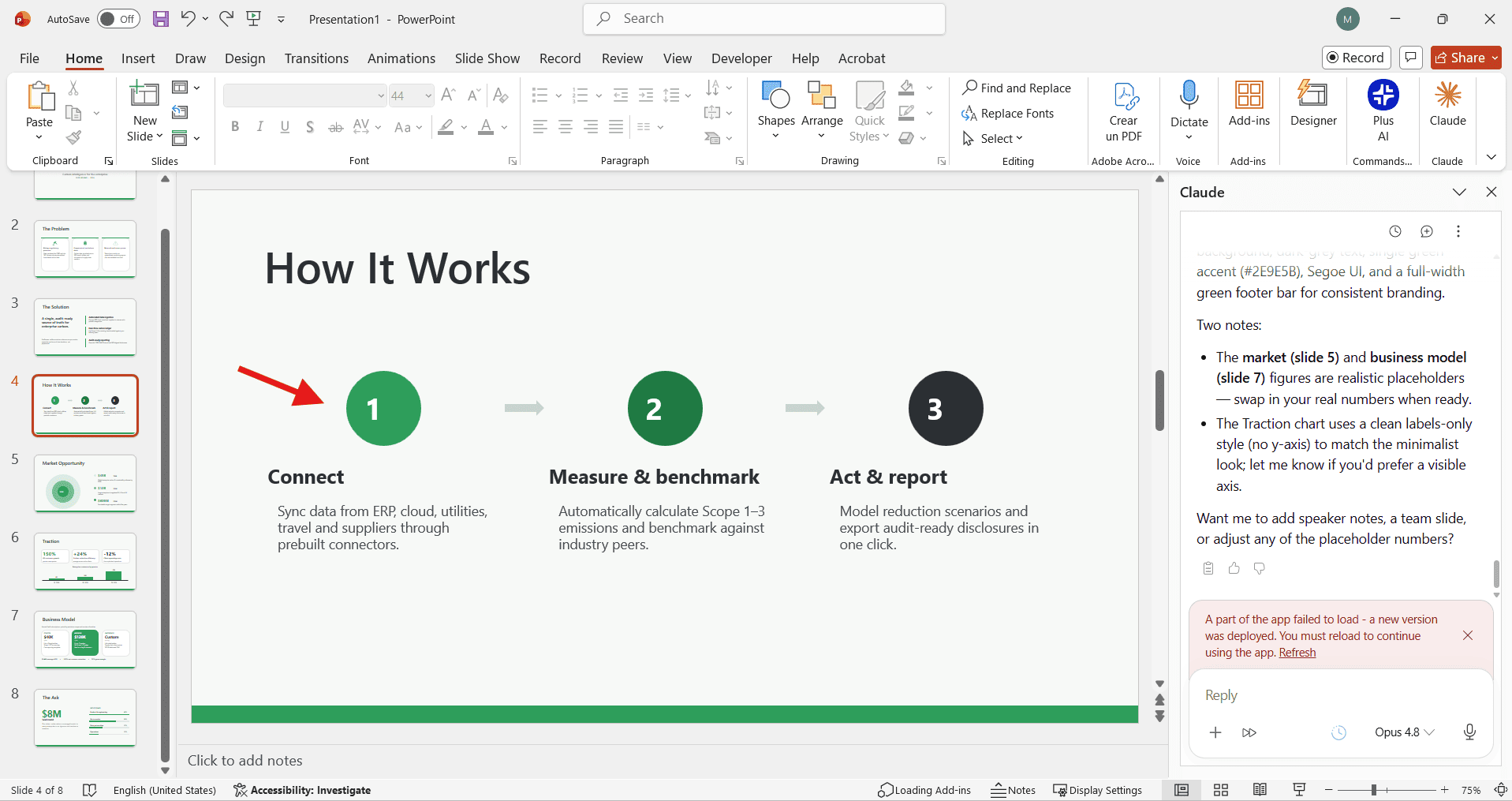
- Strict Contextual Discipline: Claude does exactly what you ask. Unlike other tools that hallucinate unwanted "extra" design elements, Claude maintains strict obedience to your prompt.
- Intuitive Safe Editing: Chat-based editing executes revisions perfectly without accidentally destroying the rest of the slide layout.
Cons
- The Web Export Bug: There is no free-form canvas in the Design Tab. Elements are trapped inside invisible bounding boxes. When exporting these web-coded slides to PowerPoint, it creates an "Editing Tax" resulting in minor formatting bugs.
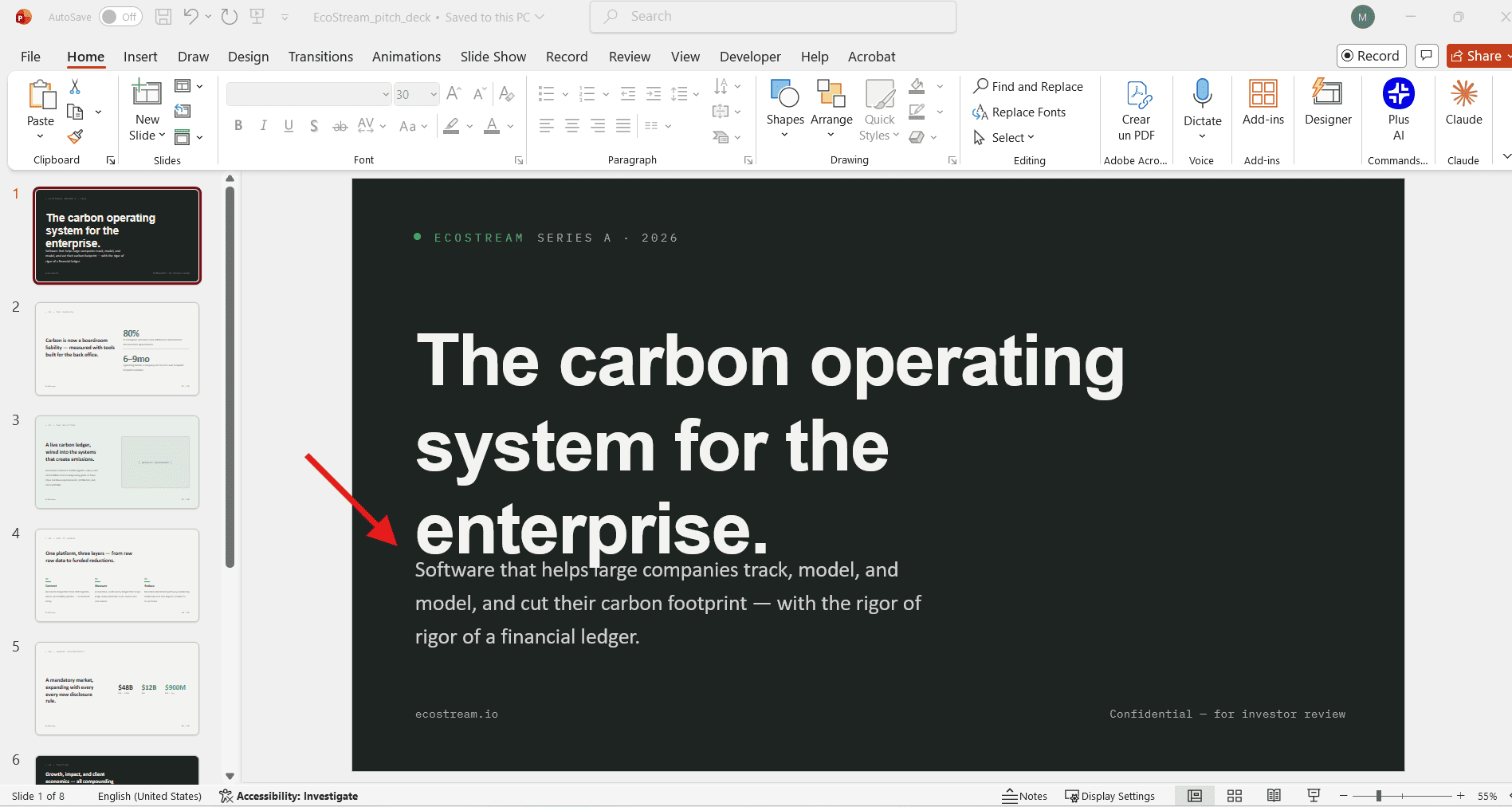
- Heavy Token Consumption: Using advanced models like Opus 4.8 burns through your AI subscription limits very rapidly. Our team frequently hit the 5-hour usage quota while stuck in the "refinement loop," forcing us to export the deck to finish it manually.
Not For You: When to Skip Claude
Skip Claude if you are on a strict budget, as unlocking its true presentation capabilities requires a Pro subscription ($17/month). You should also avoid it if you prefer manual, drag-and-drop design. Claude is built for conversational, chat-based edits—but because advanced visual generation burns through tokens so quickly, relying purely on the AI to tweak your layout will frequently lock you out of your account until your quota resets.
2. Gamma: Best for web-first visual storytelling
Gamma is one of the most popular AI presentation generators on the market. As a "Liquid Canvas" tool, it abandons traditional, rigid slide formats in favor of a fluid, webpage-like experience.
(Note for free users: The AI image generation on the free plan is very basic; we highly recommend replacing images with your own high-quality assets. Additionally, if you want custom corporate fonts, you must upgrade to the PRO plan; otherwise, you are stuck with generic typography).
Key Features
- The Liquid Canvas: Instead of rigid 16:9 slides, it uses flexible "cards" that automatically adapt to your text length, breaking down complex ideas into highly readable, scrollable chunks.
- Multi-Format Generation: From a single prompt, Gamma can generate presentations, scrollable webpages, and text documents.
- Source References: Because Gamma actively expands on your prompt to fill space, it provides unique clickable citations so you can verify where the AI pulled its supplemental information.
How It Handled Our Benchmark Prompt
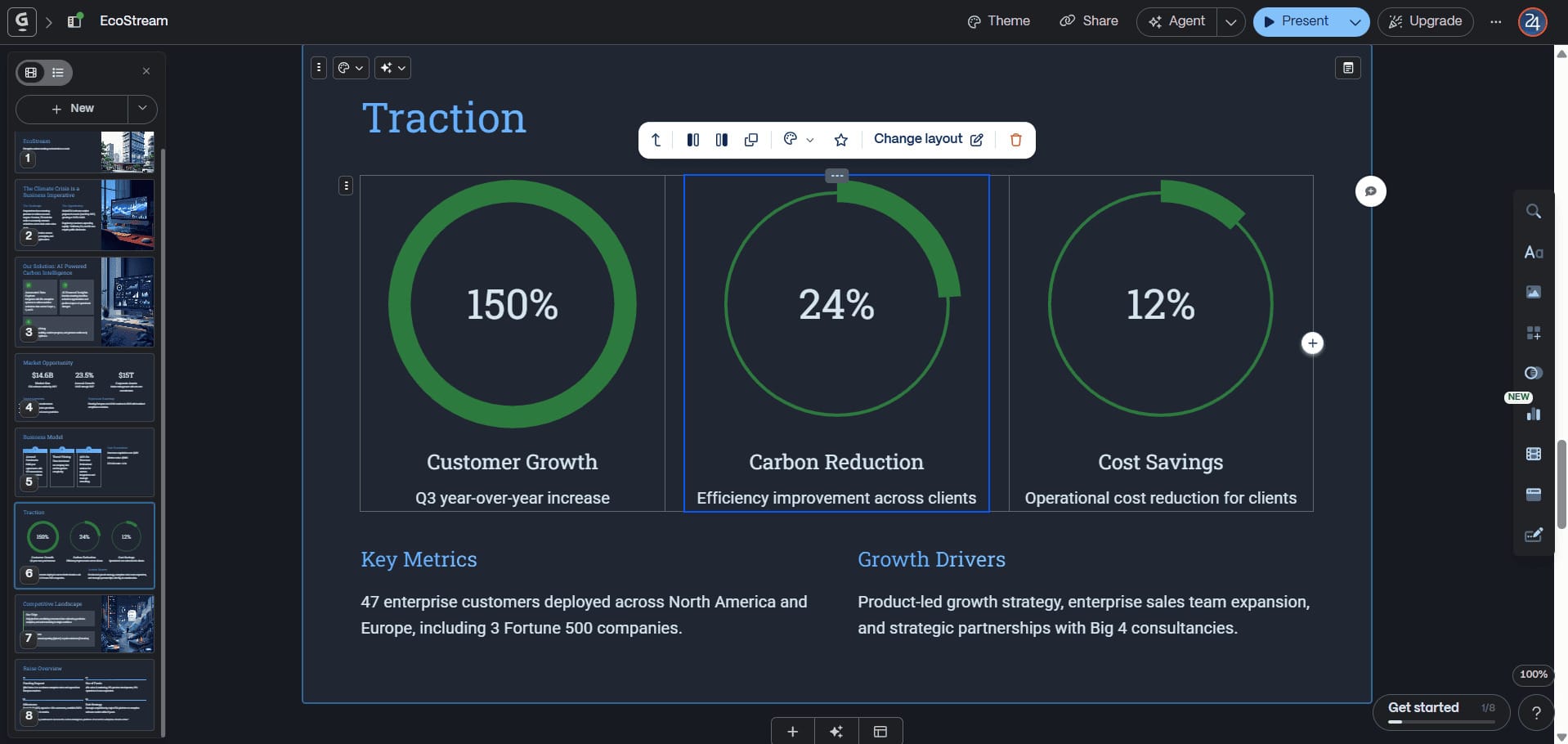
Gamma successfully extracted our exact data constraints (150%, 24%, and 12%) without hallucinating fake numbers. However, it struggled with our strict brand parameters. Our "strict green" command resulted in a light, faded green that wasn't consistently applied.
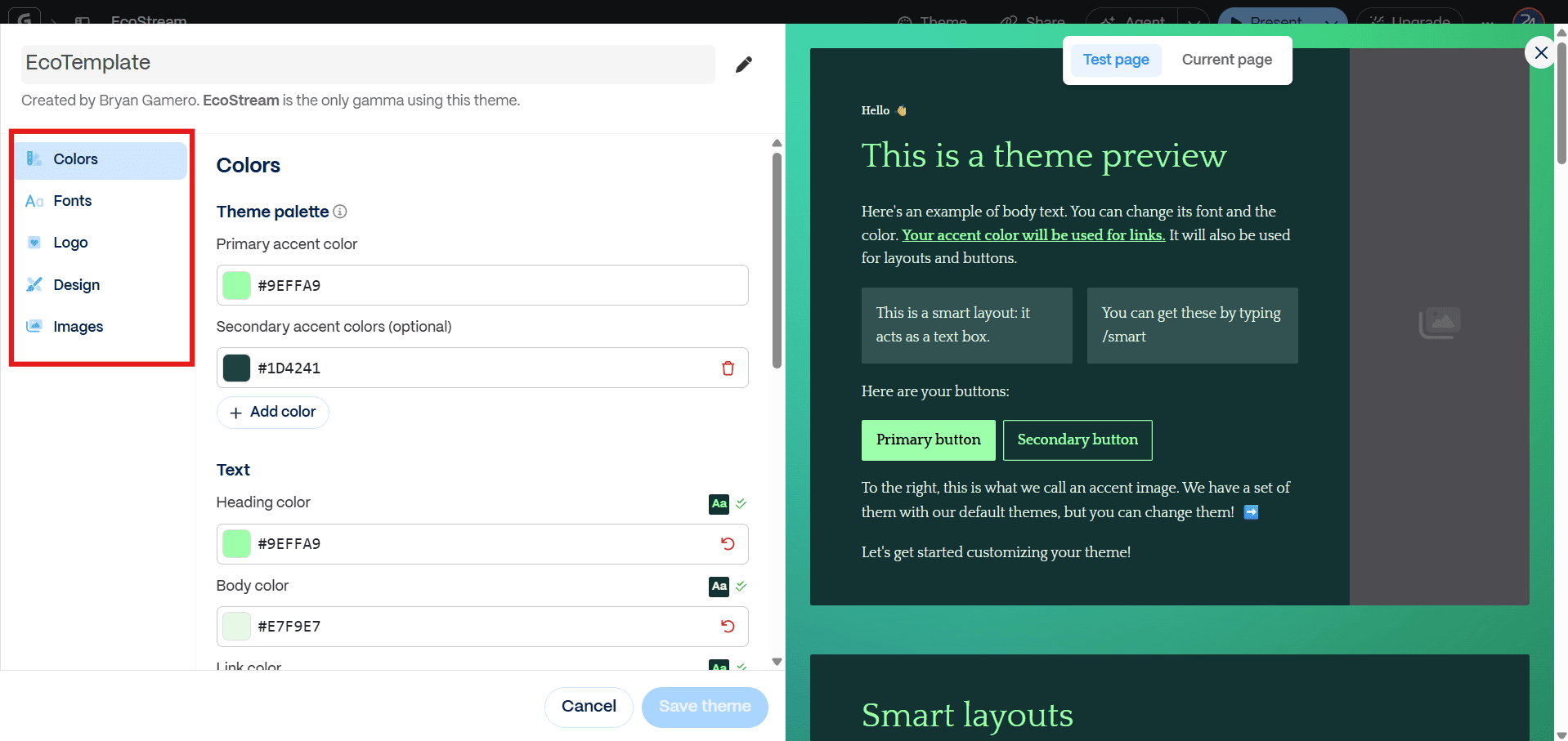
Fortunately, Gamma features a robust manual Theme Editor. Our designers easily input exact corporate hex codes to instantly bring the entire deck perfectly on-brand.
Pros
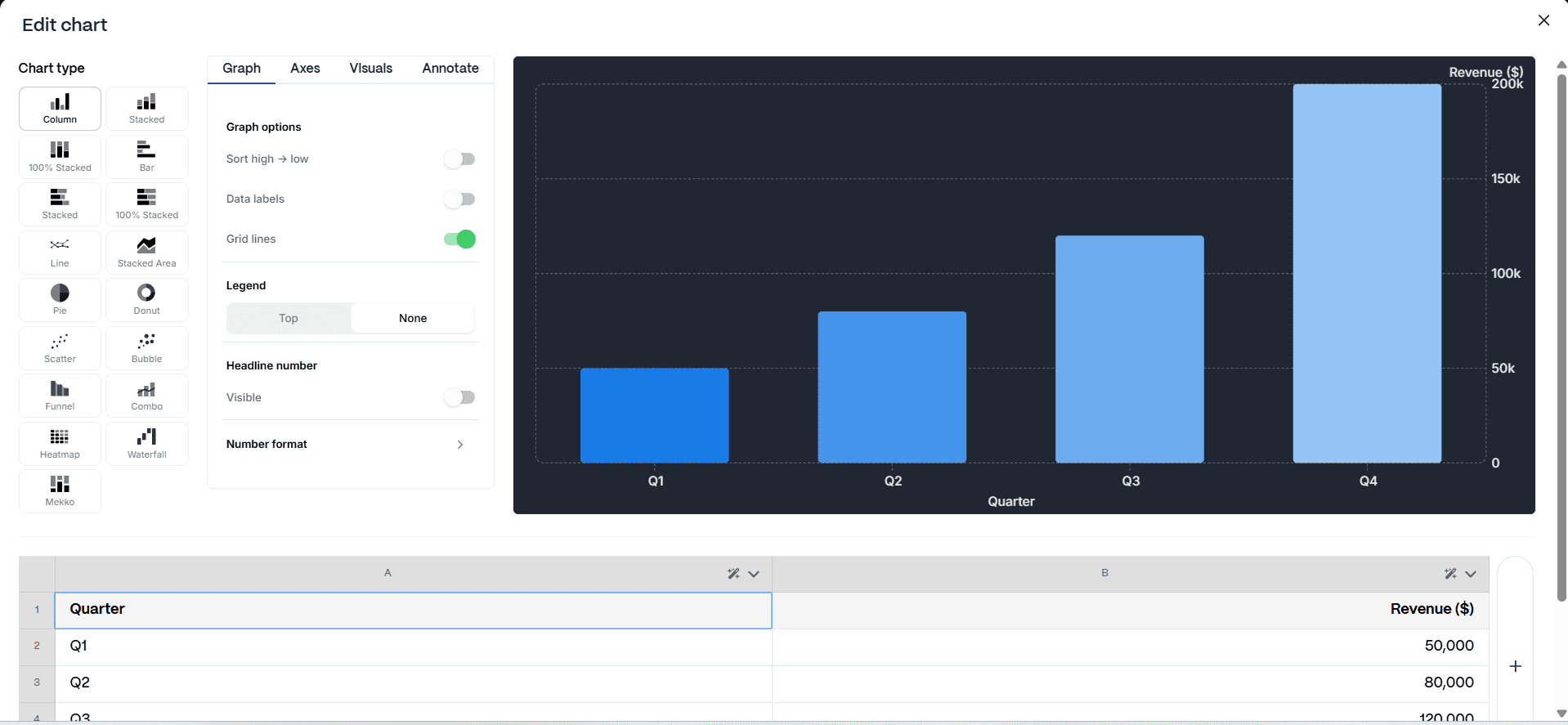
- Relational Data Charts: While isolated numbers generate static icons, prompting the AI "Agent" chat with a relational dataset generates true, data-linked charts.
- Cures the "Tetris" Game: Because Gamma is fluid, it eliminates the tedious process of perfectly aligning boxes. The AI handles the spatial flow automatically.
- One-Click Themes: You can instantly transform the entire visual style and typography of your presentation with a single click.
Cons
- Rigid Block System: The fluidity comes at the cost of precision. You cannot freely drag, drop, or layer elements.
During our workshop, our designers noted that making manual layout changes causes the blocks to separate, making it highly complicated to move elements. After trying to change the layout several times, the AI actually generated formatting errors and bugs.
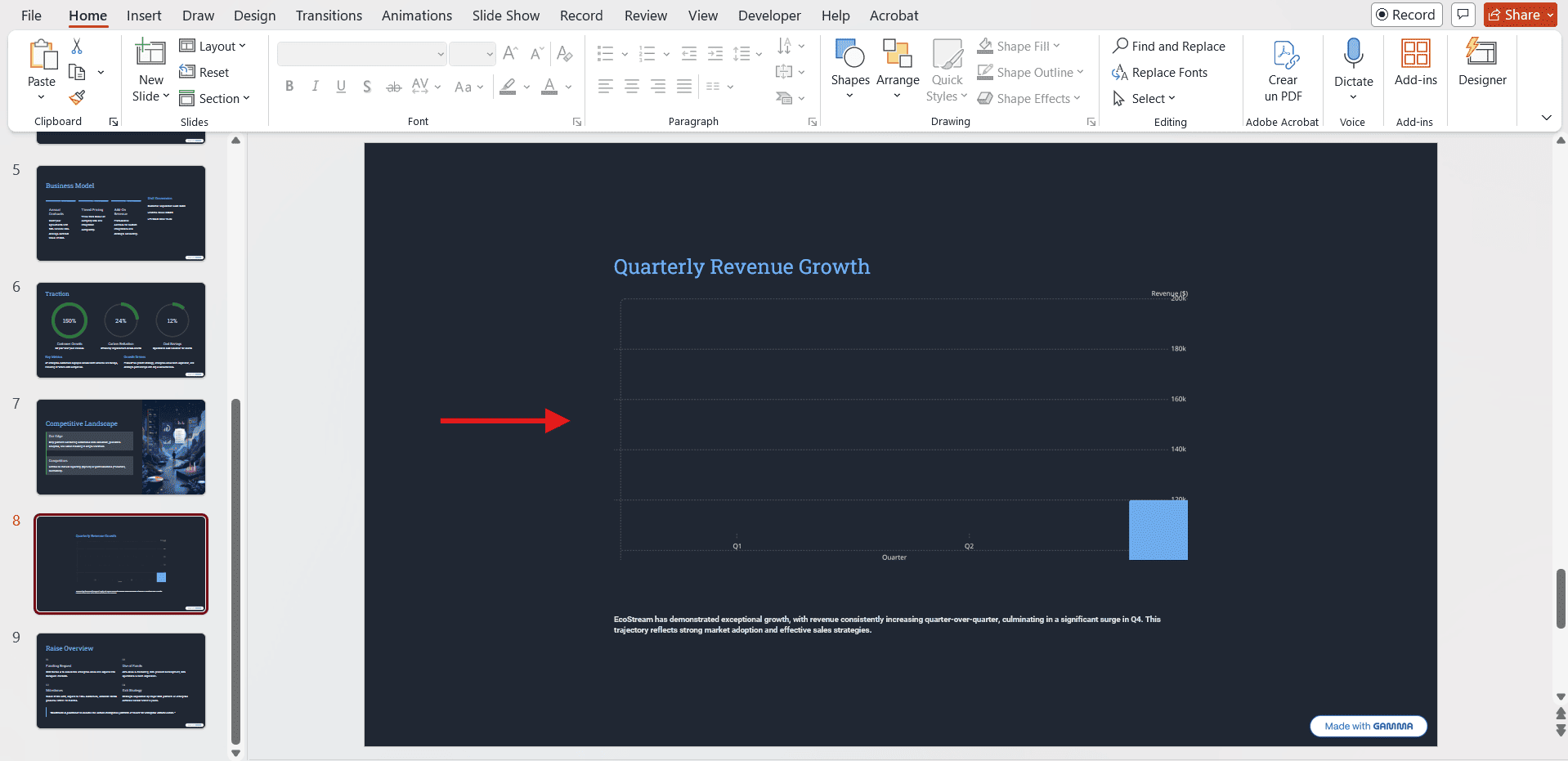
- The Sizing Trap & Export Bug: Forcing Gamma into a traditional 16:9 ratio leaves awkward empty spaces. Crucially, translating this fluid web-code into a native PowerPoint file causes severe formatting bugs and broken charts.
- Non-Renewing Credits: The free tier provides 400 sign-up credits that do not renew. Generating a single deck costs roughly 40 credits, meaning you hit a hard paywall after about 10 presentations.
- Free Tier Limitations: Gamma provides 400 sign-up credits that do not renew, meaning you hit a hard paywall after about 10 presentations. Additionally, AI image generation on the free plan is very basic (we highly recommend replacing them with your own assets), and custom corporate fonts are locked entirely behind the Pro plan.
Not For You: When to Skip Gamma
Skip Gamma if your corporate team requires strict brand consistency and flawless offline files. Because its fluid canvas overrides rigid corporate templates, it scored poorly on our Brand & CVI Compliance tests. It is also not for professional designers who need a free-form canvas to build complex, overlapping visual compositions.
For more example outputs and a full breakdown of the software, read our complete Gamma App Review.
3. SlideSpeak: Best for clean PowerPoint (.pptx) exports
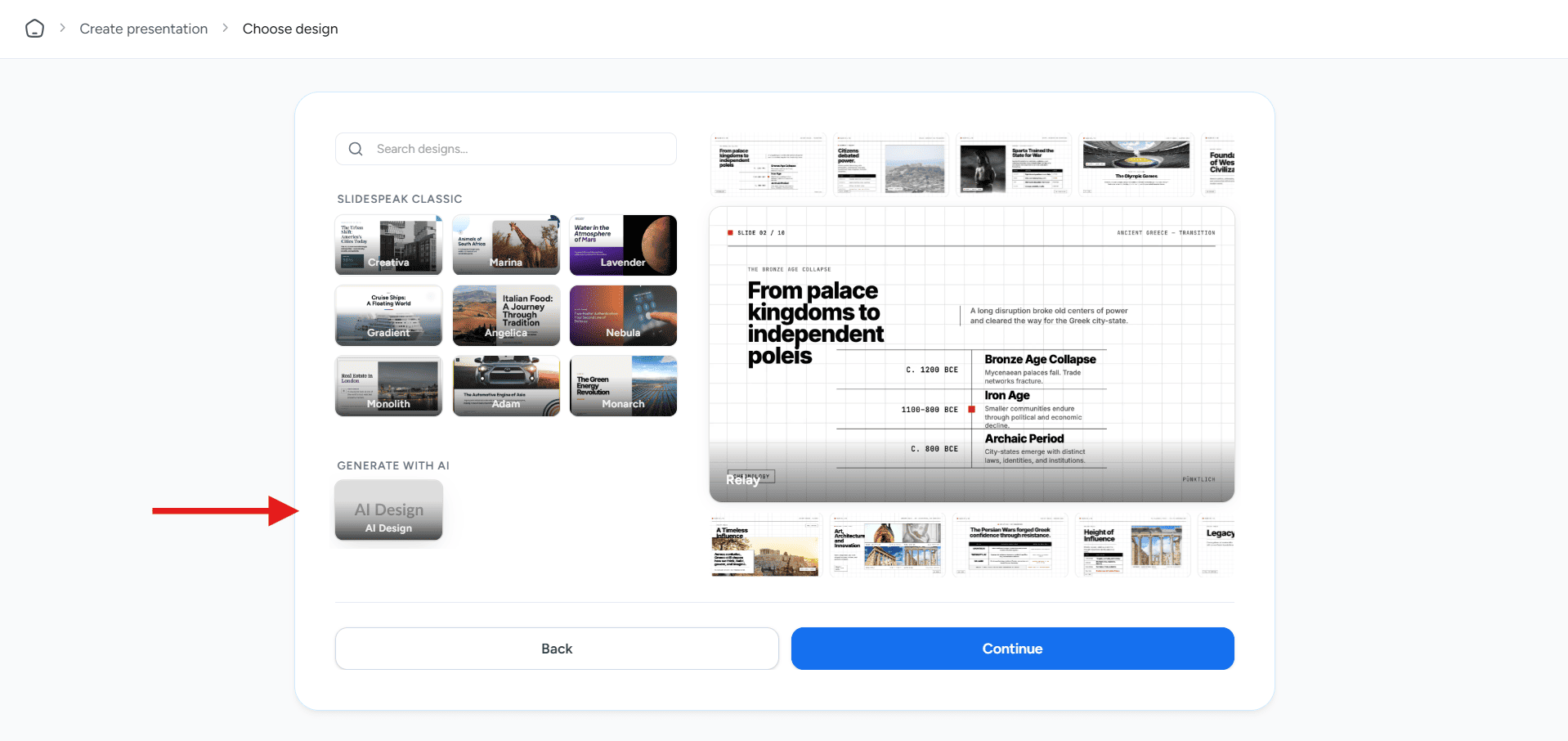
SlideSpeak is a highly versatile AI tool that turns documents, text, and ideas into polished presentations. Since our last review, they have updated their engine, abandoning rigid templates for true generative design powered by two new models: SlideSpeak AI 4.0 and the advanced AI 5.0.
(Testing Note: The SlideSpeak team granted us a Premium Plus account to test their paywalled export features, but this review remains 100% independent and based strictly on our agency's design standards).
Key Features
- Generative AI Engine: The AI reads your visual prompts (e.g., "dark grey background") and generates visually rich, unique layouts from scratch.
- "Charles" AI Assistant: A dedicated, onboard ChatGPT-powered editor. You can converse with the chat to rewrite text, change specific colors, or insert new content.
- Document-to-Slide Engine: Upload Word docs or PDFs; the AI extracts key insights while preserving original charts and formatting.
- New Integrations: Recently added interactive quizzes, slide transitions, and direct exports to Google Slides.
How It Handled Our Benchmark Prompt
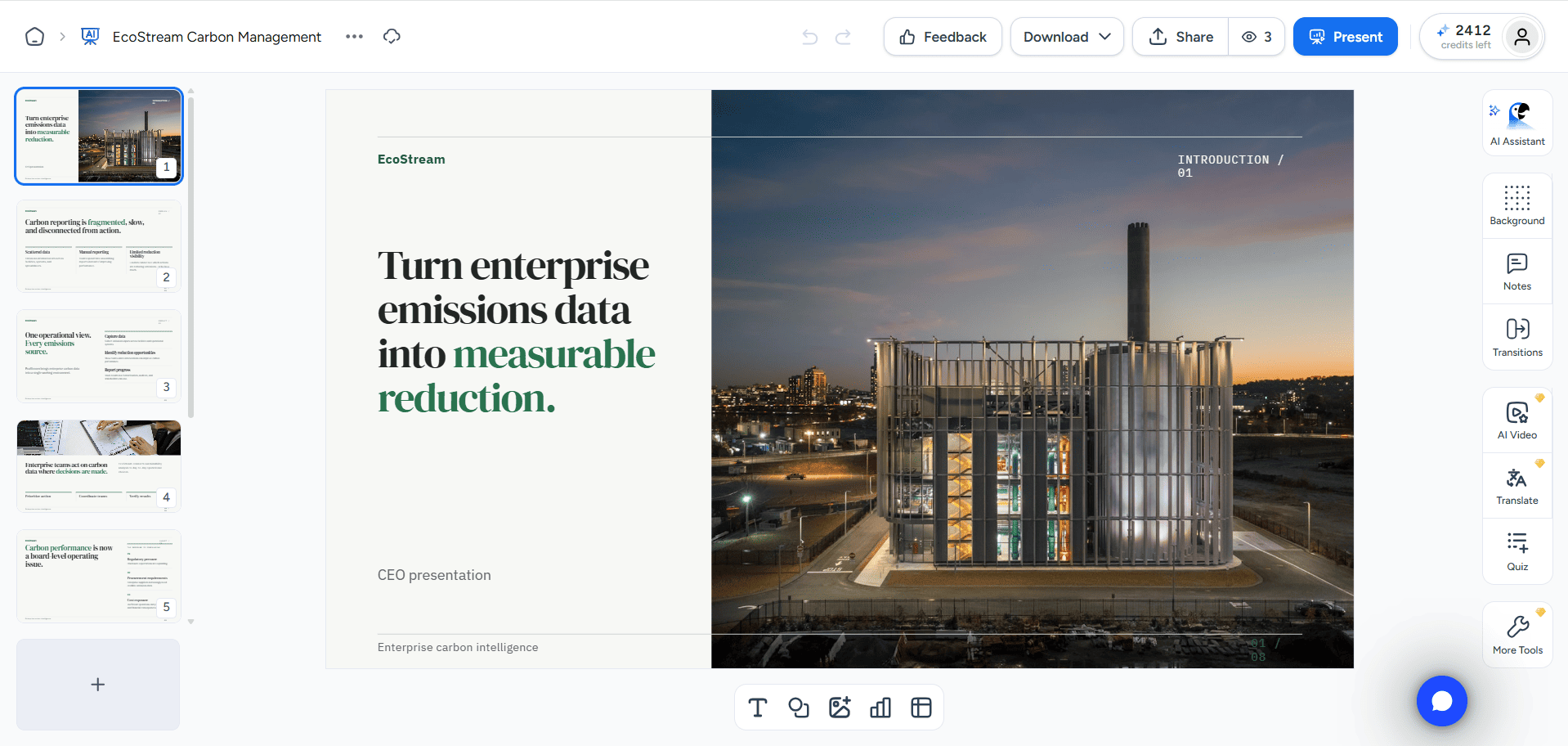
We tested the advanced AI 5.0 model, and its reading comprehension was excellent. It effortlessly extracted our 150%, 24%, and 12% metrics. Its visual accuracy was also a standout feature: it successfully applied our "strict green and dark grey" palette instructions. (Note: We also tested the AI 4.0 model to save credits, but the visual output was noticeably inferior).
Pros
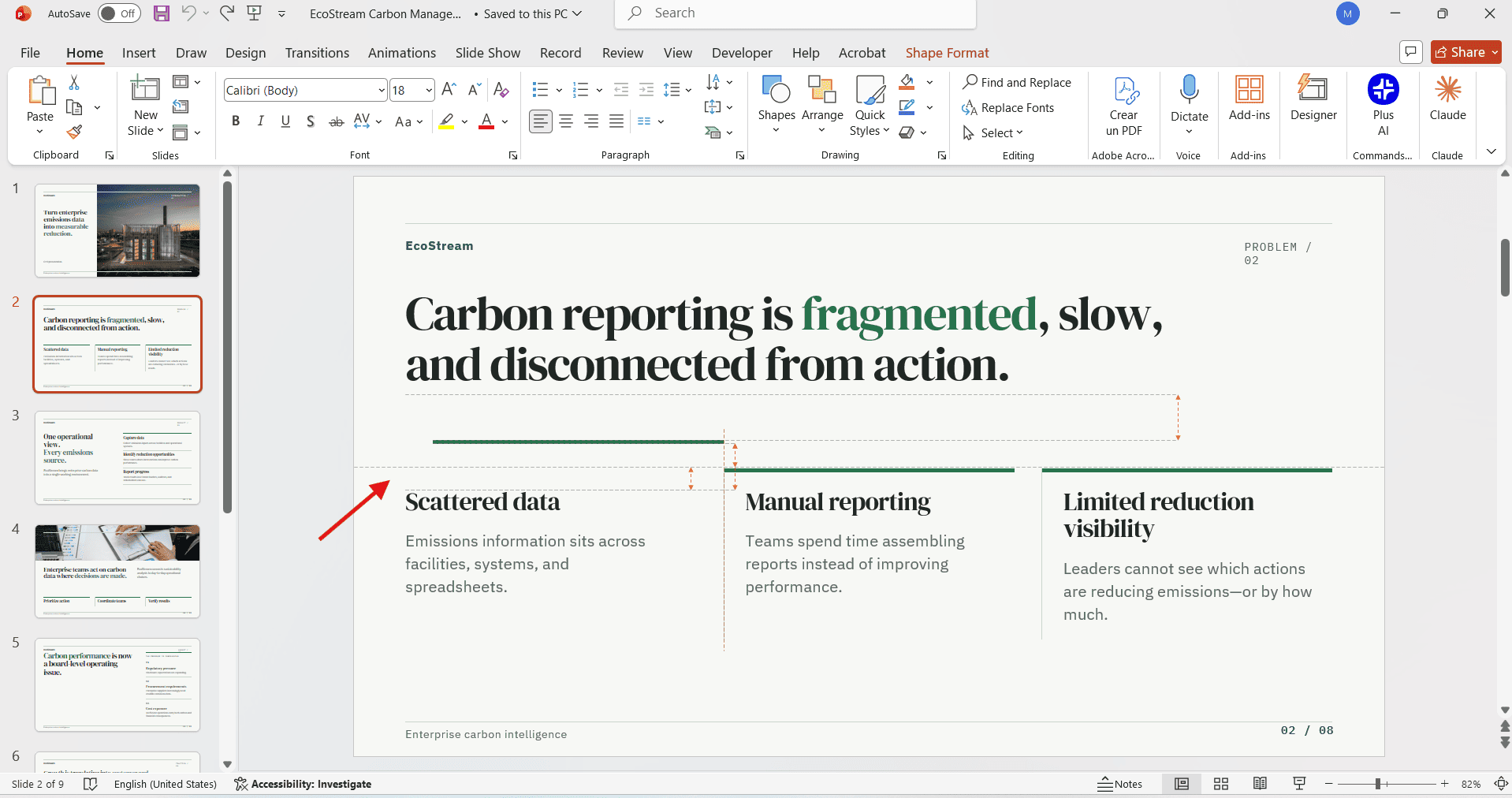
- Flawless PPTX Vectors: When downloaded to PowerPoint, the presentation doesn't flatten into a background image. Individual elements (like lines, text boxes, and shapes) remain fully editable, native PowerPoint objects, allowing users to adjust them freely.
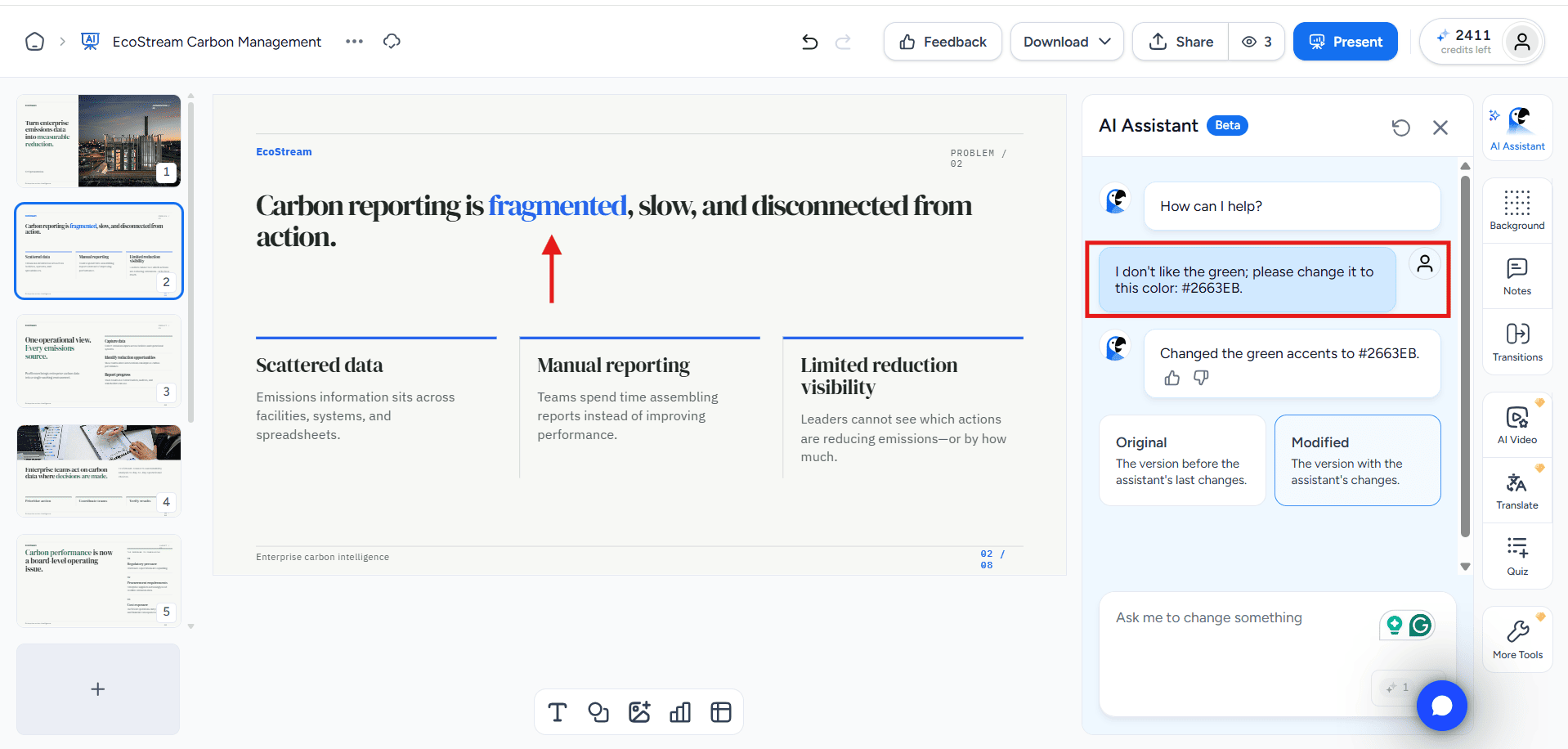
- Precise AI Editing: The AI chat executes precise revisions flawlessly. We asked it to update a color to an exact Hex code (#2663EB), and it worked perfectly without breaking the layout.
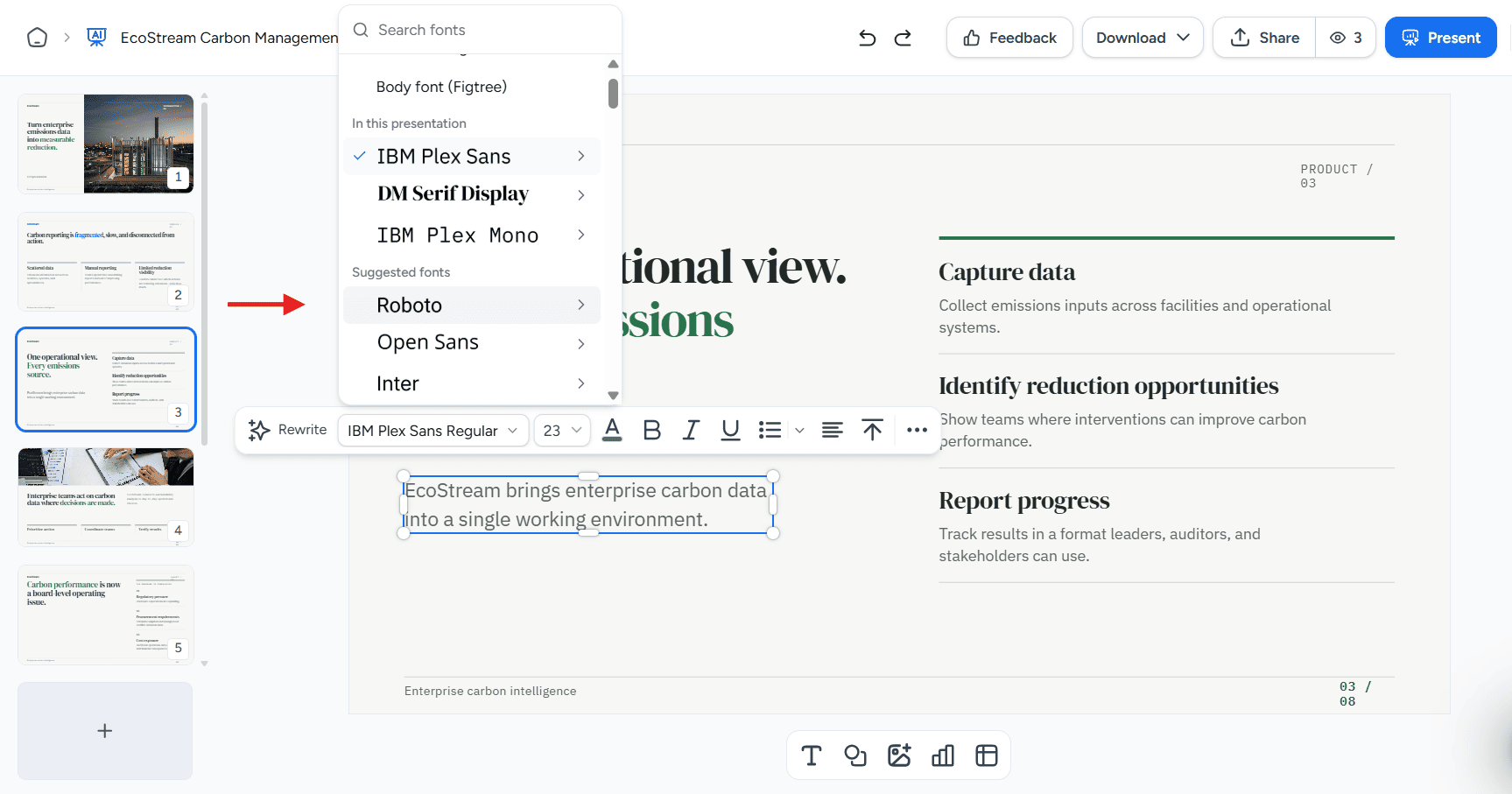
- Superior Manual Control: Unlike other tools that force global theme changes, SlideSpeak allows for granular, local font adjustments on individual text boxes.
Cons
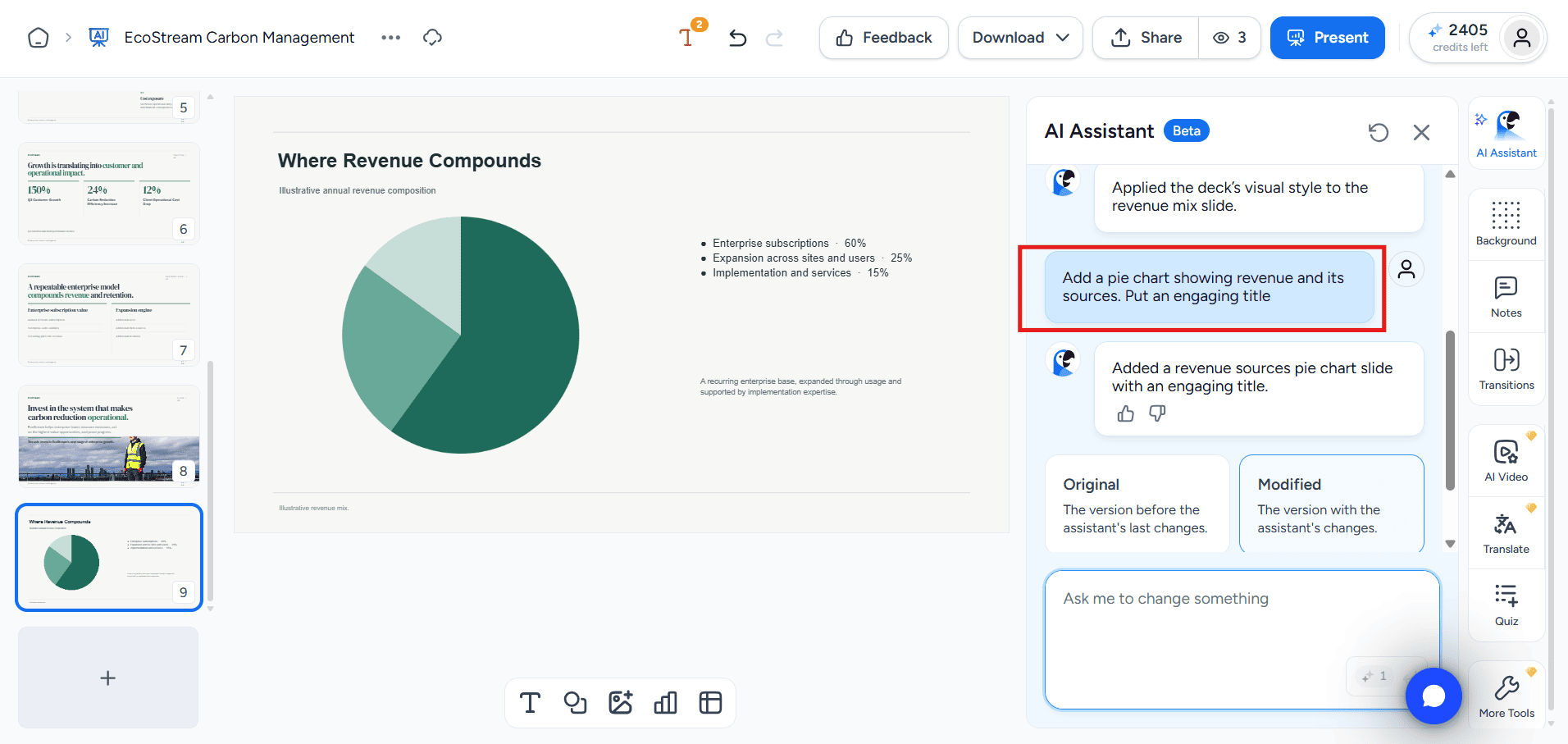
- Chart Generation Bugs: When we asked the AI chat to "add a slide with a pie chart," it generated a blank white slide that completely broke our theme. When we duplicated an existing slide and asked it to add a chart, it worked, but the AI used a completely different font that ruined the visual consistency.
- Static Data Charts: While text and shapes export perfectly, any generated data charts export to PowerPoint as static images rather than native, data-linked Excel charts.
- No Third-Party Integrations: It currently lacks live data integrations with external apps like Google Sheets.
Not For You: When to Skip SlideSpeak
Skip SlideSpeak if your marketing team relies heavily on integrating live data from external apps, or if you expect the AI chat to flawlessly generate completely new, on-brand slides post-generation without manual font fixing. It is also not for users looking for a free AI presentation maker for ongoing use, as exporting the final .pptx file requires a premium subscription.
4. GenSpark: Best for unique, high-impact layouts
GenSpark is a massive "all-in-one" AI workspace. Typically, "jack-of-all-trades" tools fail at specialized design, but GenSpark’s dedicated "AI Slides" feature operates on a completely different architectural level, acting more like an AI software engineer coding your slides in real-time.
Crucial Note: Be extremely careful with GenSpark's credit economy. While the base plan is $24.99/month, running complex tasks on 'Ultra' mode burns through premium credits incredibly fast.
Key Features
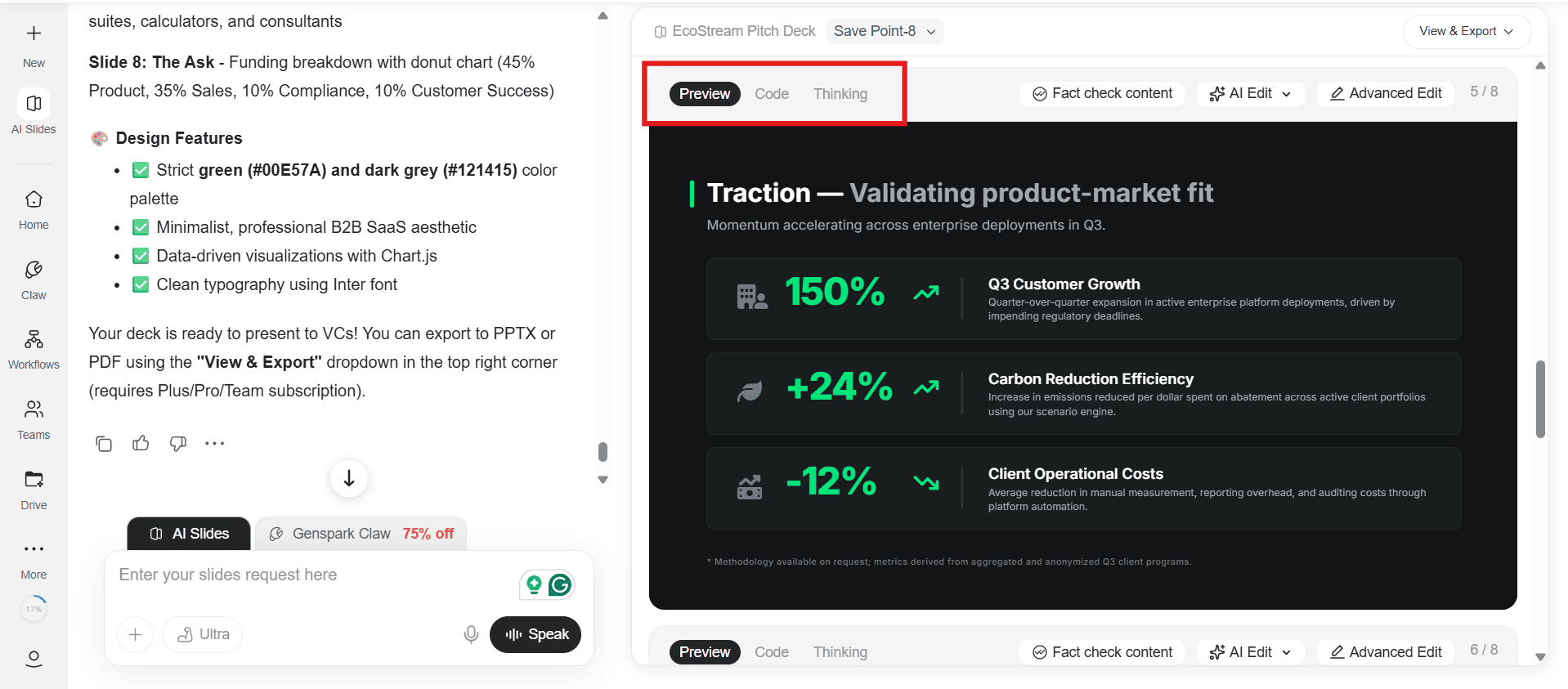
- The "Thinking & Code" Engine: As the AI generates slides, you can toggle between three views: the Visual Preview, the raw HTML/CSS Code, and the AI's internal "Thinking" process.
- Selectable AI Models: You can choose your AI engine power (Lite, Standard, or Ultra). For our benchmark, we used "Ultra."
- Granular Design Adherence: The AI explicitly lists the exact hex codes and typography it is using in the chat to ensure strict brand compliance.
- "Mark and Edit" Targeting: A unique cursor tool allows you to select a specific element (like a chart) and give the AI a highly localized command.
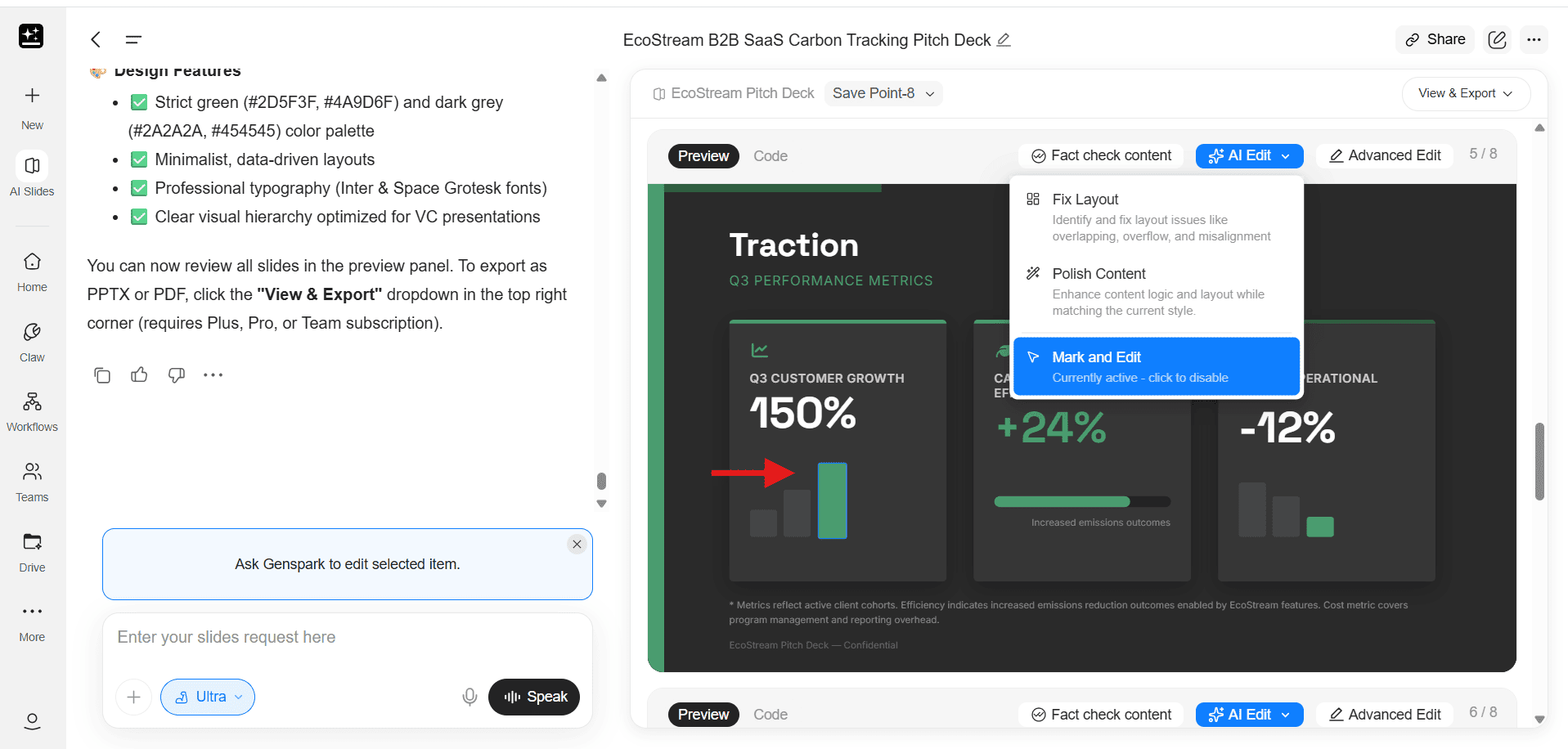
How It Handled Our Benchmark Prompt
GenSpark’s reading comprehension on 'Ultra' mode is phenomenal. It successfully extracted our metrics and strictly obeyed our hex code requests. Although our prompt didn't request a market slide, GenSpark proactively generated a TAM, SAM, and SOM breakdown to intelligently expand the business narrative.
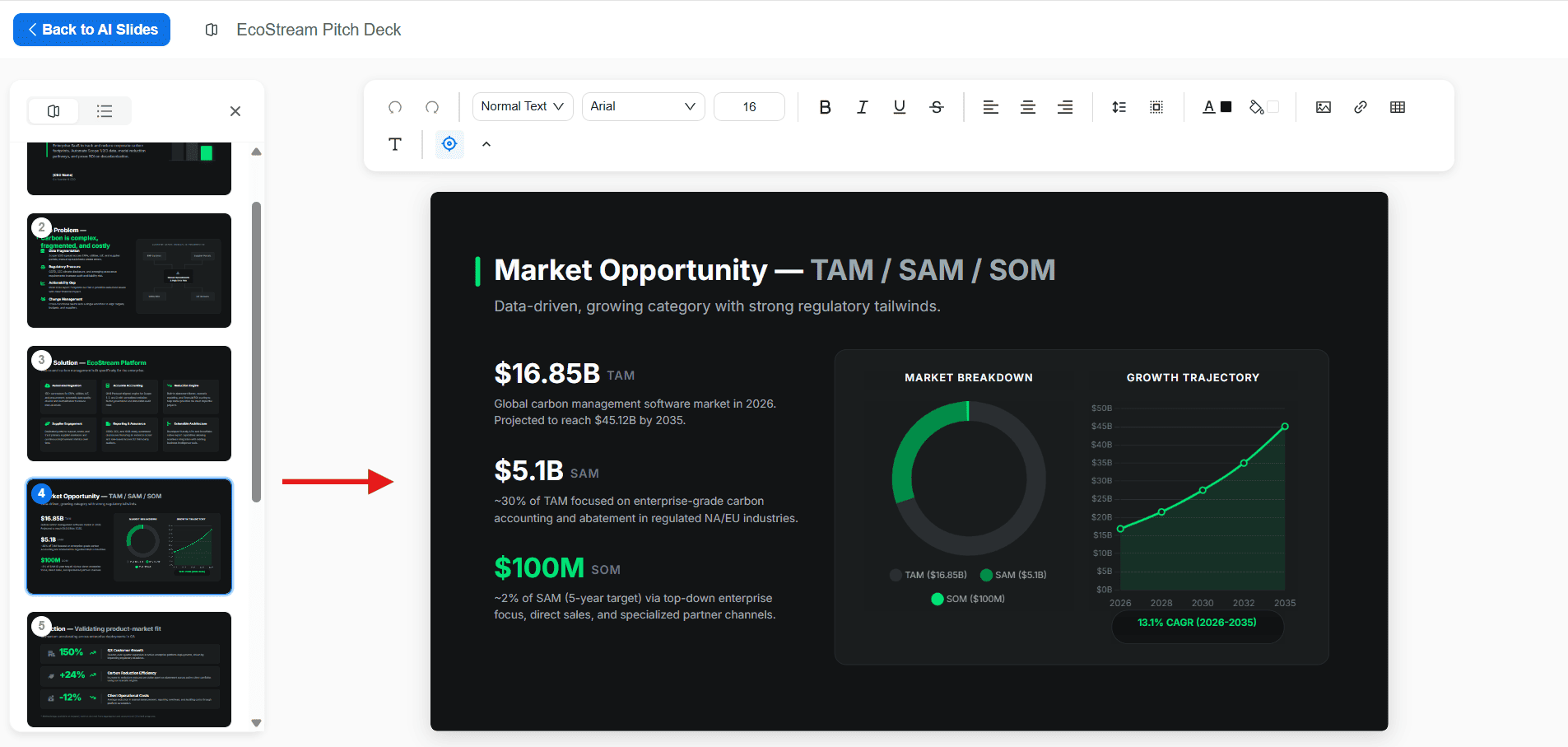
💡 Transparency Note on the Raw Output: During our workshop, we opened the 'Advanced Edit' window, which triggered a bug that made our icons disappear. When we used the 'History' button to revert the change, it accidentally wiped the presentation back to a 1-slide state! We had to prompt the AI to regenerate the deck. Click here to view the 100% raw, unedited AI output.
Pros
- Unique Generative Layouts: It actively reasons and codes custom layouts for your specific prompt instead of injecting text into a static template.
- Strict Brand Adherence: Unlike most competitors, GenSpark successfully followed our strict color constraints, even outputting the exact hex codes in the chat to prove it.
- AI-Driven Polishing: You can use the "Fact Check Content" button to correct hallucinations, or the "AI Edit" menu to automatically polish logic and formatting.
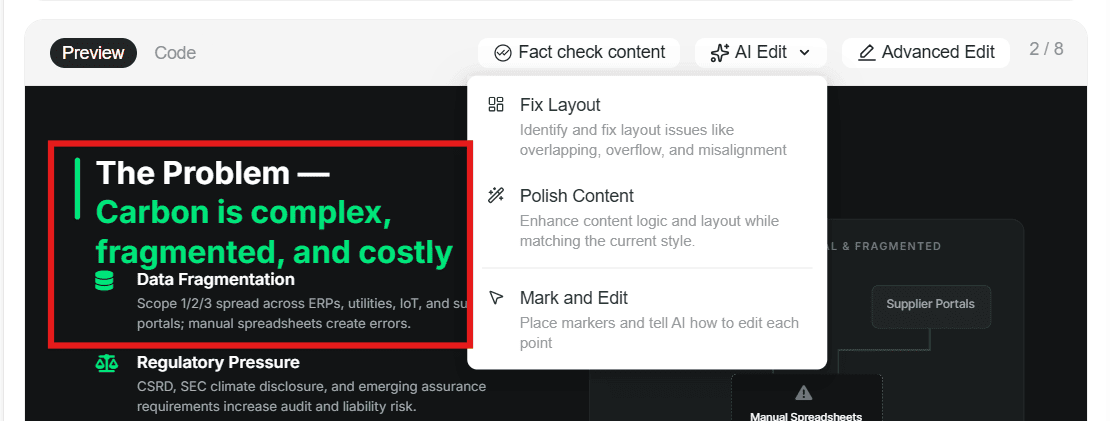
- Multimodal Suite: Beyond slides, the platform gives you access to AI audio, video, and document generation within the exact same workspace.
Cons
- Locked Manual Charts: Once you open the "Advanced Edit" window, you quickly realize the charts are locked. You cannot manually change their colors or update data points yourself.
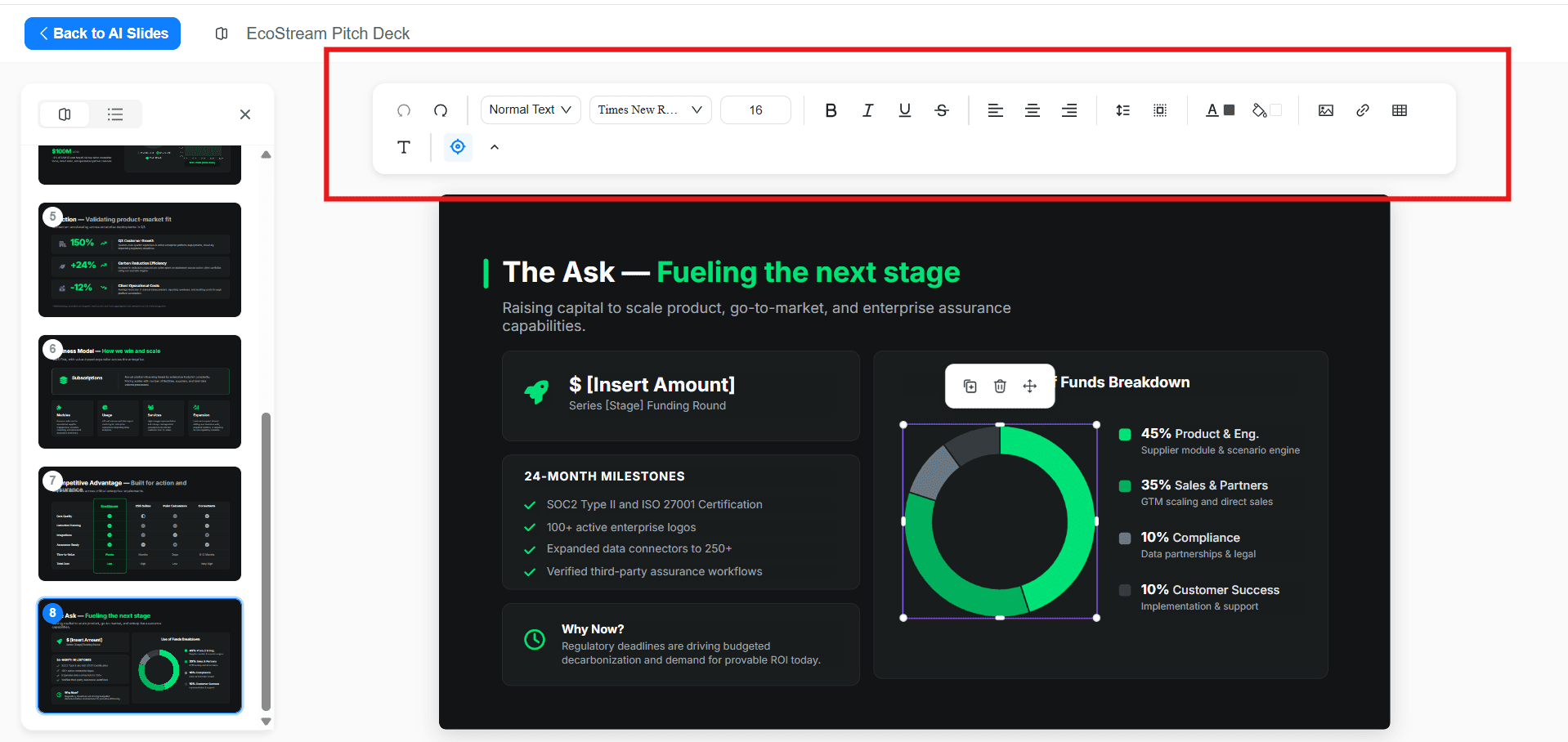
- Manual UX Bugs: Manual text editing is a UX nightmare; a UI bug makes the manual text cursor completely invisible on dark backgrounds.
- Credit Burn: Running complex tasks on 'Ultra' mode burns through premium credits incredibly fast.
Not For You: When to Skip GenSpark
Skip GenSpark if you represent a corporate brand with strict, static brand demands. It does not have a traditional "Brand Kit" tab where you upload your logo once; it uses an agent to dynamically generate an identity system. It is also not for users in a rush (generating an 8-slide deck took roughly 12 minutes), or for free users who need to download their final .pptx files, as exports require a paid plan.
5. Prezi: Best for interactive, non-linear keynotes
Prezi has been famous for years for its non-linear, zooming presentations. Now, they have integrated a powerful AI engine that builds these dynamic, spatial canvases from a single text prompt, completely abandoning the concept of linear "slides."
Crucial Note on Free Usage: Prezi offers 500 AI credits (no credit card required) to test its zooming canvas. However, key features like PDF/PPTX export, video recording, and chart creation require a paid plan. Fortunately, Prezi's paid plans are budget-friendly.
Key Features
- AI-Powered Spatial Canvas: The AI generates a zooming, interconnected mind-map organized into "Planet Topics" and "Page Topics."
- "Ask AI" Text Editor: Highlight any text block to summarize, simplify, or instantly transform paragraphs into a flowchart or an "Animated Story."
- Unrestricted Canvas & Story Blocks: Freely move, scale, and layer pre-designed content containers anywhere on the infinite canvas.
- Prezi Video (Paid): Record or live-stream with yourself on-screen next to your presentation.
How It Handled Our Benchmark Prompt
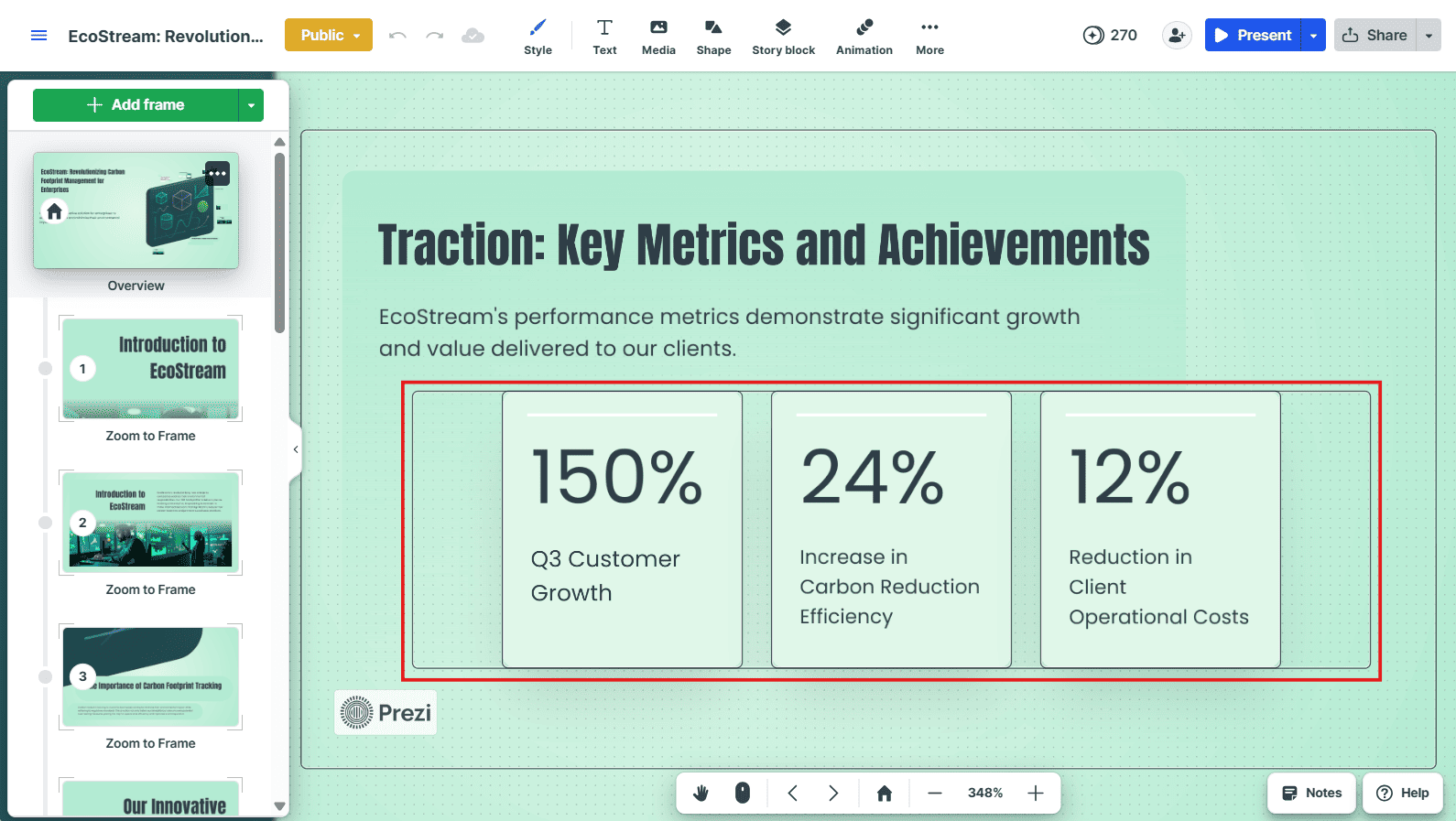
The prompt interface is incredibly simple, and the AI's reading comprehension was top-tier. It successfully parsed our requested 150%, 24%, and 12% metrics into perfectly aligned text blocks while strictly obeying our minimalist green and dark grey color rule.
The raw output. Notice how the AI organizes the pitch into zooming, interconnected "topics." It also generates supplementary copy to cure writer's block, though you must proofread this "bonus" text carefully. Click here to view the 100% raw, unedited AI output
Pros
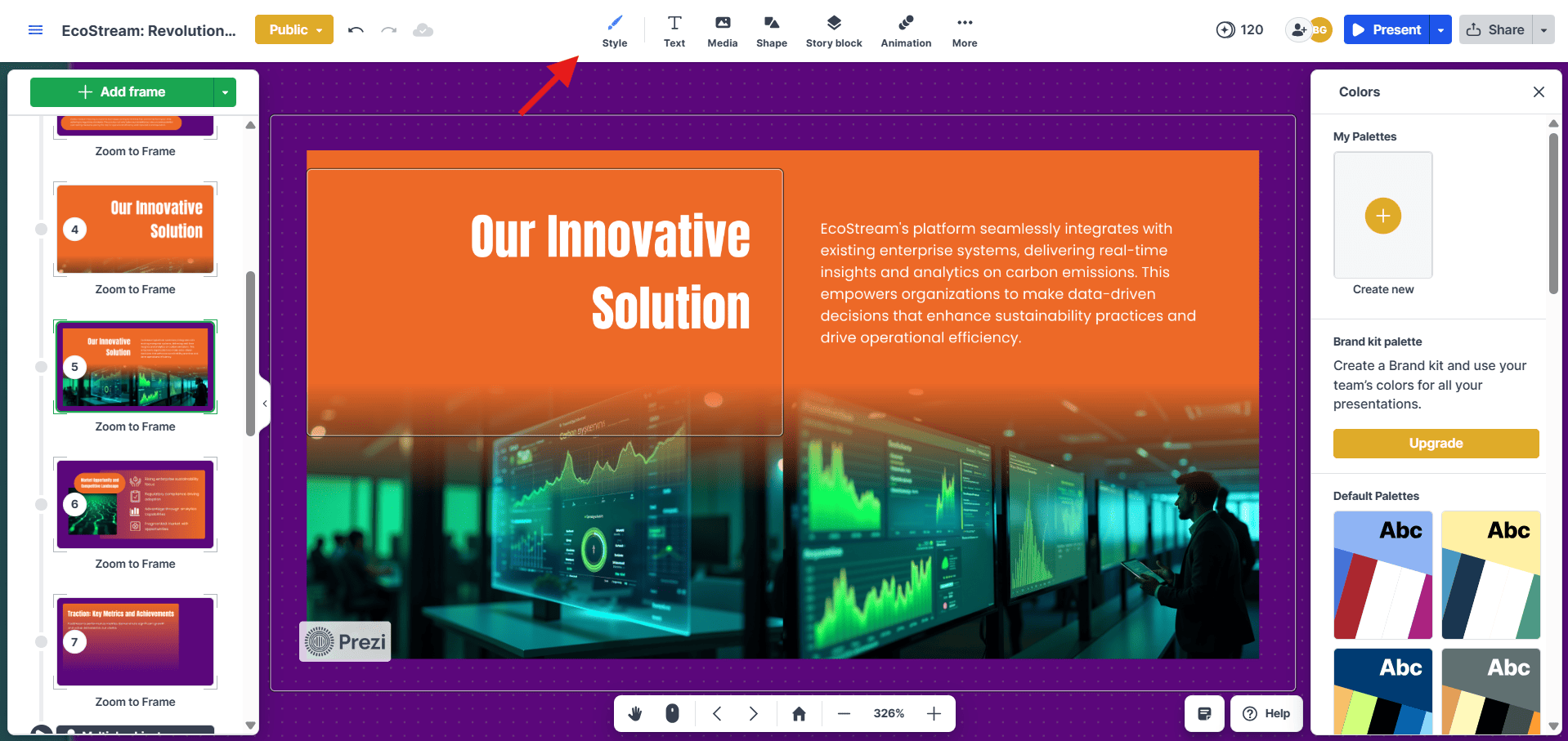
- Superior Color Control: The "Style" menu makes it incredibly easy to swap out entire color palettes or change the background to custom content.
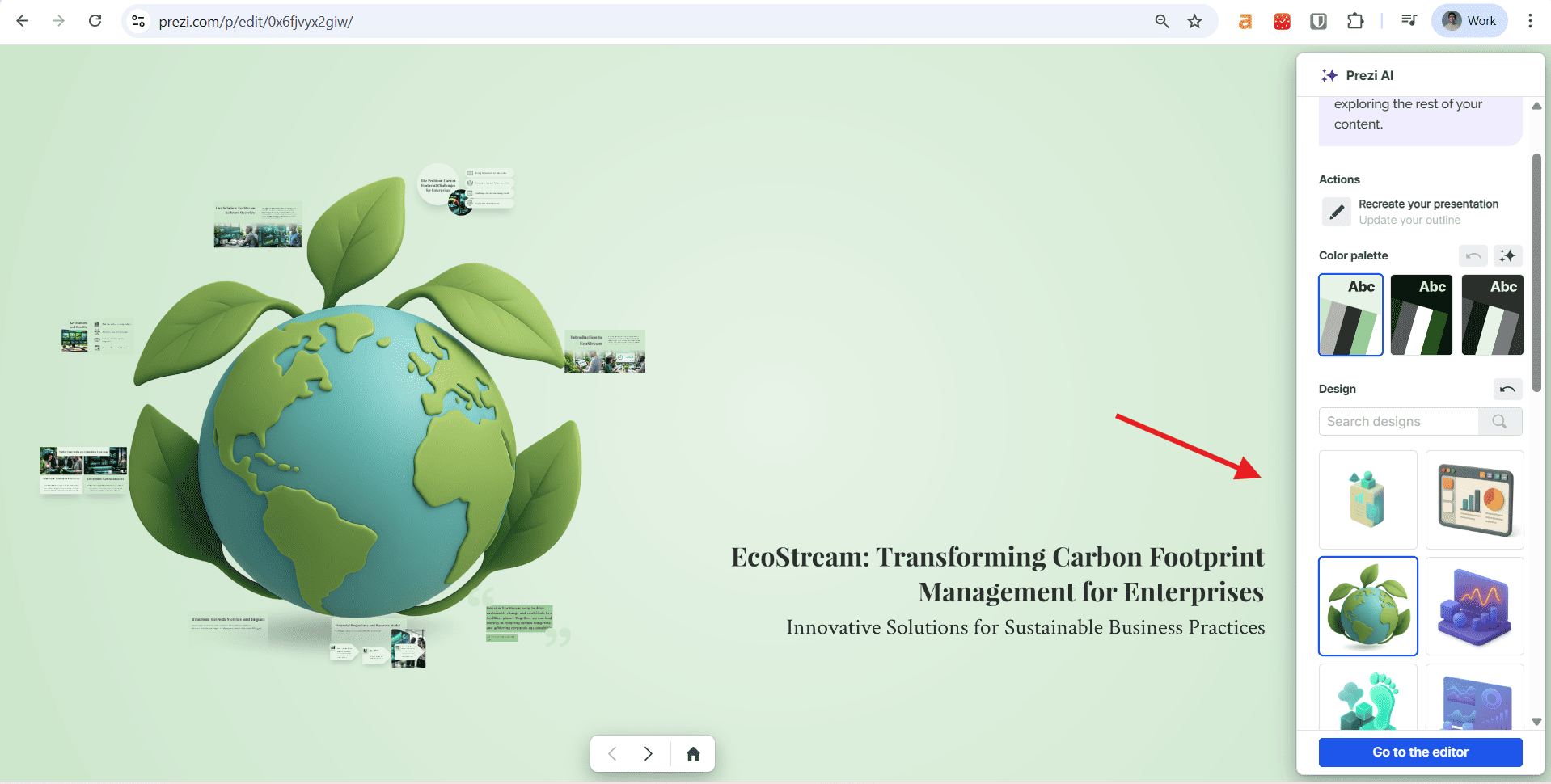
- Global Layout Anchors: You can easily change the central 3D visual anchor of your canvas to completely change the vibe of your presentation.
- Highly Engaging Format: Unmatched for live keynotes, allowing presenters to dynamically jump to any topic based on audience questions.
Cons
- No Conversational AI Chatbot: As Gabo noted, you cannot simply type "insert a new data chart here" or ask it to completely redesign a slide on the fly.
- Repetitive Internal Layouts: While the overall zoom feature is unique, the internal layouts inside the actual "Topics" can feel repetitive.
- Paywalled Exports: Standard PDF/PPTX exports and native chart creation are strictly locked behind paid tiers.
Not For You: When to Skip Prezi
Skip Prezi if you are a financial analyst, a designer seeking deep granular customization, or if you need to deliver a fully editable .pptx file to a client on a free budget. Because it completely abandons traditional slides, it is highly unconventional and not suited for conservative corporate teams that prefer native PowerPoint edits.
6. Alai: Best for generating multiple layout variations
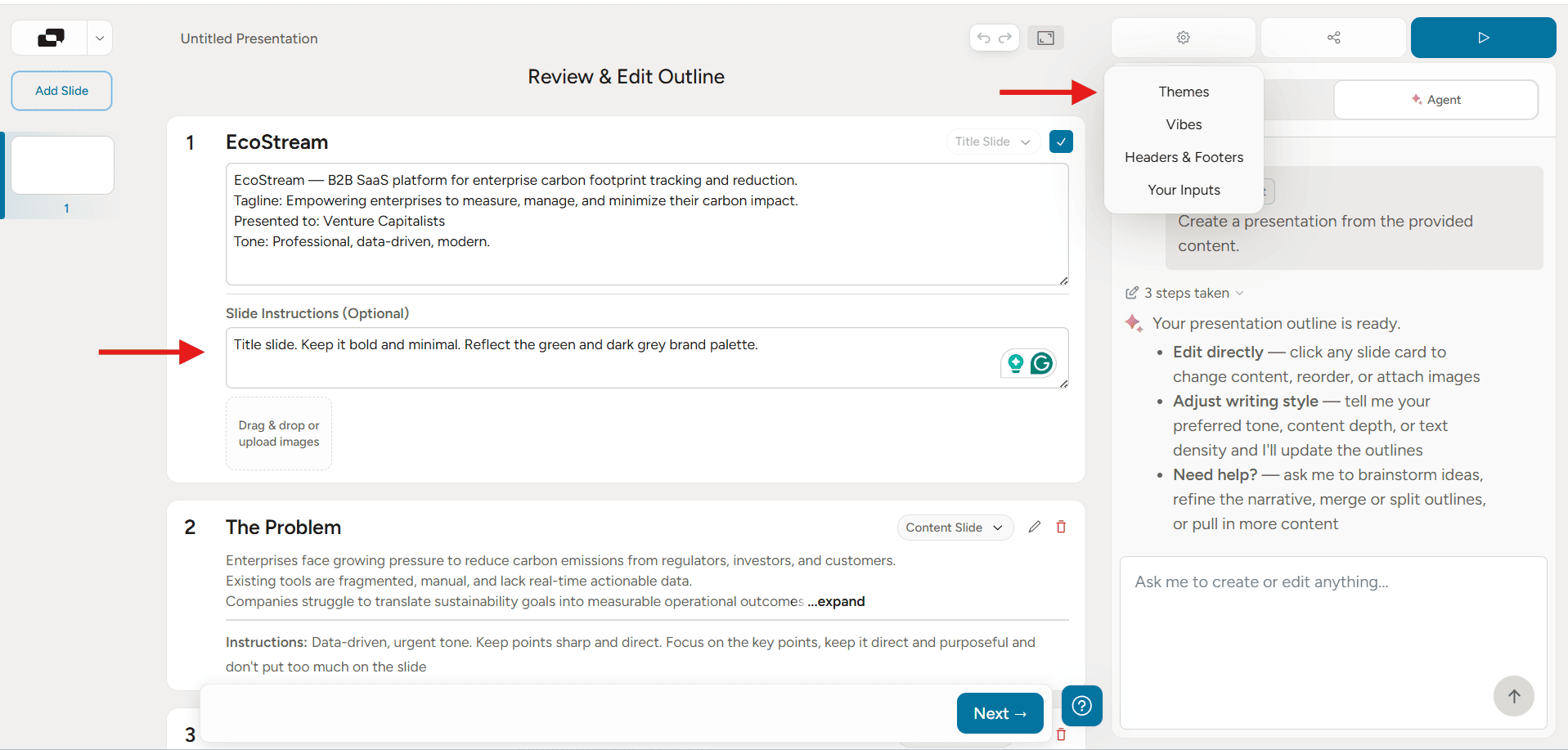
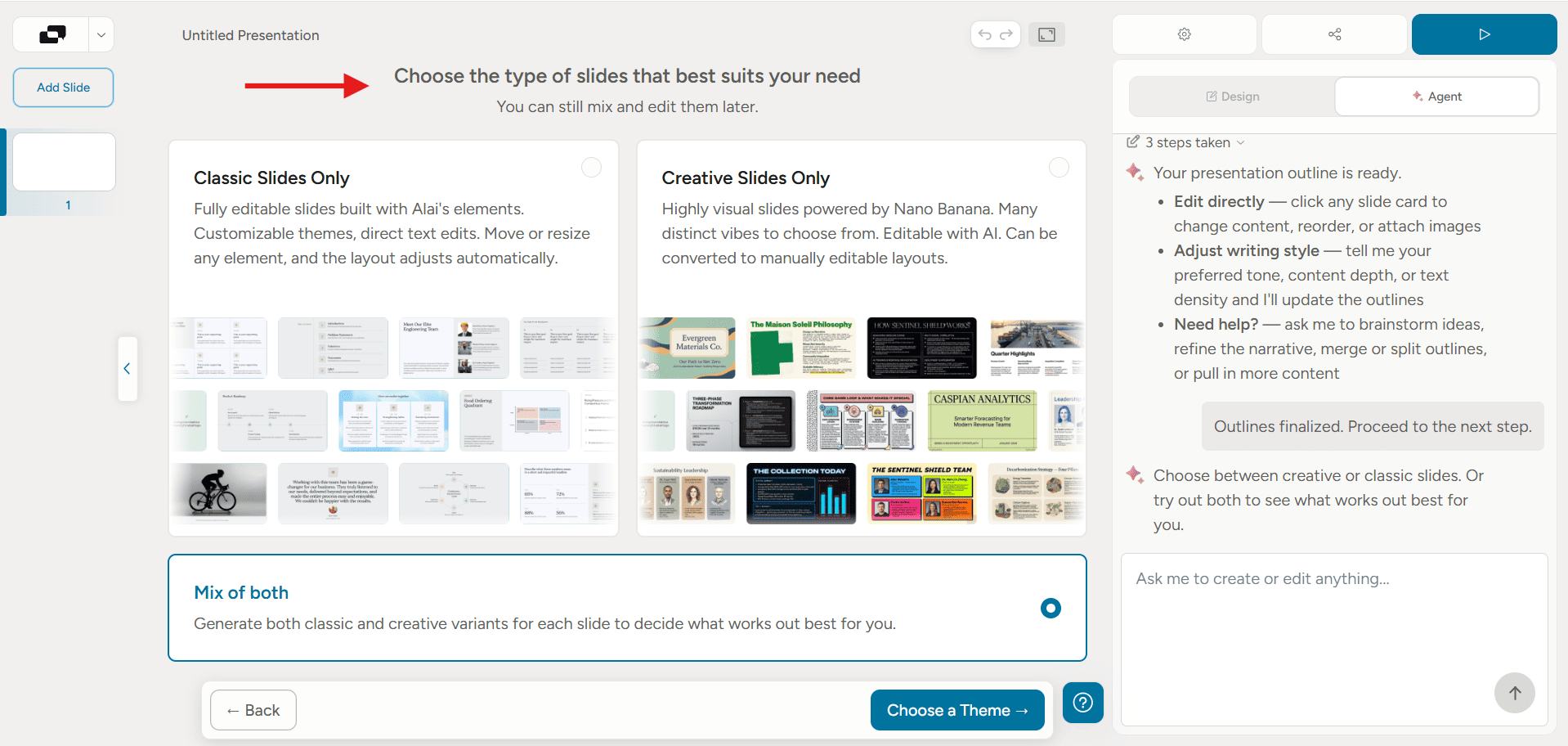
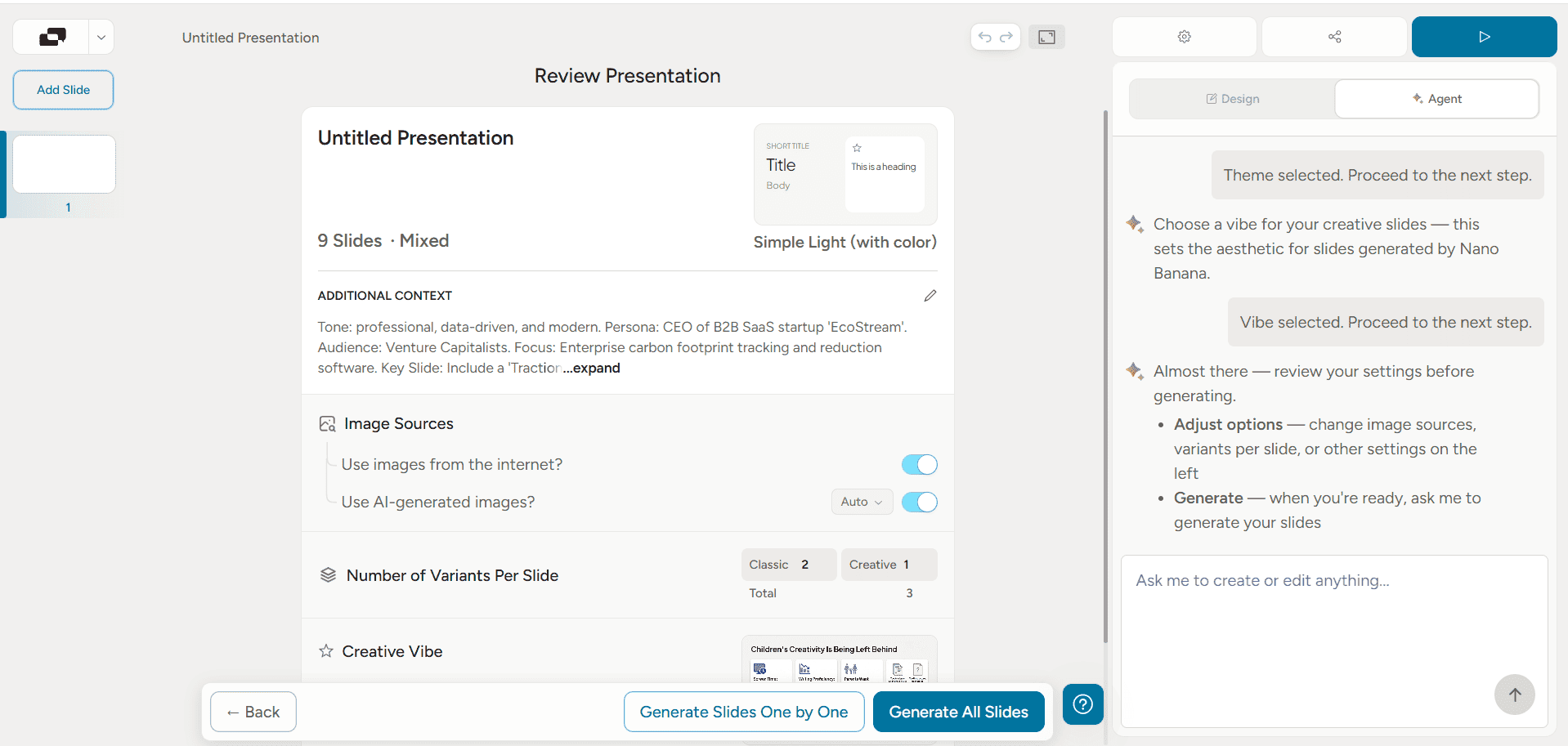
Alai distinguishes itself through a highly guided, step-by-step creation wizard. Rather than spitting out a presentation in one click, it walks you through an interactive setup, giving users the ultimate luxury of choice before the final deck is built.
Key Features
- Classic vs. Creative Modes: Generate "Classic Slides" (standard, editable layouts) or "Creative Slides" (highly visual, generative layouts powered by Nano Banana).
- Slide Variations: The AI generates multiple layout variations per slide, allowing you to manually pick the strongest option for your data.
- Omnipresent AI Agent: A conversational assistant built directly into the editor handles layout shifts and content rewrites via chat.
How It Handled Our Benchmark Prompt
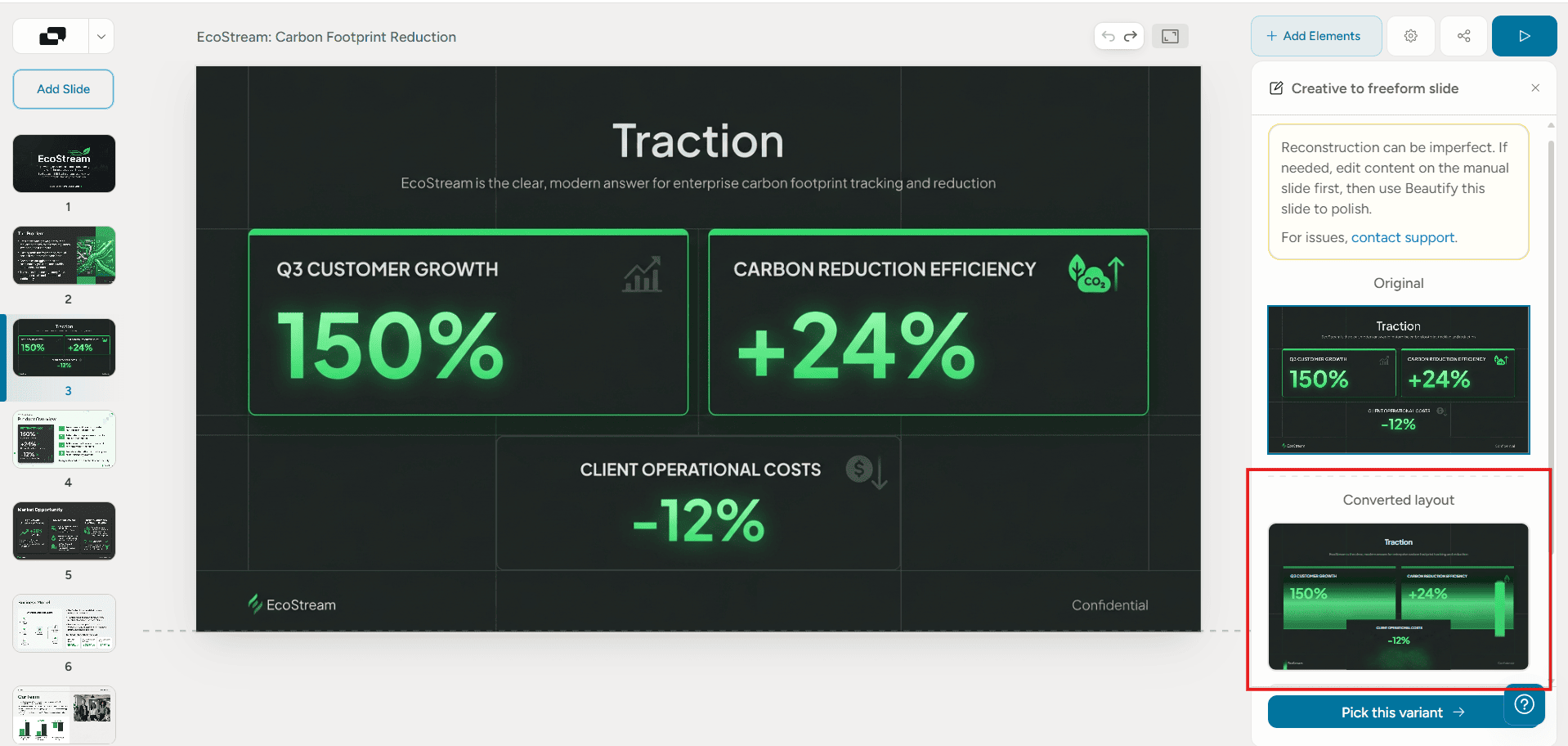
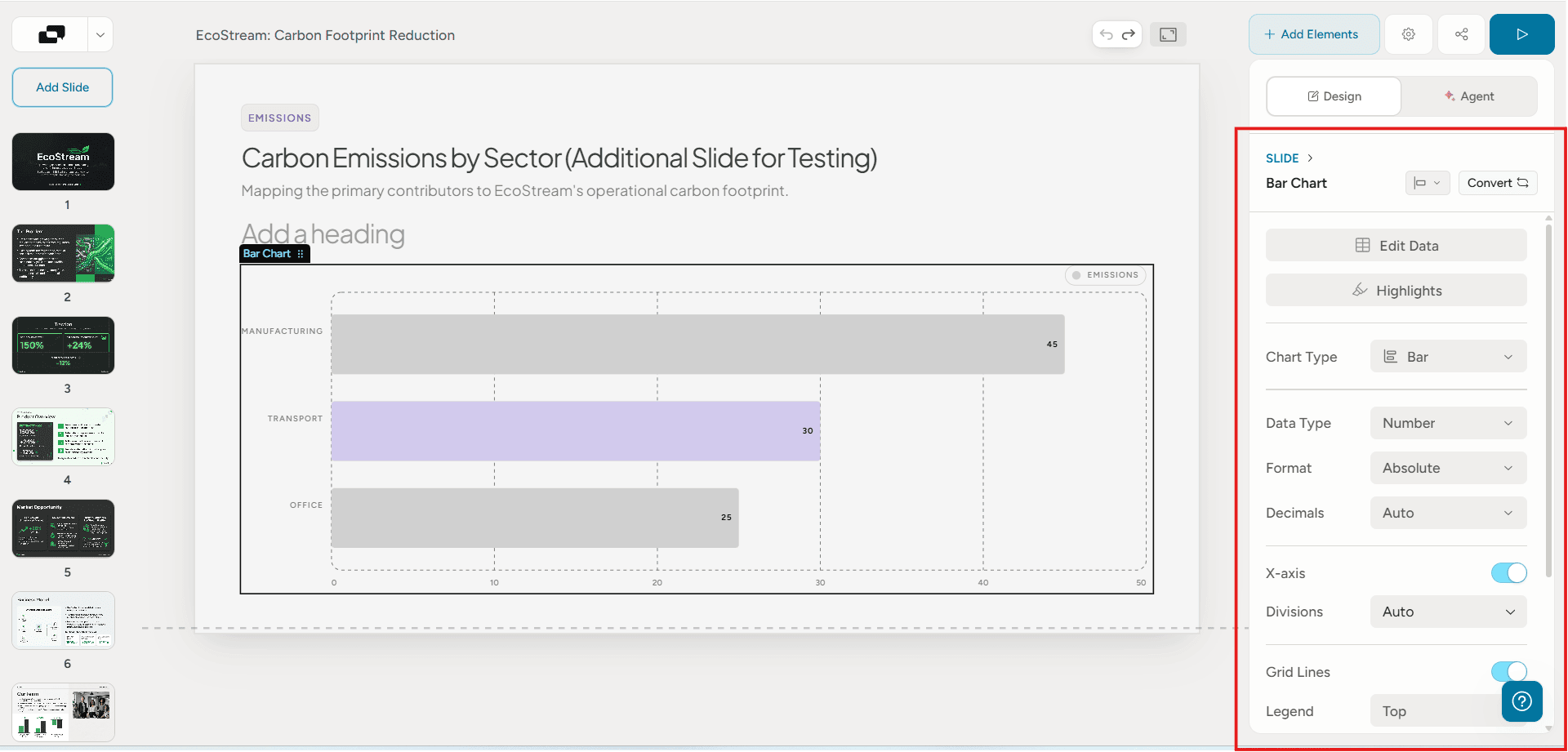
While usability during setup is top-tier, the AI struggled during the editing phase. Although it applied our requested colors, it failed completely at brand consistency, hallucinating five different, conflicting logos across our "Creative" slides.
Pros
- The "Variations" Engine: Marries the speed of an AI presentation maker with the creative control of a manual workflow by offering choices before committing to a design.
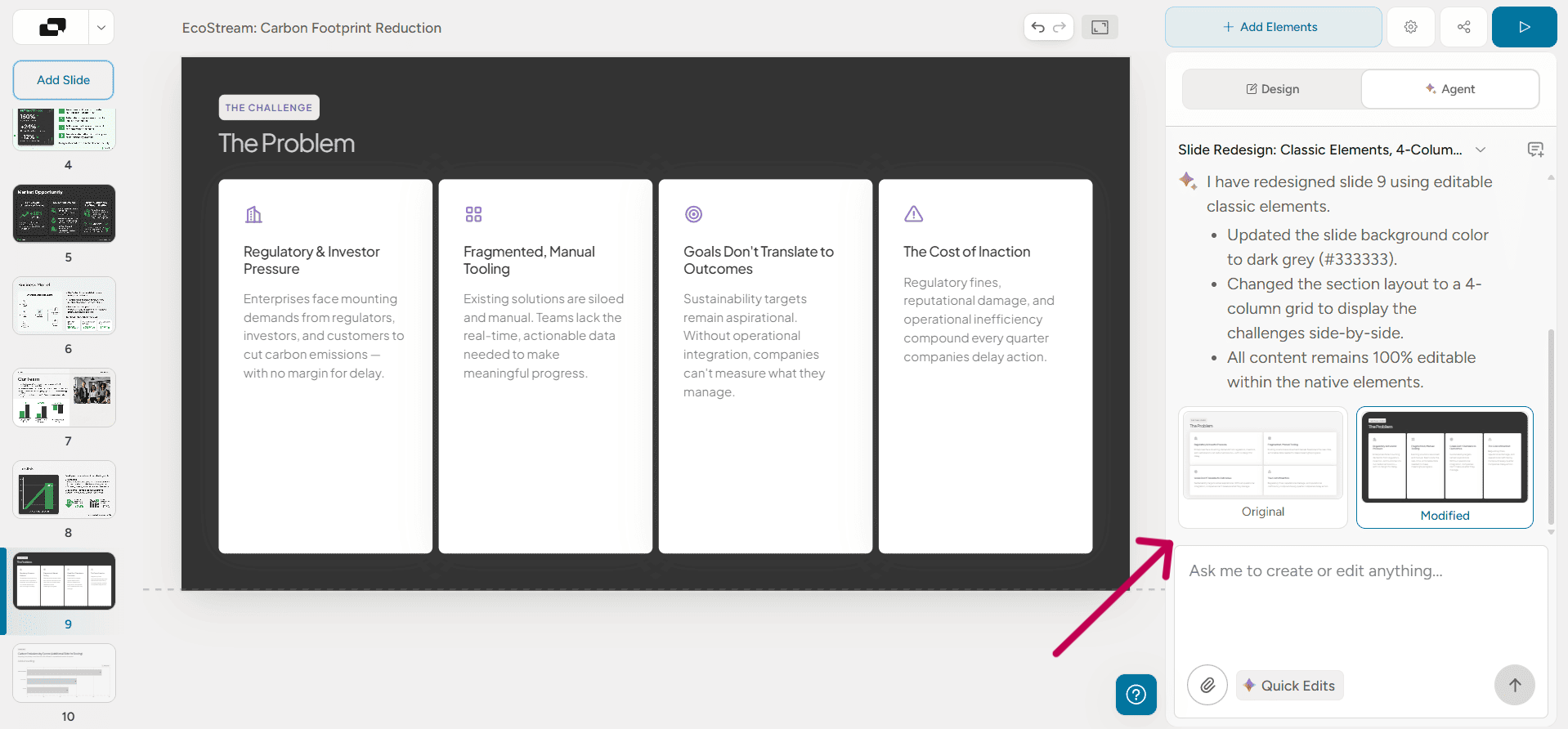
- The Manual AI Fix: If you bypass the automated buttons and prompt the AI Agent directly (e.g., "redesign using editable classic elements"), it can flawlessly rebuild a slide into a custom grid.
- Robust Elements Library: The manual menu is highly comprehensive, allowing you to drop in smart elements, tables, and customizable data charts.
Cons
- The "Beautify" Trade-off: The "Beautify this slide" button instantly upgrades your visuals, but it transforms your work into a "Creative" slide by flattening text into a static picture. You are forced to choose between a highly visual slide that you can't edit properly, or a plain classic slide that is perfectly editable.
- Data Deletion Bugs: You must carefully proofread your deck. Using the beta "layout remix" feature occasionally deleted portions of our data from the slides.
- Chat Chart Failures: Prompting the AI chat to "add a pie chart" frequently results in uneditable static images. (Pro-tip: Prompting "replace this slide with a pie chart" yields better results).
- Restricted Formatting: Granular text formatting is locked. You cannot simply highlight a text box to change its font; you are forced to navigate to the global "Theme" menu.
Not For You: When to Skip Alai
Skip Alai if you are in a massive rush, as the multi-step wizard slows down generation. It is also a poor fit for corporate brands that require strict adherence to visual guidelines. Because Alai lacks a free-form canvas, professional designers cannot freely layer objects or micro-adjust elements to match an exact corporate standard. (Note: Never mix Classic and Creative slides in your final deck, as it creates a jarring, inconsistent presentation).
7. Plus AI: Best for native PowerPoint and Google Slides users
Plus AI takes a completely different approach than standalone web apps. It is a dedicated add-on that lives directly inside your existing Google Workspace or Microsoft Office. As a pure "Injector" tool, it uses AI to generate and format slides without forcing you to learn a new platform or worry about broken export files.
(Testing Transparency: Plus AI provided our design team with an editorial testing account to bypass this billing wall. No compensation was exchanged, and this review remains 100% impartial, based strictly on our agency's professional scoring rubric).
Key Features
- Native Integration: Functions directly inside Google Slides and PowerPoint, theoretically eliminating the need to ever export or convert files.
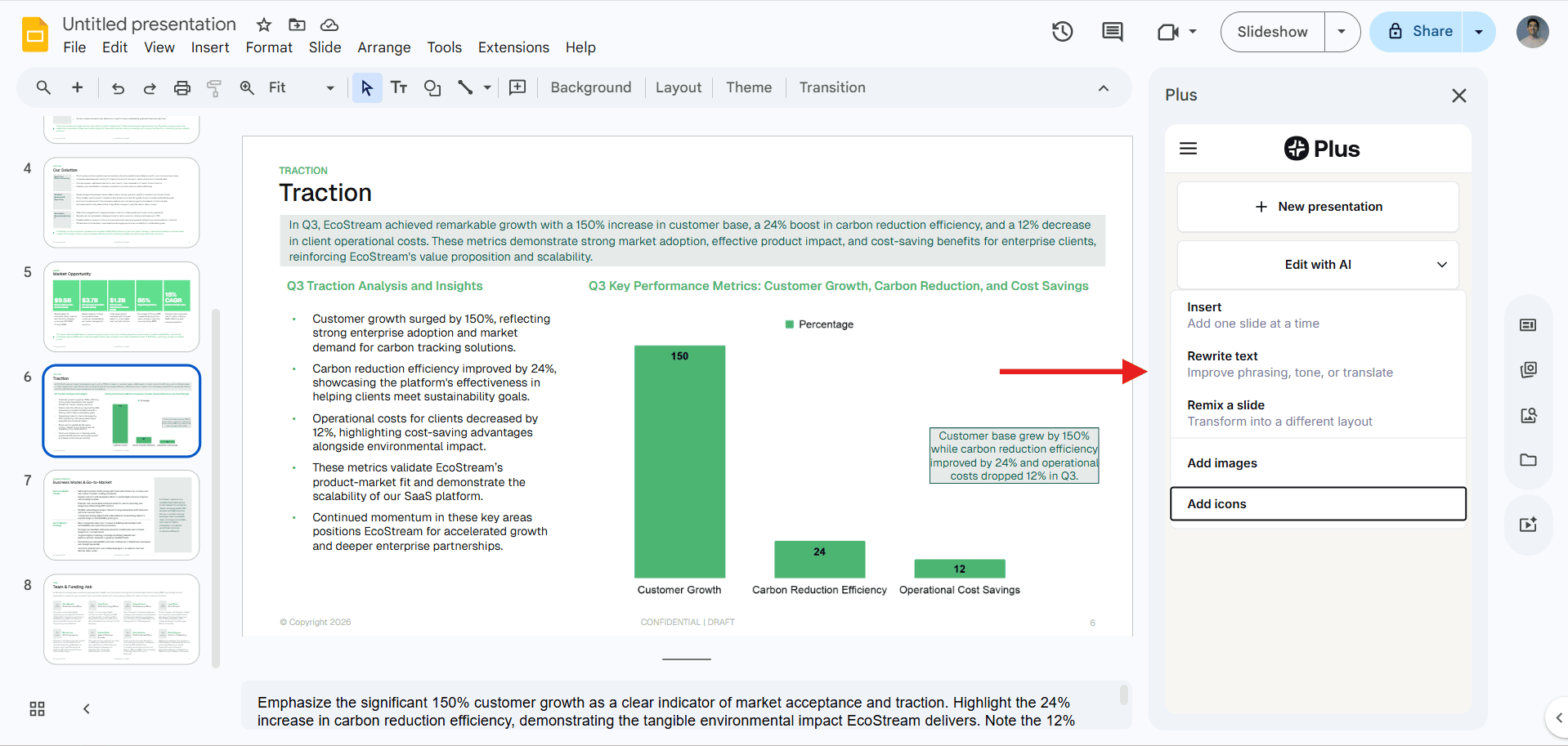
- AI Slide Editing (Remix): Highlight an existing slide and ask the AI to reformat it into a new layout via the sidebar.
- Automated Speaker Notes: The AI automatically generates detailed speaker notes summarizing the content of each slide.
- Corporate Data Tools: Features "Live Snapshots" to automate regular data updates from external apps, and allows enterprise users to train the AI on their custom slide masters.
How It Handled Our Benchmark Prompt
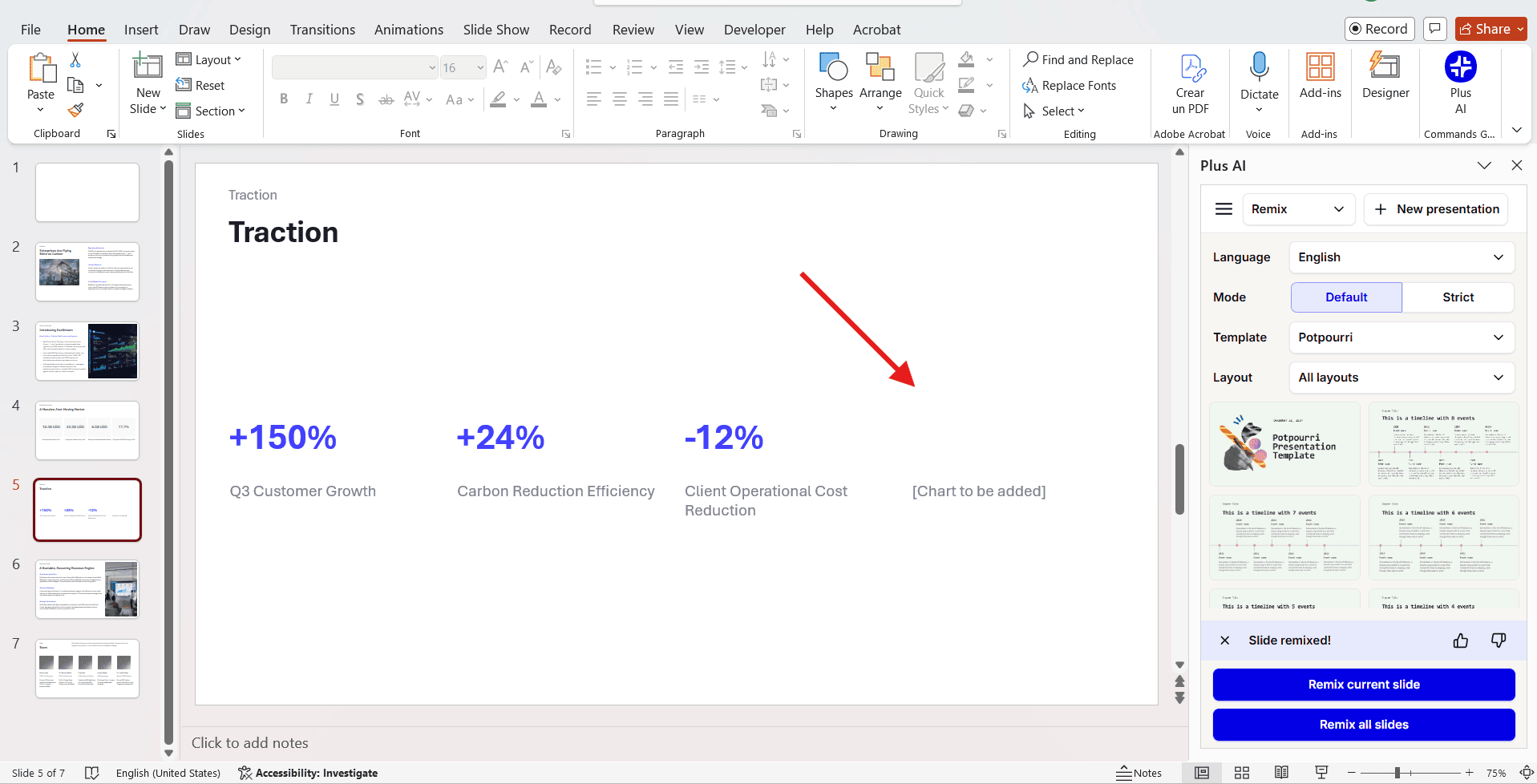
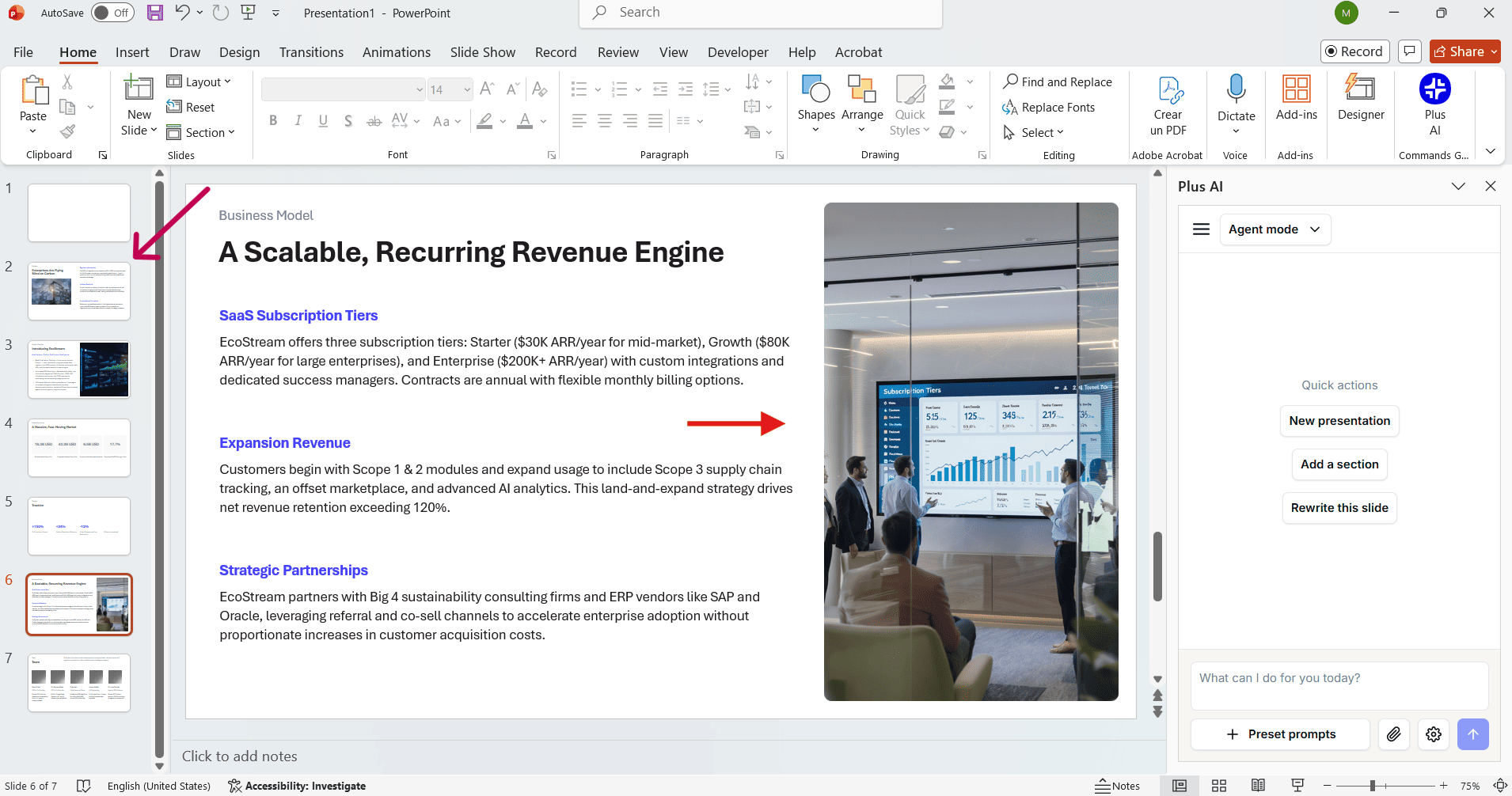
While usability is high because it exists where you already work, accuracy was a major issue. When we fed it our 8-slide EcoStream prompt, the AI completely ignored our length constraint, generating only 6 slides. While it captured the core text data, it failed to execute complex instructions accurately, leaning heavily toward standardized, rigid formatting.
Pros
- 100% Manual Control: Because the output is just a native slide, human designers have immediate manual control to fix formatting using traditional Office tools.
- A Massive Time-Saver for Presenters: The ability to auto-generate comprehensive speaker notes for every slide is a phenomenal touch.
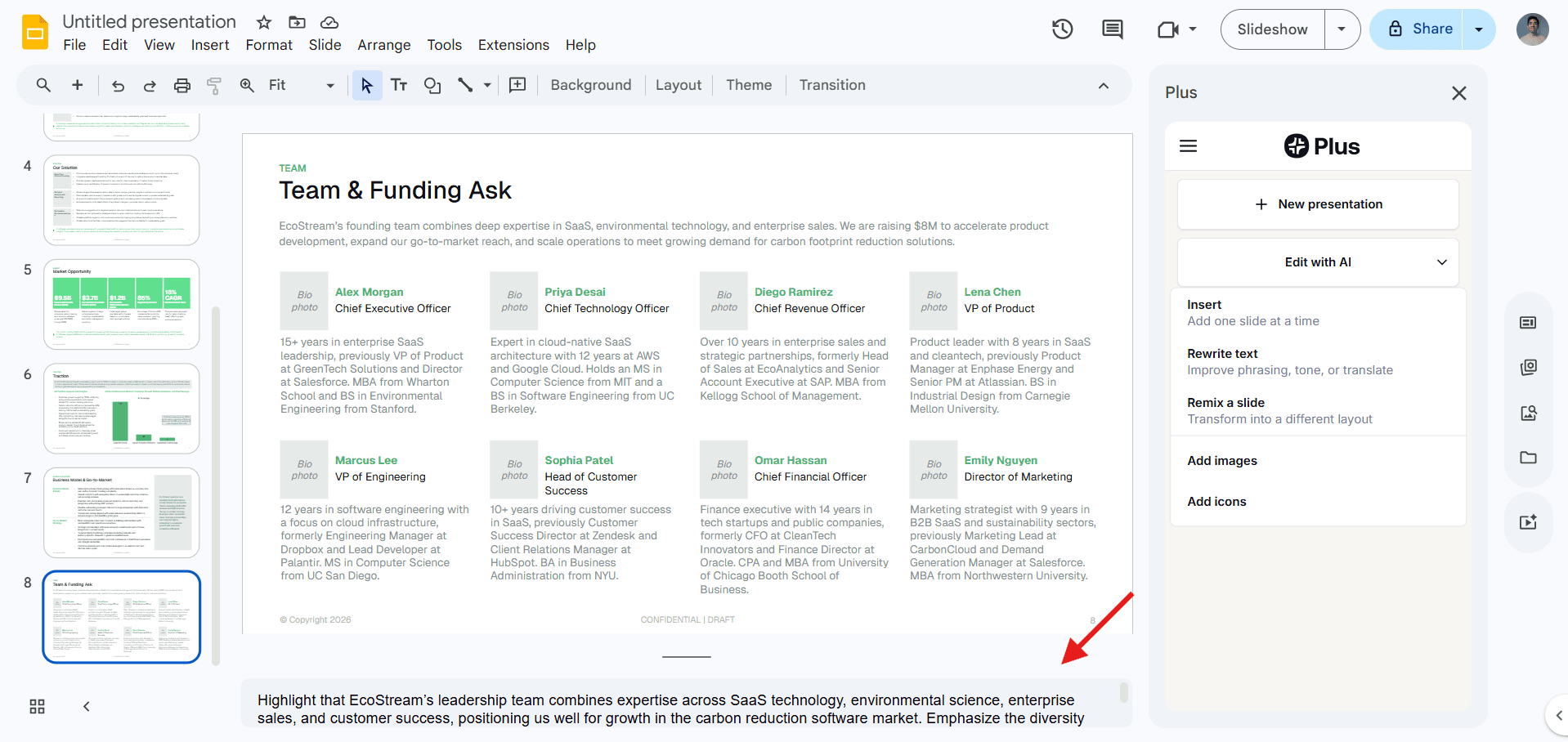
- Google Ecosystem Stability: We noted that the layout engine performs much smoother and faster in Google Slides than it does in PowerPoint.
Cons
- PowerPoint Glitches & Errors: The actual execution in PowerPoint was highly buggy. The AI assistant frequently froze, threw errors, and left awkward empty placeholders (e.g., "[Chart to be added]").
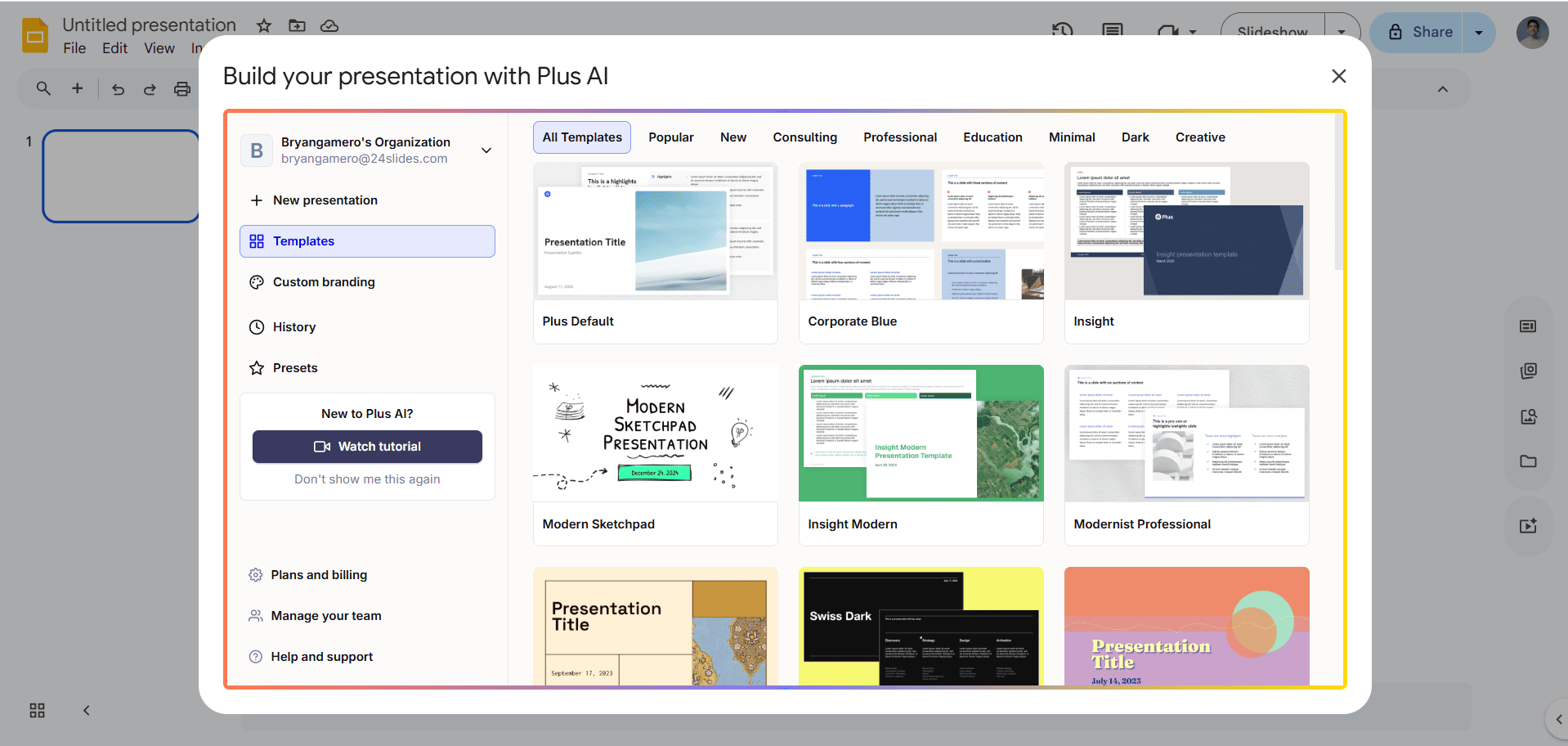
- The Layout Bottleneck: Plus AI acts strictly as an "Injector." You are forced to rely on a small handful of basic, pre-made structural templates. Furthermore, relying on the 'Remix' formatting assistant often resulted in the AI accidentally changing our content rather than just adjusting the layout.
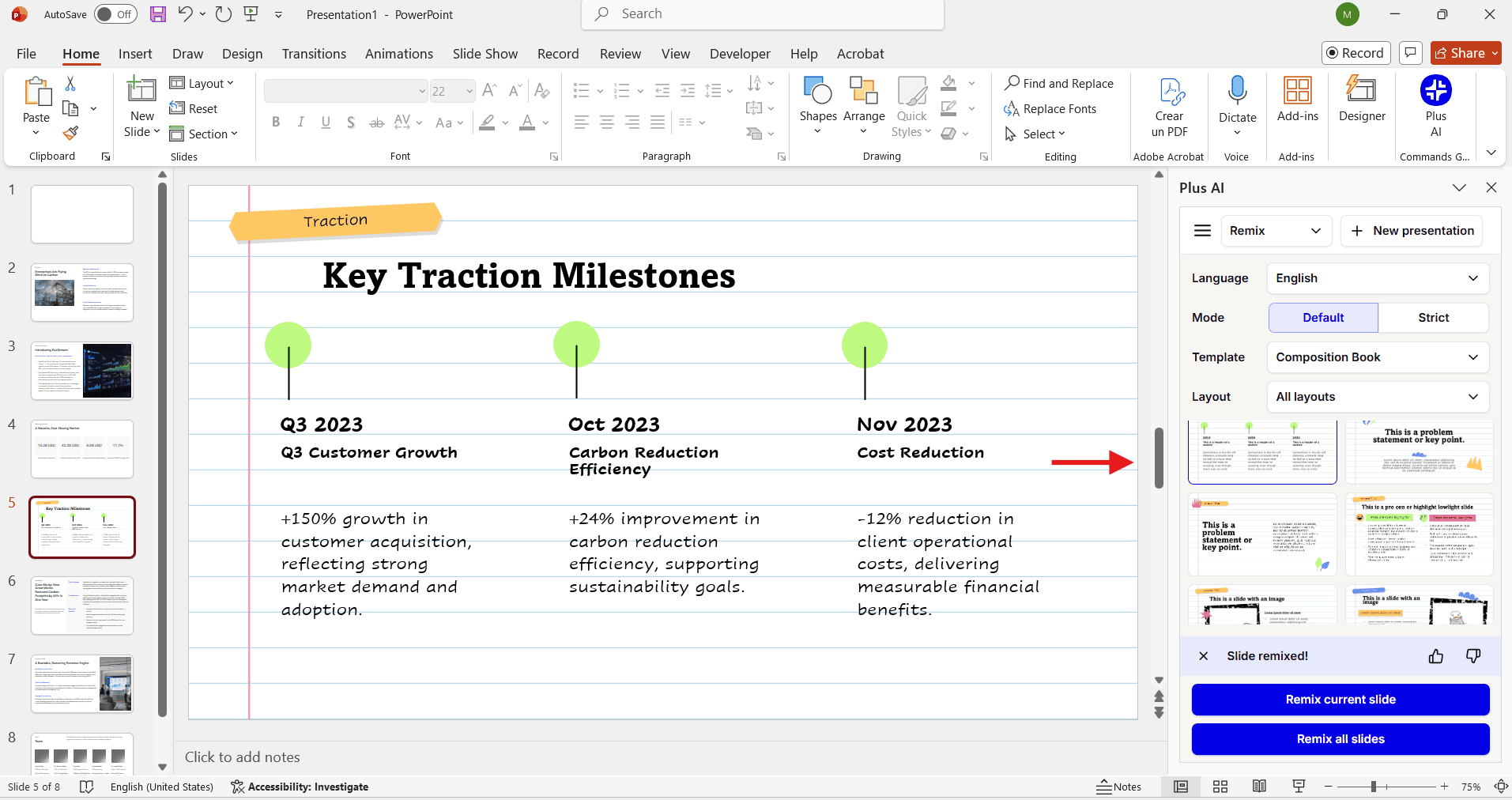
- Bizarre Visual Artifacts: The AI-generated images often suffer from severe hallucinations.
Not For You: When to Skip Plus AI
Skip Plus AI if you are a creative agency or marketer looking for highly unique, boundary-pushing visual layouts. You should also skip this tool if you are just looking to experiment with AI without commitment, as activating the 7-day trial requires entering a credit card upfront.
8. Canva: Best for asset-heavy marketing decks
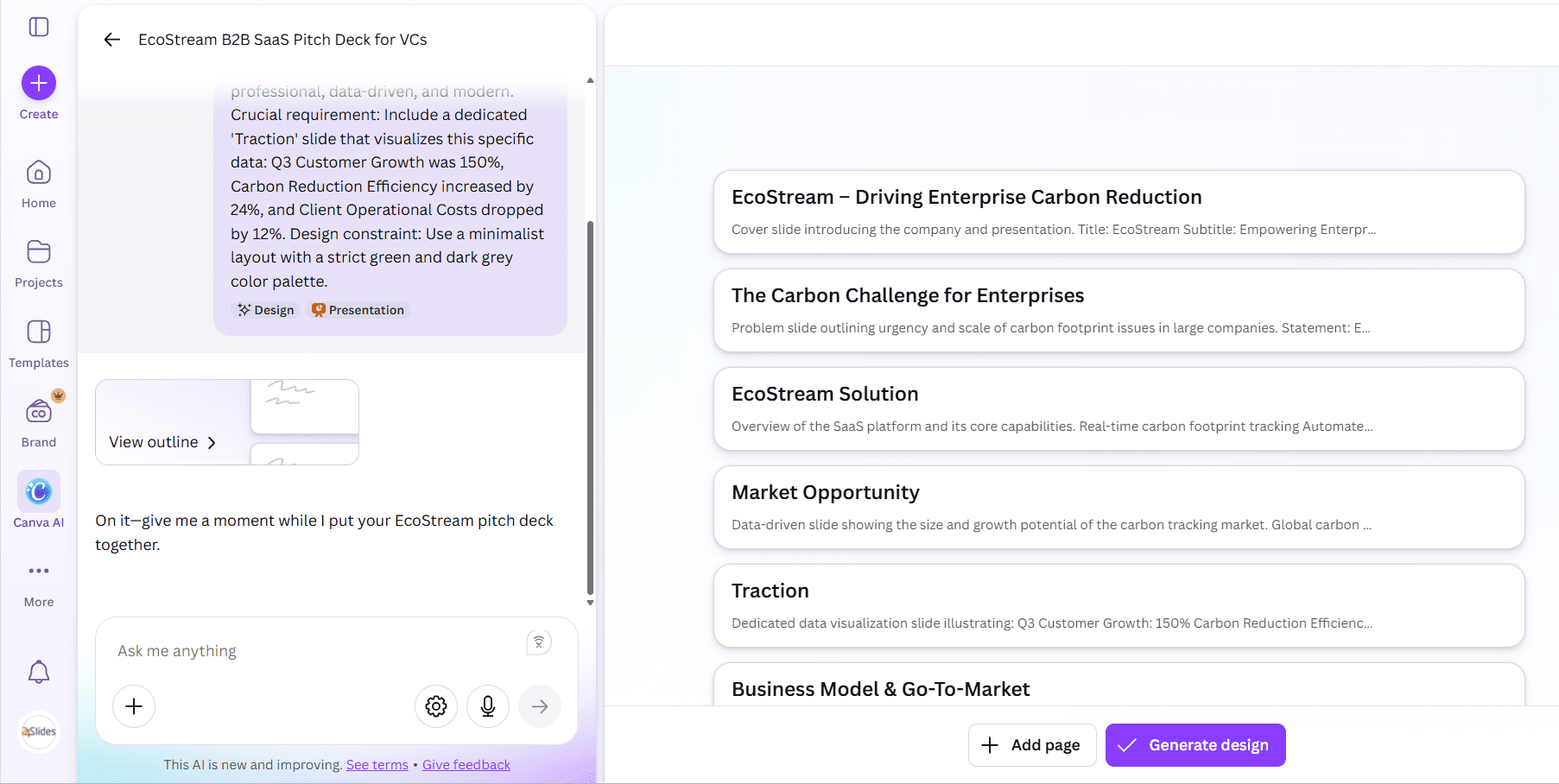
Canva is a titan in the design world, and its "Magic Design" tool brings AI directly into its massive ecosystem. Functioning fundamentally as an "Injector" tool, Canva takes your prompt and intelligently fills existing, highly visual templates rather than building a slide layout from scratch.
Key Features
- AI Connectors & Media: Seamlessly connect external assistants like ChatGPT and Claude directly to Canva, and use "Magic Media" to add custom AI images, graphics, and video.
- AI Voice & Music: Generate AI voiceovers or music tracks directly on the canvas. (Note: AI Music requires a separate subscription from Canva Pro and is restricted to personal use only).
- Magic Write: A powerful built-in AI assistant for rewriting and summarizing text on the canvas.
- The Ecosystem: Access a massive library of integrated third-party apps, Brand Kit controls, and real-time collaboration tools.
How It Handled Our Benchmark Prompt
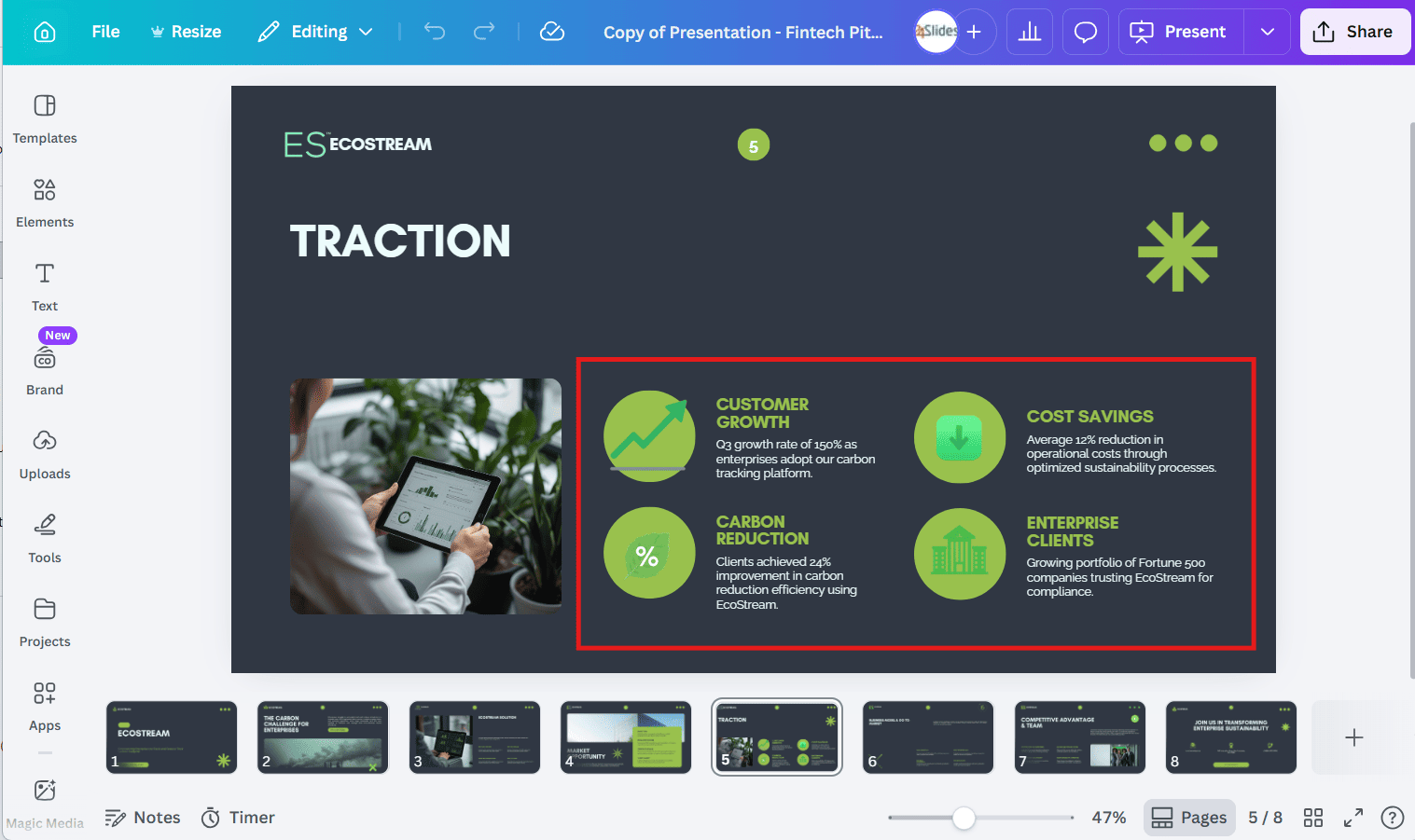
Canva's AI generation is a bit of a slot machine—you must be prepared to hit 'Generate' multiple times. On our first attempt, it failed brand consistency completely and ignored our data hierarchy. Our second attempt yielded a better layout, but it hallucinated four different, conflicting logos across the deck!
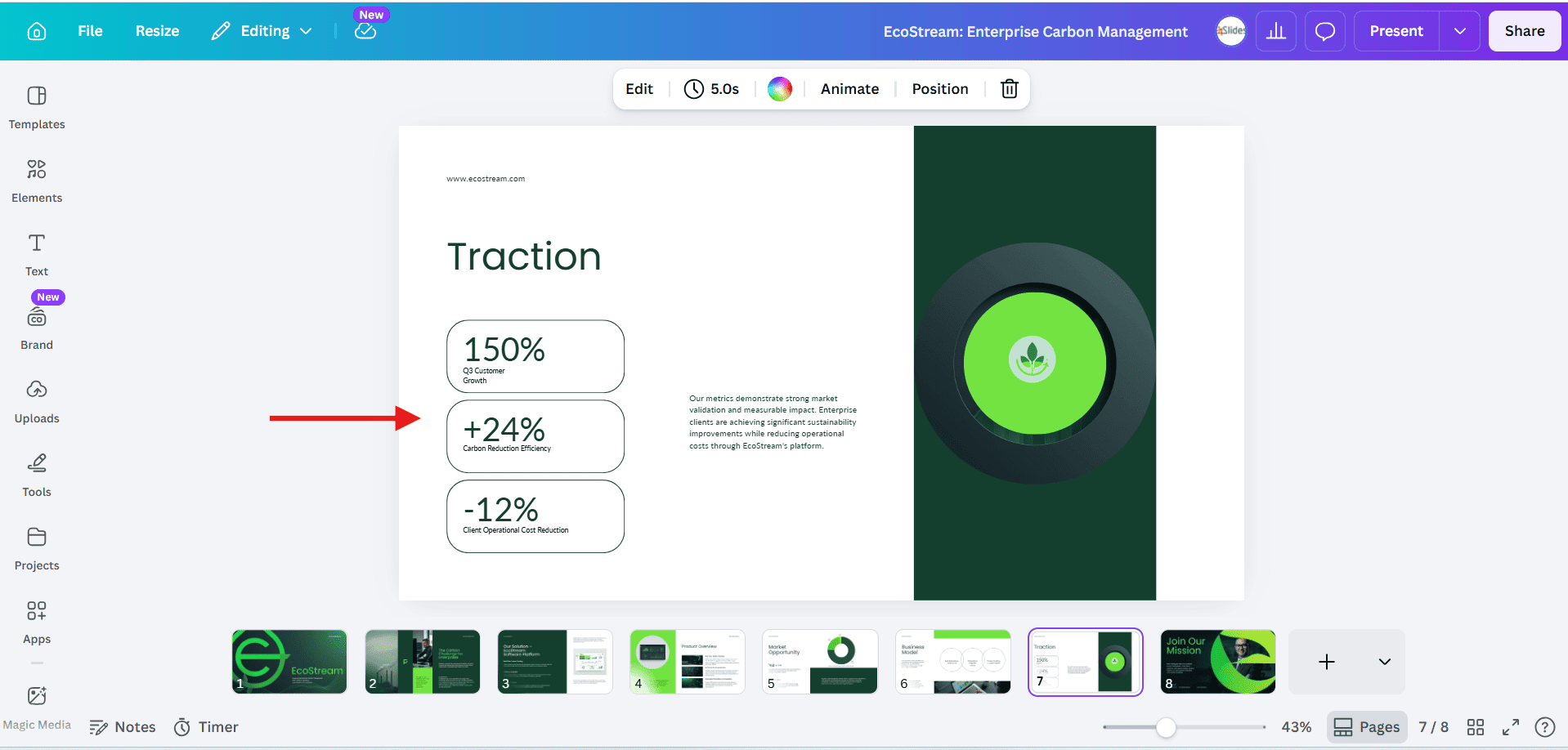
Because Canva acts as an "Injector," it also struggled to visualize our exact 150%, 24%, and 12% metrics, opting instead to bury the numbers in small paragraph text beneath generic icons.
Pros
- The Free-Form Canvas: Unlike rigid web-builders, Canva gives you pixel-perfect freedom. If the AI injects text poorly, you can freely drag, drop, and layer objects anywhere to fix it manually.
- Unrivaled Asset Library: It remains the undisputed king for sourcing high-quality visual elements to manually finish your AI drafts.
Cons
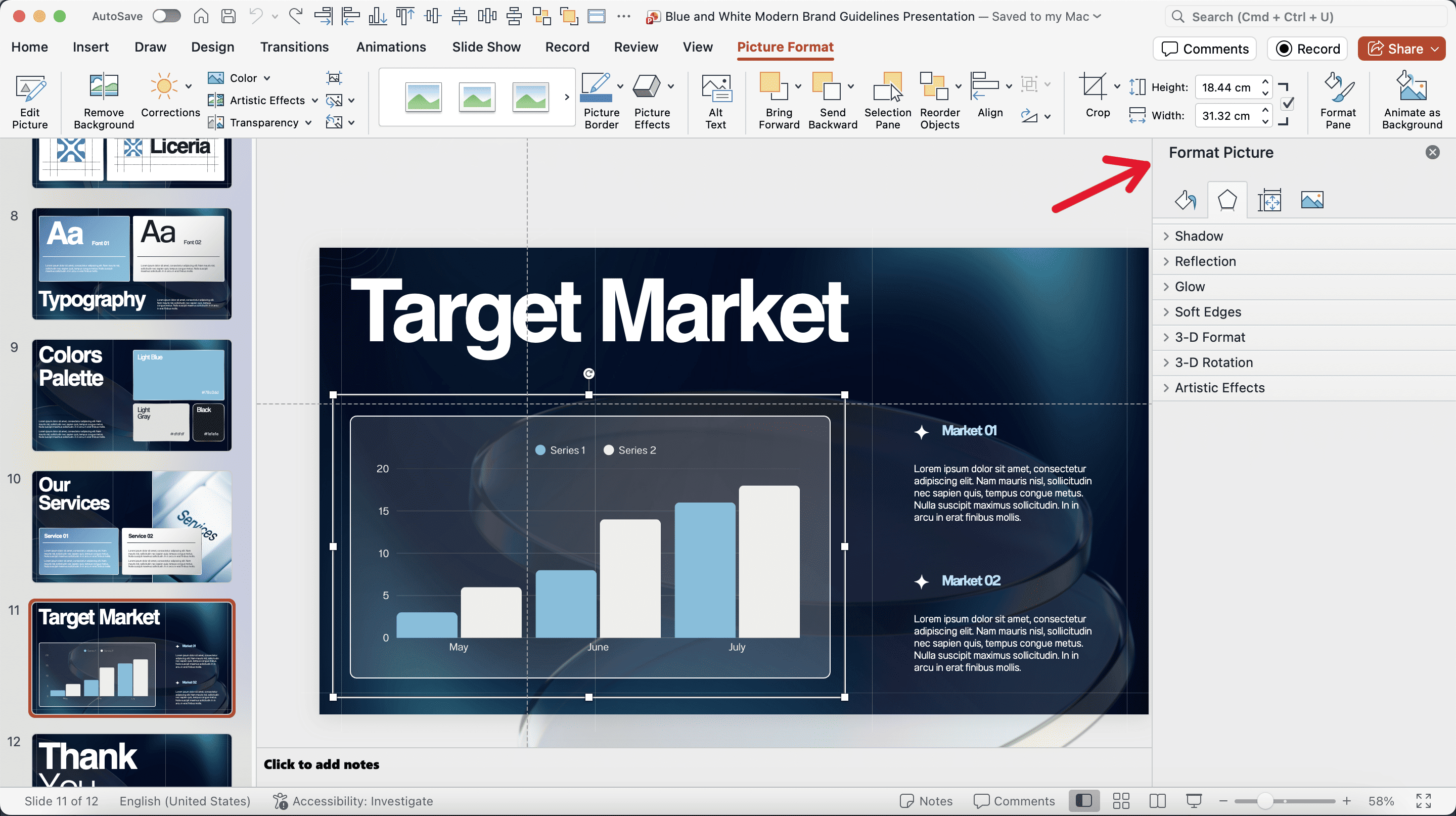
- Flattened PPTX Exports: This is the ultimate dealbreaker for corporate reporting. When exported to PowerPoint, graphic elements and data charts are flattened into completely static images, making them impossible for clients to update natively.
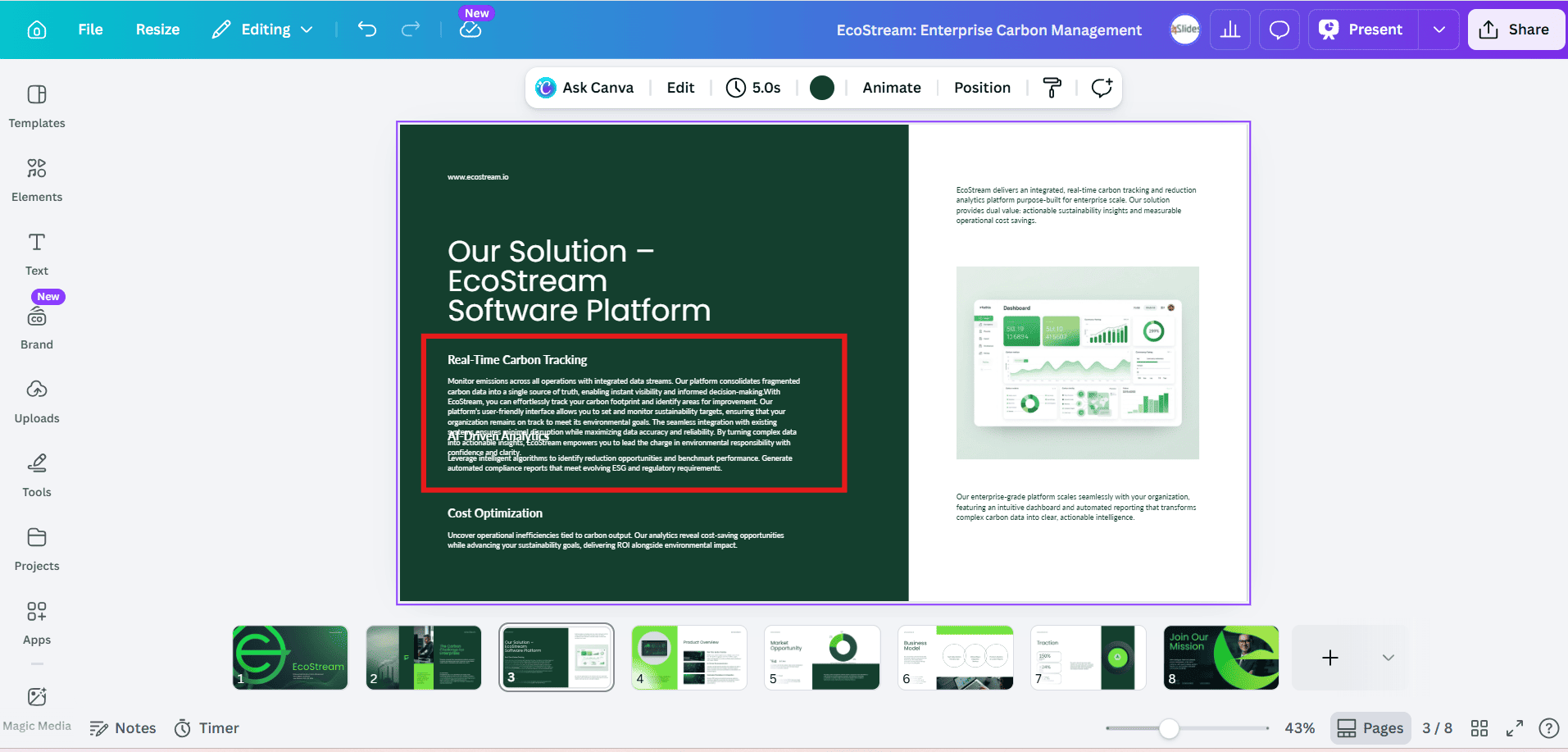
- AI Text Expansion Bugs: When you use AI to inject more text into an existing slide, it frequently dumps the new text directly over the old text without expanding the container, creating an illegible mess.
- Injector Layout Flaws: Because it struggles with spatial awareness, our drafts routinely suffered from alignment errors, awkwardly small text, and empty container boxes.
Not For You: When to Skip Canva
Skip Canva if you are a financial analyst, an enterprise user presenting complex data, or a professional who requires a flawless, 100% editable PowerPoint file handoff. If your clients expect to click and edit data charts natively in PowerPoint after you deliver the deck, Canva's static exports will be a massive liability.
For more example outputs and a full breakdown of the software, read our complete Canva Review.
9. Presentations.ai: Best for fast drafting with locked templates
Presentations.ai markets itself heavily on speed and simplicity. It operates as a strict template-injector, utilizing what it calls "Anti-fragile" design. The platform is designed to prevent users from breaking the layout, sacrificing creative freedom for rapid, foolproof generation.
Key Features
- "Anti-Fragile" Grouping: A rigid design system where elements are strictly grouped together. This acts as a safety net for non-designers, ensuring slide alignment can never be accidentally ruined.
- Multi-Source Generation: Type a prompt, paste a text outline, upload a file, or paste a live URL to generate a deck.
- The "Remix" Engine: Instantly apply new formats, layouts, and colors based on your current content if you dislike a generated slide.
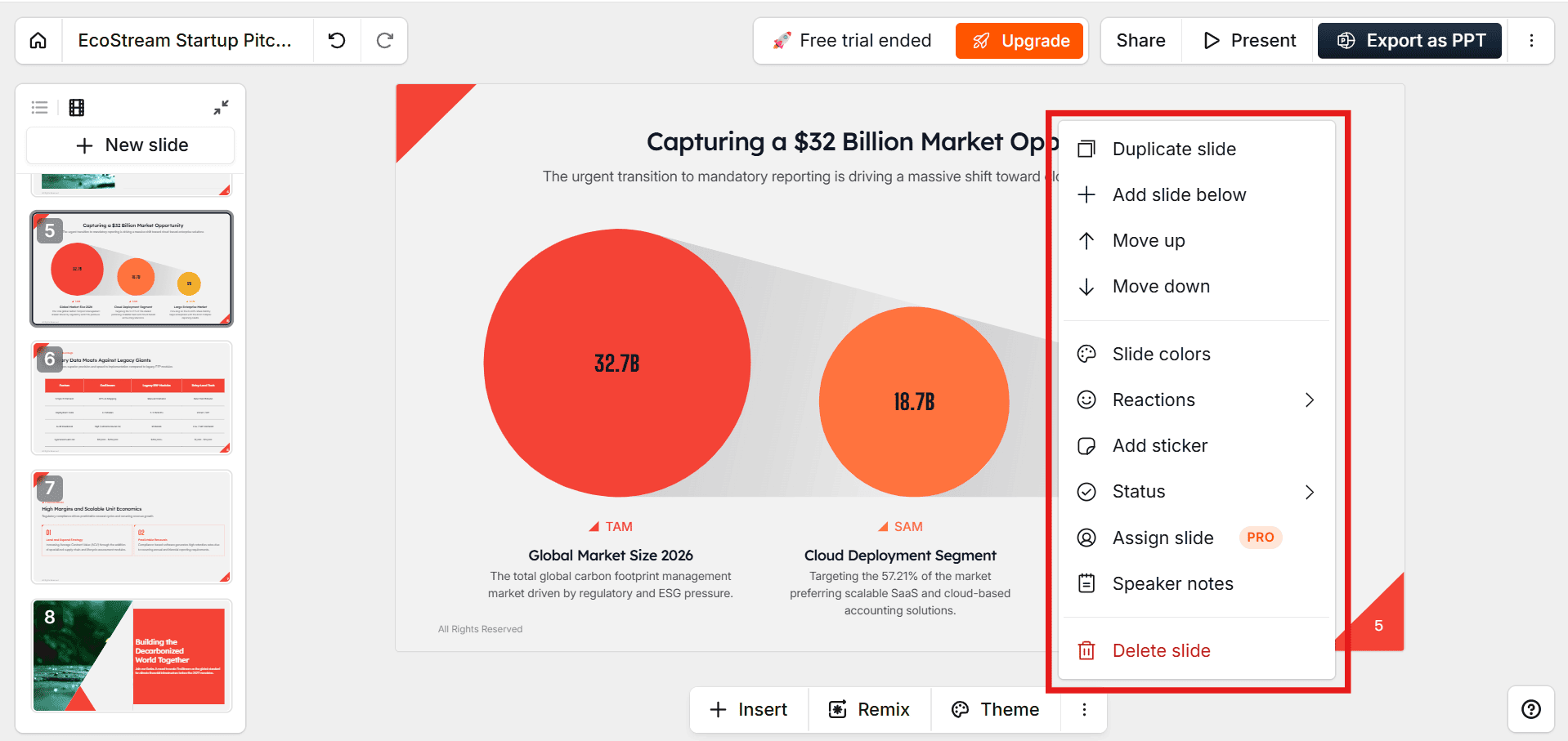
- Unique Workflow Tools: Add internal reactions, visual stickers, and status updates (To Do, Done) directly to individual slides. (Note: During our test, the status tags were buggy and failed to update properly).
How It Handled Our Benchmark Prompt
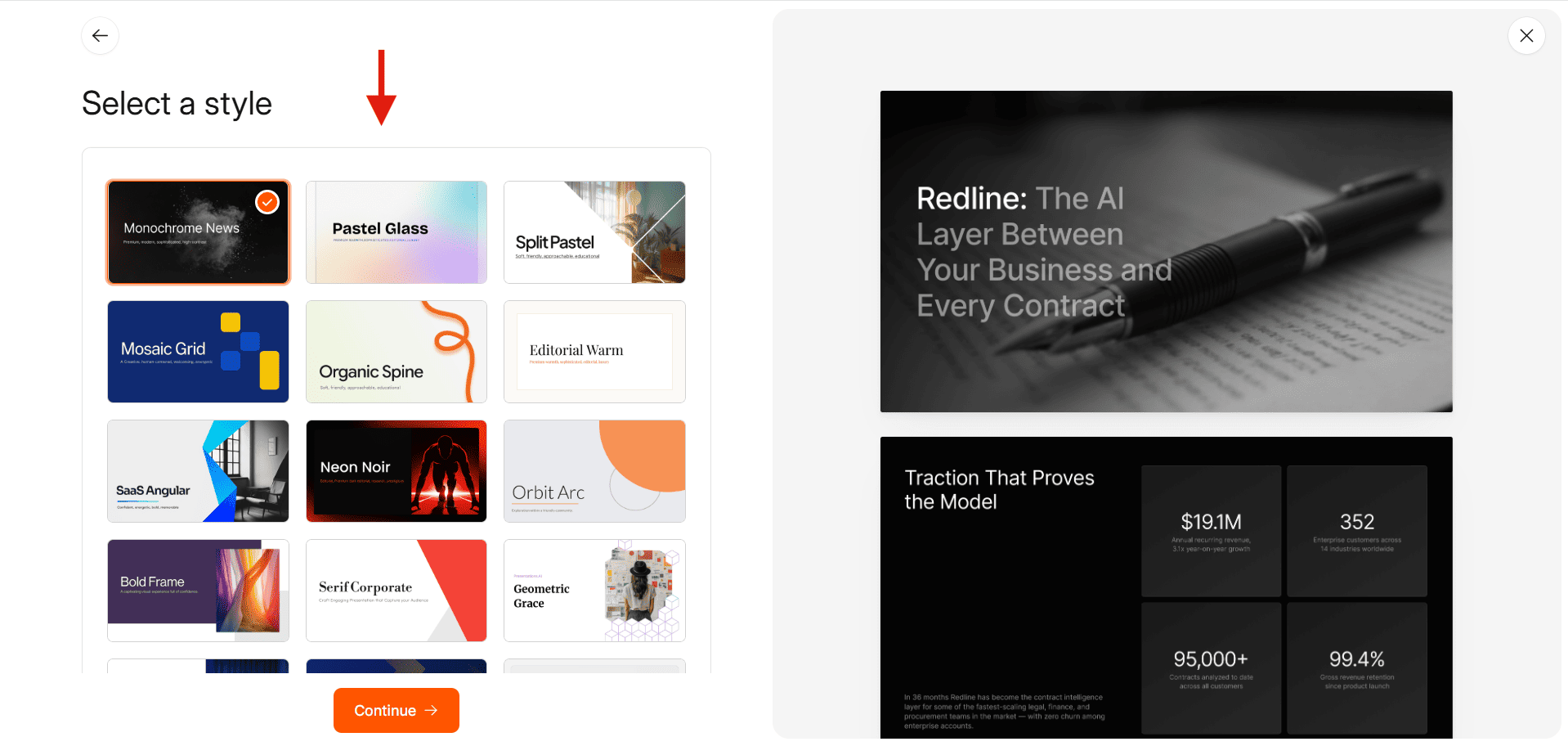
Usability during setup is highly interactive. The AI asked smart clarifying questions and successfully parsed our 150%, 24%, and 12% constraints into clean, readable blocks. However, it completely ignored our "green and dark grey" command because the engine relies entirely on you manually selecting one of their limited templates.
The raw output and the "Anti-fragile" editor. The AI successfully extracted our data points into clean, highly readable blocks. However, the elements are grouped, so you can’t move them individually. Click here to view the 100% raw, unedited AI output
Pros
- Foolproof Alignments: It is incredibly fast for beginners, ensuring your formatting always looks structured and cohesive.
- Dynamic List Expansion: Instead of manually drawing a new text box, you simply click the "Add Point" button to have the AI automatically generate and format new list items perfectly into the grid.
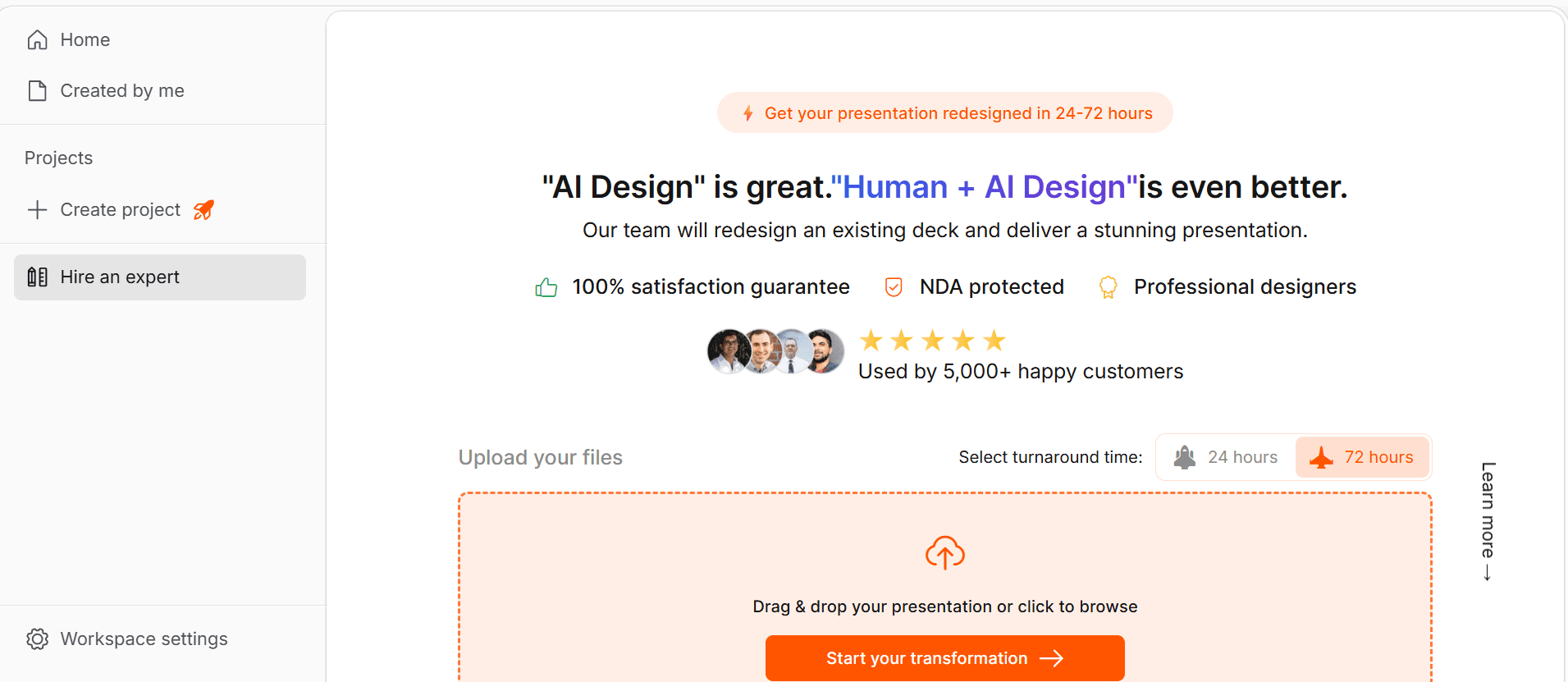
- Self-Aware Limits: Interestingly, the platform itself acknowledges the limits of purely automated design. Inside the dashboard, it explicitly offers a "Hire an expert" human redesign service.
Cons
- Zero Free Exports: Exporting your file in any format is completely blocked on the free tier.
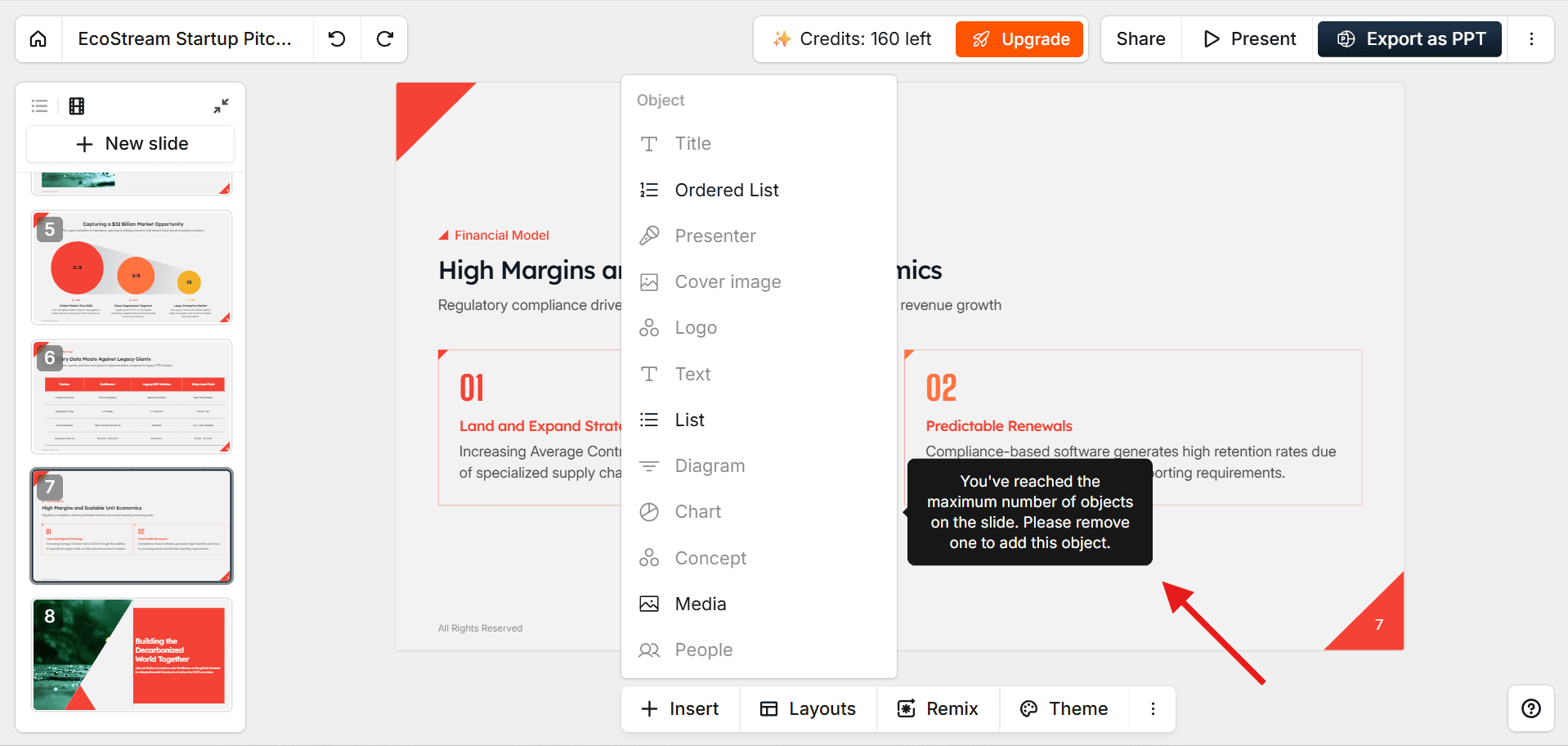
- Strict Capacity Limits: The system actively blocks you from adding content if it determines the slide template is "full," protecting the layout at the expense of your creative freedom.
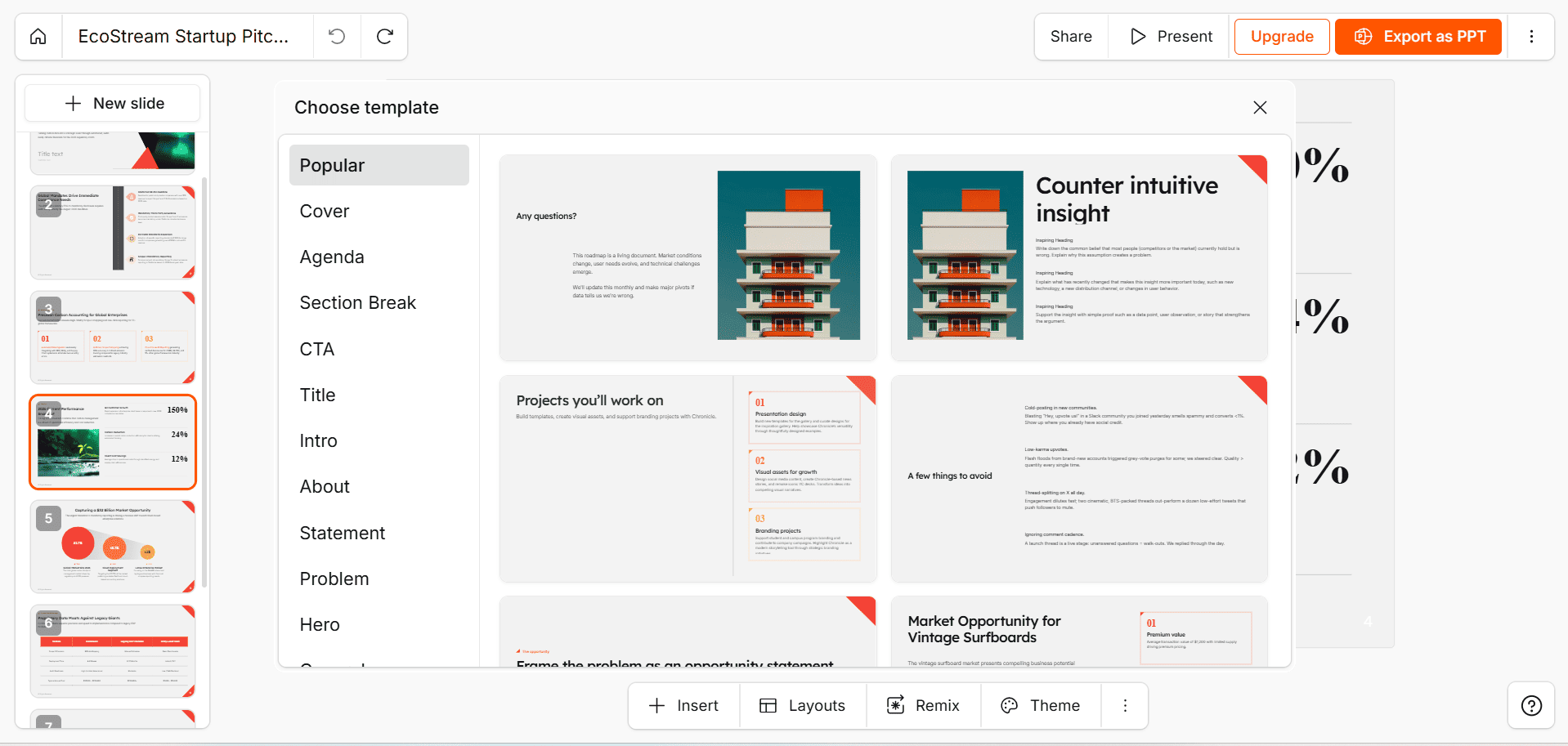
- The Layout Bottleneck: You cannot manually draw a custom text box or chart. Expanding your presentation requires you to insert pre-made, rigid template blocks from their library.
Not For You: When to Skip Presentations.ai
Skip this tool if you are a professional designer, agency, or corporate user with specific branding demands. The inability to move objects freely or input exact custom color codes (without paying for upgrades) is a massive dealbreaker. It is also a terrible choice for users looking to download a free PowerPoint file, as exports are locked.
For more example outputs and a full breakdown of the software, read our complete Presentations.ai Review.
10. Pitch: Best for real-time team collaboration
Pitch is a modern, web-based platform that has become the industry standard for polished presentations and team collaboration. We included it for a very specific reason: while its AI generator is basic, its multiplayer workflow is unmatched. It works like an AI-enhanced, highly aesthetic version of Google Slides.
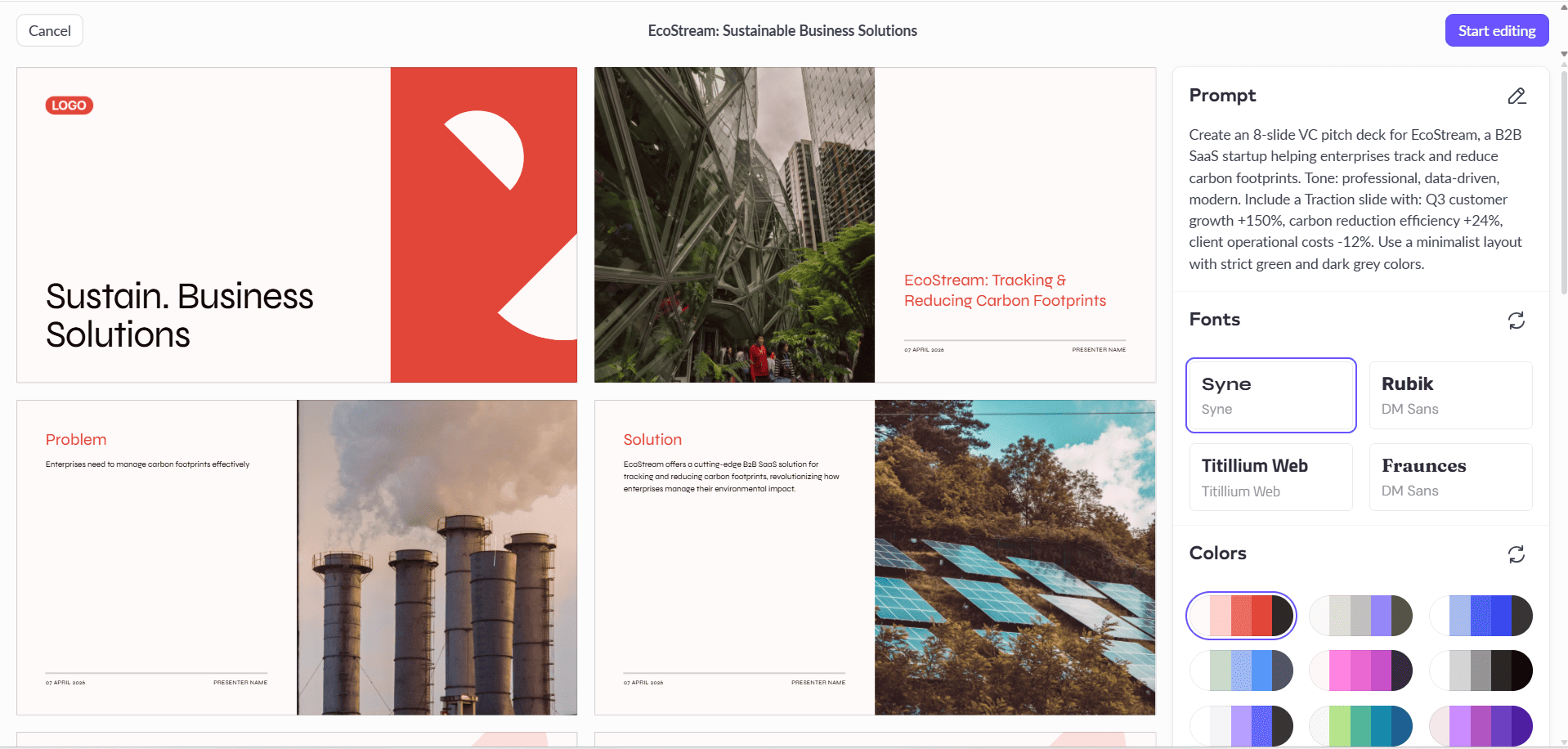
The AI doesn't automatically generate colors based on your text; you must manually select a color palette before generating, meaning our "strict green" text command was essentially useless for design.
Key Features
- Live Collaboration: Supports real-time multiplayer editing, live video cursors, and project management status updates directly on the slides.
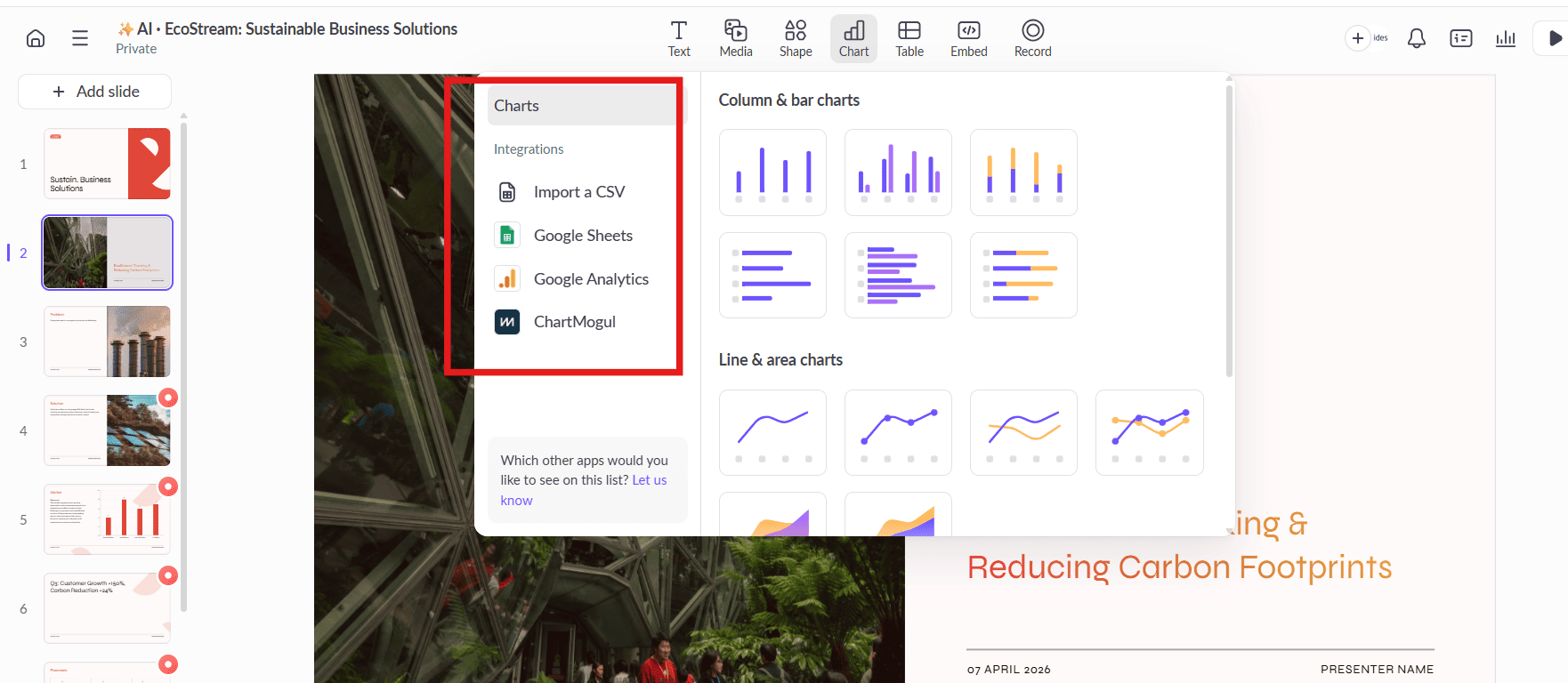
- Deep Integrations (Free): Connects seamlessly with Google Analytics, Google Sheets, Giphy, Slack, and Vimeo even on the free tier.
- Command Line Editing: Use quick keyboard commands to rapidly edit and format the presentation on the fly.
How It Handled Our Benchmark Prompt
During our stress test, we hit a hard wall: Pitch restricts AI prompts to just 450 characters. Because of this, we had to compress our EcoStream instructions. Despite explicitly asking for a "strict green and dark grey" palette, the AI generated a red-and-white template. Furthermore, instead of building a data chart for our metrics, it just dumped the numbers into a plain text title.
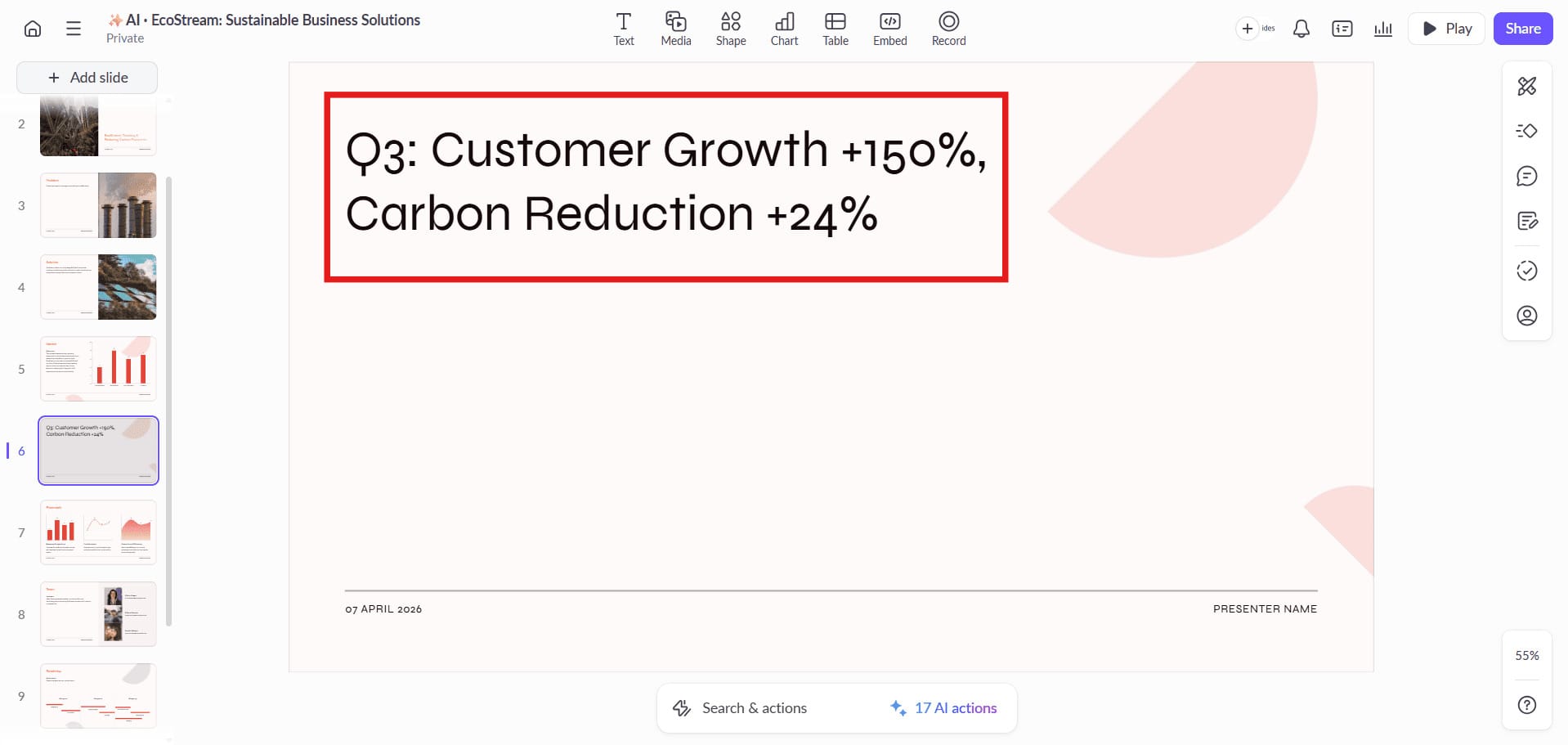
Pros
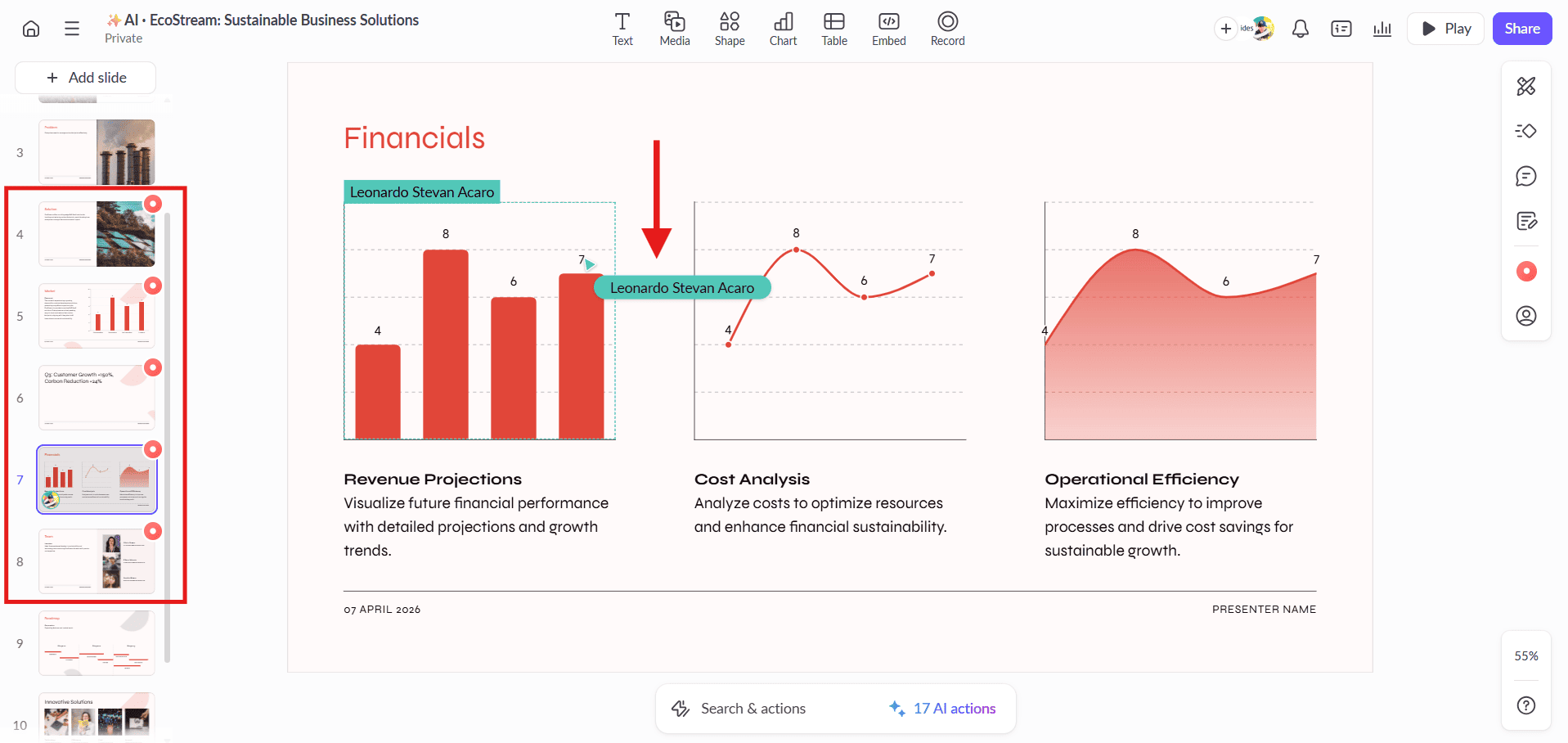
- Unmatched Multiplayer Workflow: You can see live cursors from colleagues as they edit charts in real-time.
- World-Class Manual Integrations: While the AI failed to generate a chart, you can manually connect live Google Sheets or Google Analytics data directly into the slide to build flawless charts.
- Free-Form Canvas: You can freely drag, drop, and layer objects anywhere, giving human designers total control to fix the initial AI limitations effortlessly.
Cons
- Severe Prompt Limits: The 450-character limit prevents you from feeding the AI complex corporate instructions or massive data sets.
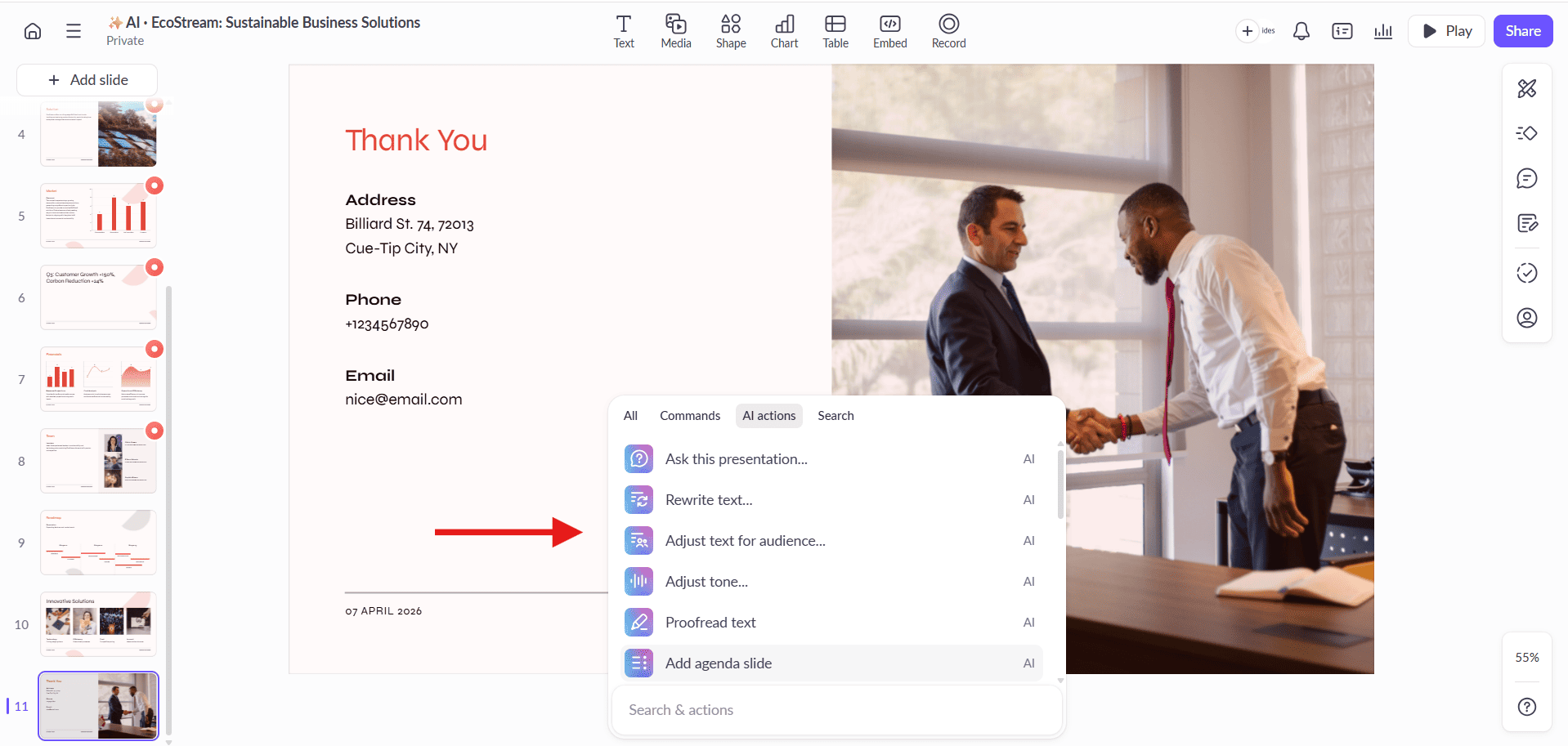
- AI Editing Limitations: Unlike other tools that offer conversational AI chatbots, Pitch relies on a simple drop-down menu of pre-established commands (like "Rewrite"), limiting your ability to give complex editing instructions.
- Paywalled Exports: PPTX and PDF exports, as well as video uploads, are strictly locked behind paid tiers.
Not For You: When to Skip Pitch
Skip Pitch if you are a professional with highly specific data requirements who expects the AI to do 100% of the heavy lifting. The AI acts as a basic structural wireframe generator; you must be prepared to manually overwrite the text and build your own data visualizations. It is also not for users looking to export final .pptx or PDF files to clients for free.
For more example outputs and a full breakdown of the software, read our complete Pitch Review.
Can AI Tools Generate Charts and Data Visualizations From Raw Data?
While almost every AI presentation maker claims to handle data visualization, our agency testing revealed a massive "web illusion."
Many platforms (like Gamma, Canva, or Alai's Creative Mode) generate visually stunning, interactive charts inside their own browser apps. However, the true test for corporate workflows happens the moment you click "Export to PowerPoint."
In the enterprise world, an executive needs the ability to right-click a chart natively in .pptx, select "Edit Data in Excel," and modify the figures if business strategies change. Unfortunately, exporting fluid web-based charts frequently flattens them into uneditable, static PNG images or dead vectors.
To show what happens when you feed raw data into each platform, we judged the tools below against one strict agency standard: "Manual Fix Required." (Meaning: Will a human designer have to rebuild this chart from scratch after exporting it to PowerPoint?)
Data Visualization Test: AI Chart-from-Data Capabilities & PPTX Export Compatibility
Key Agency Takeaway
If your presentation relies on real-time data, avoid tools that rely solely on generative image flattening. For boardroom-ready decks, choose native add-ins (like Plus AI and Claude’s PPT Add-in) or document-parsers (like SlideSpeak) that retain the underlying Excel and PowerPoint data structures upon export.
Alternatively, if you use a web-based tool like Gamma or Pitch, you must budget time for a professional designer to manually rebuild your charts natively in PowerPoint before delivering the final file to your stakeholders.
The 24Slides Evaluation Scorecard
To ensure absolute fairness, we graded every tool across three core technical categories based on our "EcoStream" benchmark test.
As detailed in our methodology above, we evaluated Prompting (understanding corporate context), Content (how easily humans can fix the output), and Layout (grid alignment, white space, and brand consistency).
Note: Our layout evaluation is built directly upon the strict standards established in our previous deep-dive research: Beyond the Prompt: A 2026 Test of 5 AI PowerPoint Alternatives on Professional Standards.
10 Best AI Presentation Tools Ranked & Scored
The Hybrid Future: "Powered by AI, Perfected by People"
Because the vast majority of these tools rely heavily on injecting text into pre-existing templates, a massive problem has emerged in the corporate world: The "Sea of Sameness."
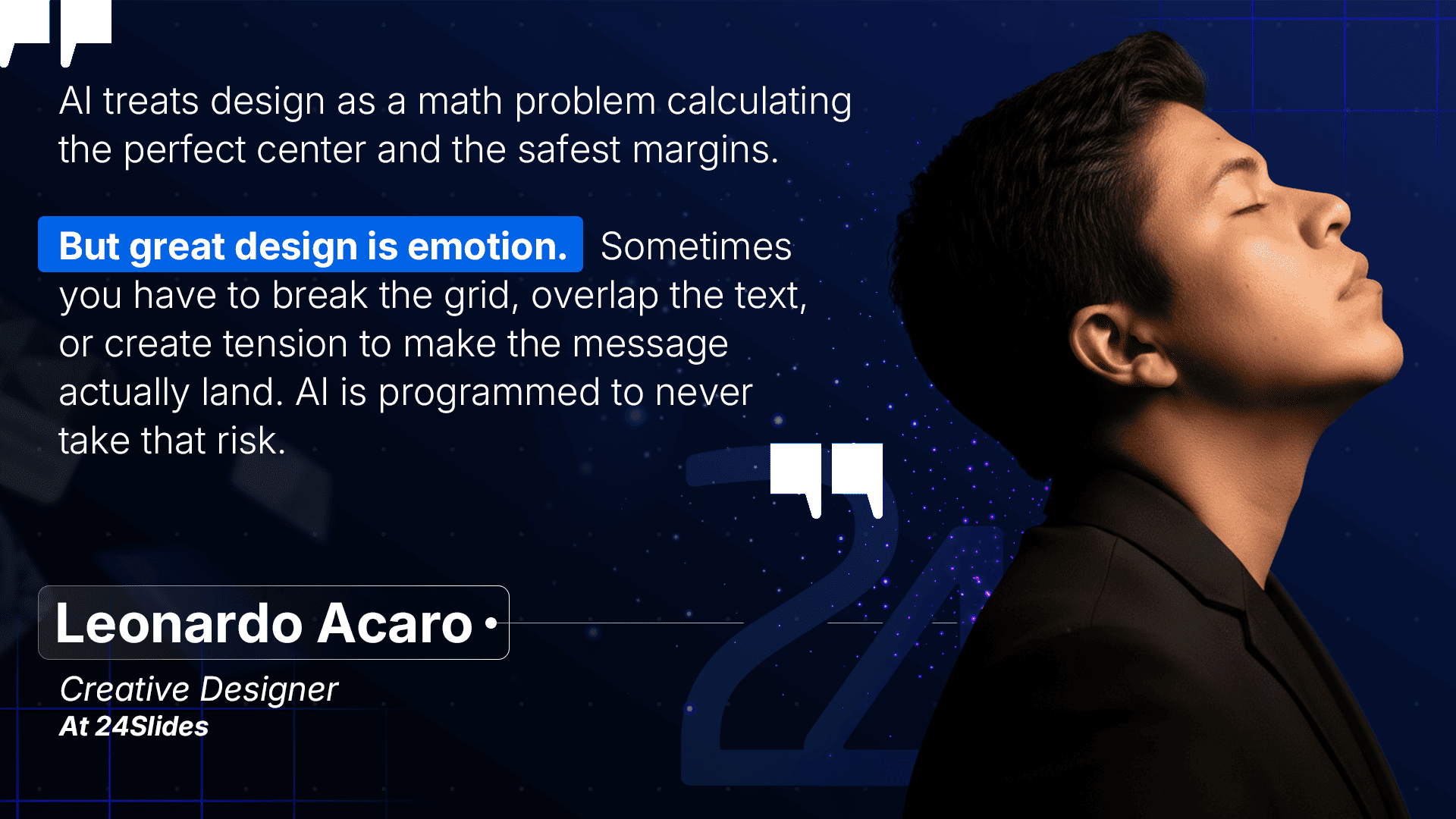
If you rely 100% on an AI presentation maker to generate your pitch deck, your presentation is going to look exactly like your competitor's pitch deck. As our Marketing Designer, Leonardo Acaro, noted after reviewing hundreds of AI slides, algorithms lack the emotional intelligence required for true persuasion.
The 24Slides Solution
High-stakes corporate communication isn't just AI—it is Powered by AI, Perfected by People.
Our 200+ in-house designers combine custom proprietary software with strict governance to deliver presentation excellence for global leaders like Novo Nordisk and IMD.
Our Enterprise Advantage:
- Proprietary AI Ecosystem: We build custom internal software, such as Brandzilla for brand compliance and The Typo Terminator for QA accuracy. Automating routine formatting allows our designers to focus purely on strategic visual persuasion.
- Unmatched Delivery Speed: You don't have to sacrifice speed for human quality. We offer a guaranteed standard 24-hour turnaround, alongside a priority 10-hour delivery for our Pro and Premium clients.
- Enterprise Security Moat: Protect confidential data from public AI risks through mandatory NDAs, SOC 2 Type II compliance, GDPR alignment, and ISO 27001-certified infrastructure.
- Certified B Corp: Our ethical, sustainable business practices provide a level of corporate accountability that generic software simply cannot match.

Proof: The EcoStream Redesign
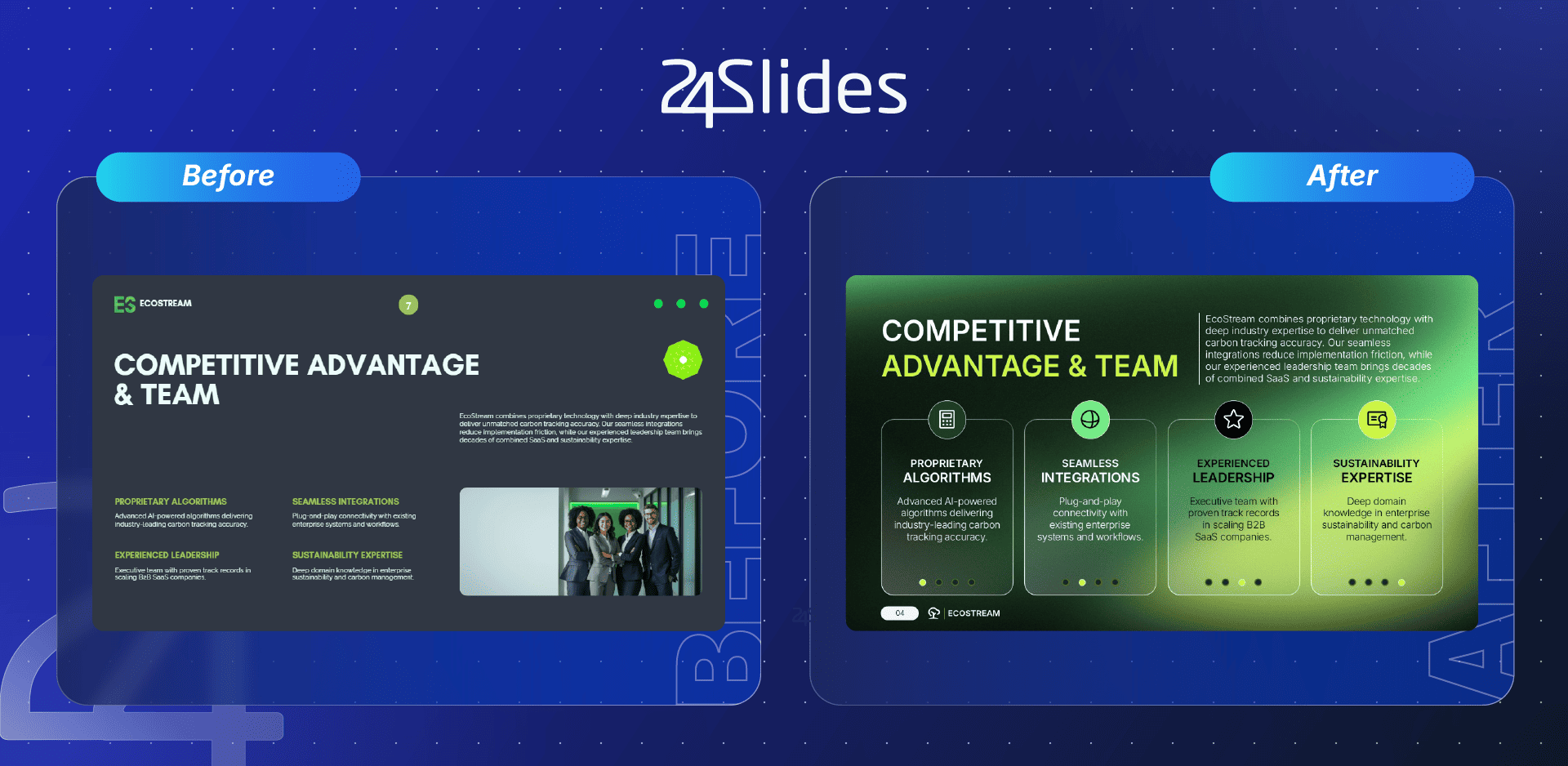
To show you the difference between a raw AI draft and an enterprise-grade corporate asset, Gabriel and Leonardo downloaded the broken .pptx exports generated during our benchmark tests.
Rather than applying our own agency's visual identity, they followed the exact instructions from our EcoStream benchmark prompt to the letter. They applied the strict green-and-dark-grey palette, establishing a clear visual hierarchy and fixing the broken data charts.
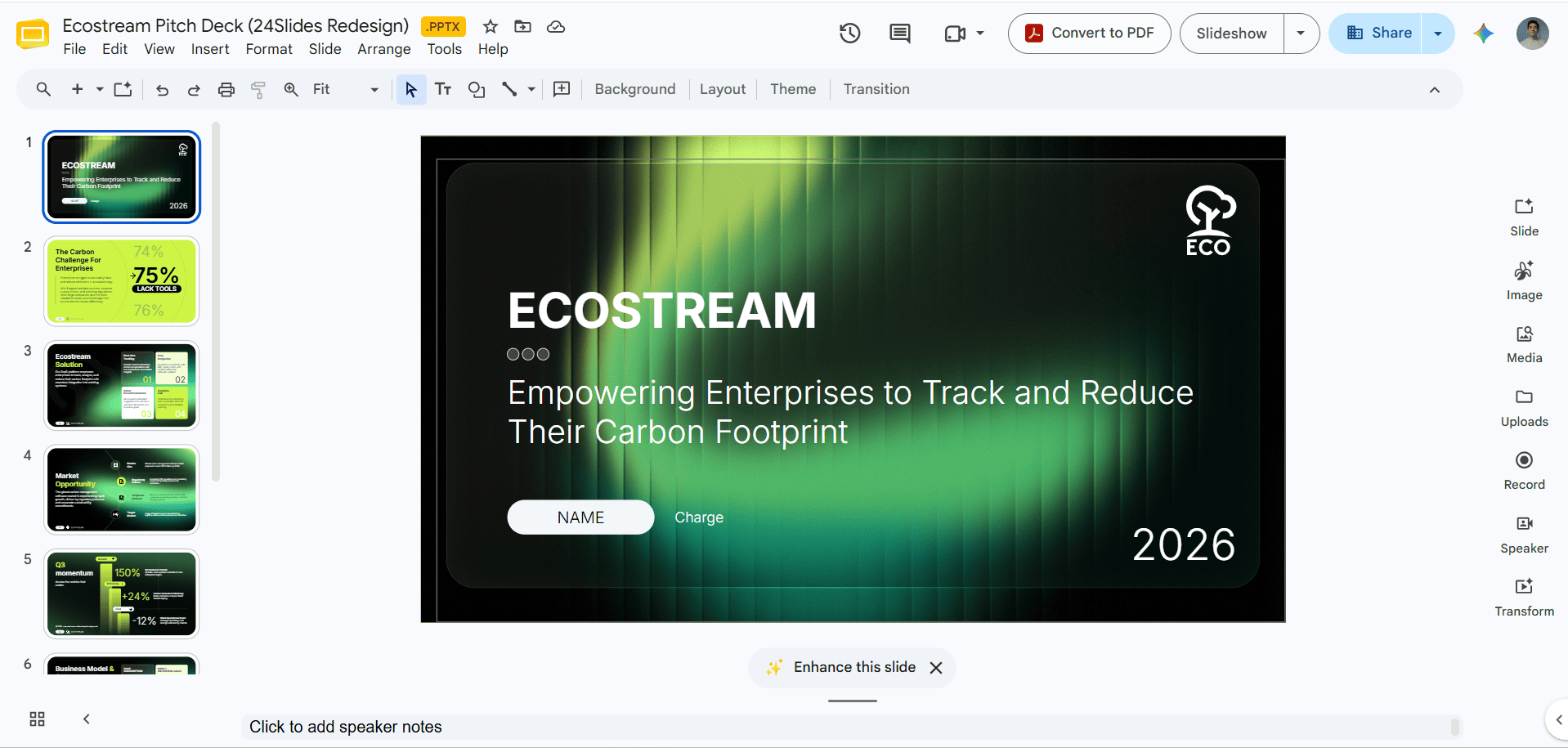
Here is exactly what happens when human expertise takes over:
🔍 Compare the presentations yourself:
When an AI Presentation Tool Is the Wrong Choice (Not For You)
We believe in brutal transparency. AI promises effortless slide creation, but our stress tests proved that relying 100% on automation can become a liability. You should steer completely clear of DIY AI tools if your organization fits these scenarios:
- High-Volume Brand Consistency Without Internal QA: If you need guaranteed brand alignment across 50+ monthly decks, AI will create more QA work, not less. As we saw, the AI routinely ignores explicit hex code prompts and hallucinates conflicting logos.
- MLR-Compliant Pharma & Healthcare: Regulatory reviews demand absolute precision. AI tools frequently convert editable data charts into static elements and scramble key numerical metrics, creating unacceptable audit risks for compliance teams.
- Confidential Enterprise Data: If your presentations handle unreleased financials, a browser tool with no dedicated account security review is the wrong fit. You need SOC 2 Type II compliance and NDA-bound production teams.
When to skip 24Slides:
We are the first to admit that hiring an agency isn't always necessary. If you just need to generate a rough first draft in under 5 minutes for a casual internal brainstorm, do not use our agency. Use Gamma or Claude directly! 24Slides' standard 24-hour turnaround (and 10-hour priority turnaround) is built for polished, brand-critical, high-stakes decks—not quick drafts.
For a complete breakdown of exactly where machine automation ends and human ROI begins, read our full report: AI Presentation Maker vs. Professional Presentation Designer.
Frequently Asked Questions (FAQs)
1. What is the best free AI presentation maker?
Canva offers the most robust forever-free plan, giving you unlimited access to their massive asset library to manually finish your deck. Gamma is the best free option for generating fast, highly visual web-based decks, offering a generous 400-credit sign-up bonus.
2. What is the best AI to make PowerPoint presentation files?
If you need a native, 100% editable .pptx file, SlideSpeak is the best option as it exports remarkably clean, editable PowerPoint vectors. Claude Pro is also exceptional for generating highly formatted native slides via its Microsoft Office Add-in.
3. Can AI tools for presentations generate charts from data?
Yes, but the quality varies wildly. SlideSpeak and Claude can generate editable, data-linked charts. However, tools like Canva and Gamma will flatten your data into uneditable static images upon PPTX export, requiring you to rebuild the charts manually in PowerPoint.
4. Is Prezi or Canva better for presentations?
Canva is better for beginners who need fast, asset-heavy marketing graphics and simple slides. Prezi is superior for live keynote speakers who want an engaging, non-linear, zooming 3D canvas to dynamically jump between topics.
5. How much do AI presentation tools cost?
Most tools offer a limited free tier. Paid subscriptions typically range from $10/month (like Pitch or Plus AI) to $25/month (like GenSpark or SlideSpeak) when billed annually, which usually unlocks native PowerPoint exports and extra AI credits.
Bottom Line: Which AI Presentation Maker Should You Use?
For absolute creative quality and complex, code-based layouts, GenSpark is the undisputed winner of our 2026 tests. If you are strictly looking for a free, highly visual drafting tool, Canva and Gamma remain industry leaders.
However, AI is only your starting block. Need decks that stay on-brand at volume, not just fast? 24Slides pairs the speed of AI with a dedicated, brand-trained design team and a guaranteed 24-hour delivery.
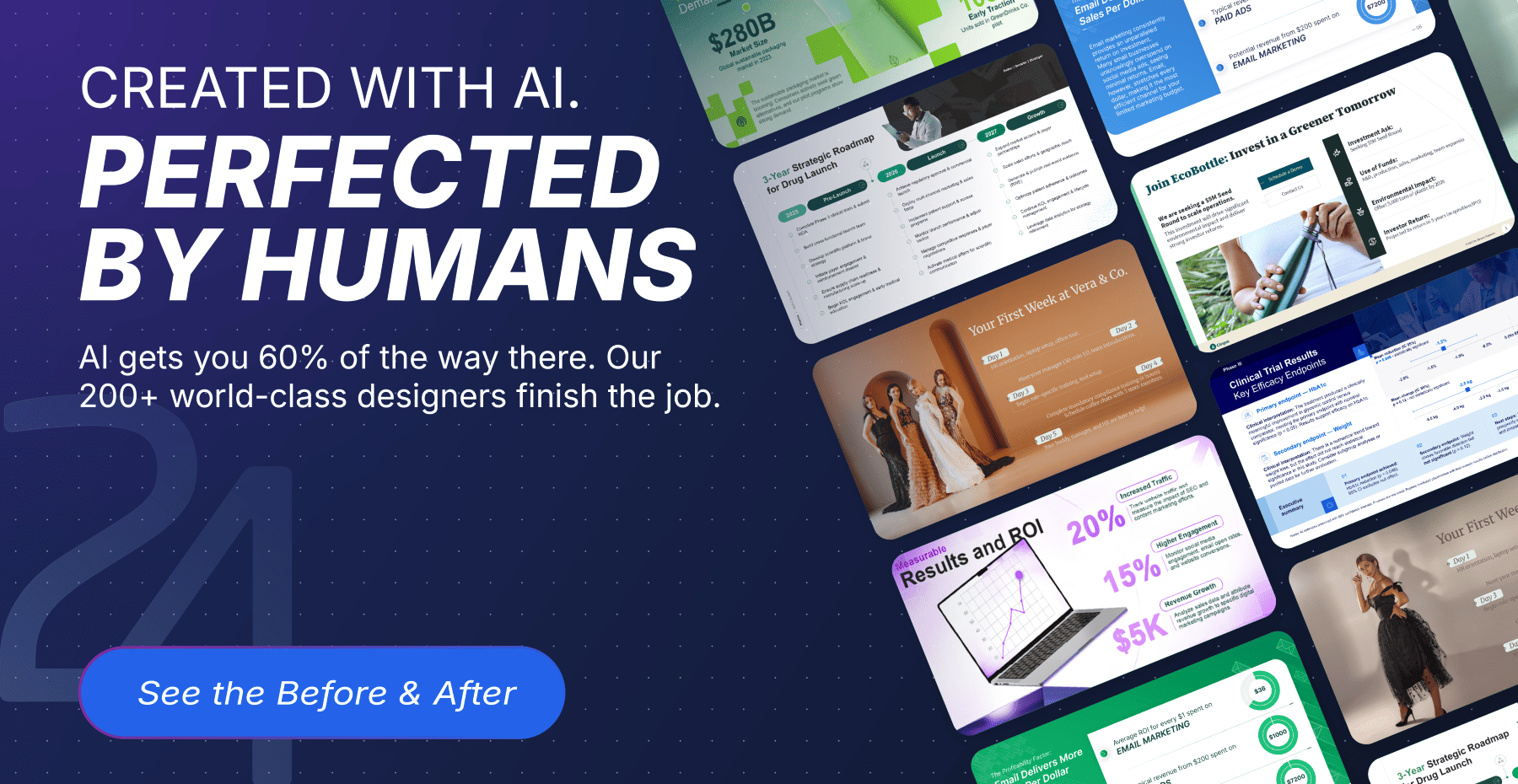
Explore our Before & After gallery today to see how human precision turns raw software output into executive-ready masterpieces.
Want to dive deeper into the world of AI presentations? Check out our detailed reviews and guides.
- AI vs. Manual Slide Design Comparison
- Gamma AI Presentation Maker Review: Stress-Tested by Professional Designers (2026)
- Visme Review (2026): AI Features, Pricing, & The Designers' Stress-Test
- How to Use ChatGPT to Create a PowerPoint Presentation (The 2026 Guide & Free Workflow)
- Presentations.ai Review: Stress-Testing the "Anti-Fragile" Maker (2026)